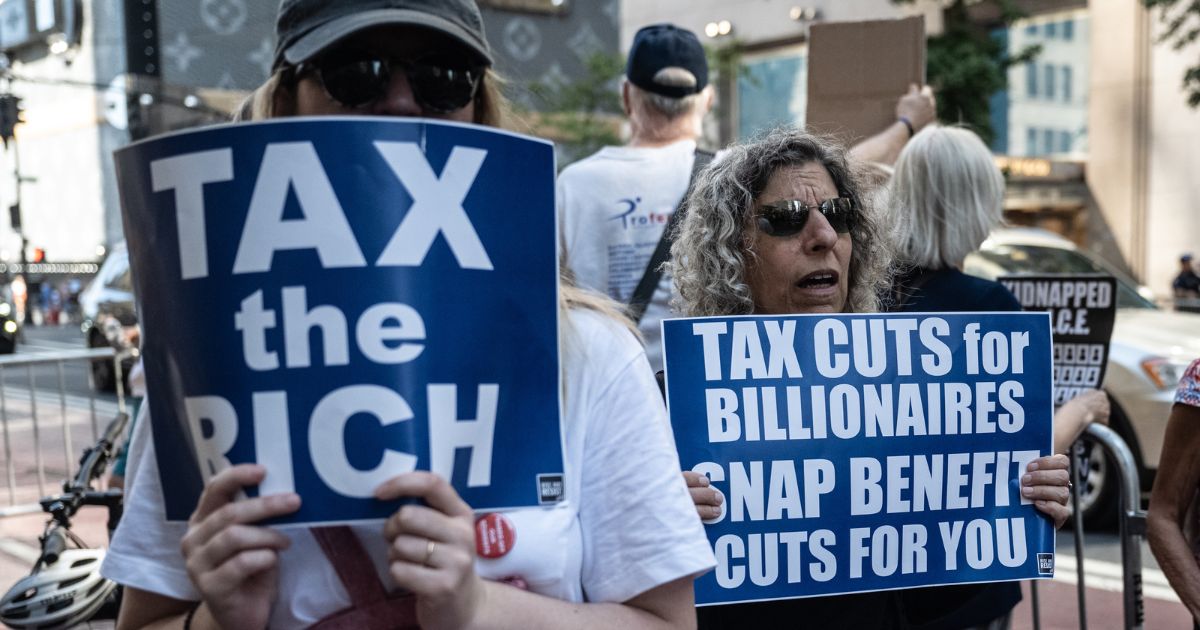
During the weeks of April 15 and May 1, few could fail to notice “Tax the Rich” walkouts, marches, and block parties in high-tax advocacy hubs across New York, Illinois, and California.
Fueled by rhetoric from progressive hustlers, protesters vented their hatred for Trump, billionaires, and capitalism.
But also tapping into the national debate over inequality and affordability, speakers focused on the supposed injustices of our economic system. However, what such socialist superstars failed to mention is that, as imperfect as our economic system is, it provides more opportunity, more of the time, for more of its people than virtually anywhere else.
When pandering to adoring crowds, it is hard to know whether woke politicians critical of our financial system are driven more by blind ignorance or clear-eyed ambitions to augment political power. But whatever their motives, their wealth of lies, as lies of wealth, doesn’t square with objective reality.
Central to their “Tax the Rich” mantra is the easy-target implication that people of means get an income-enhancing free ride. But because our tax system is overwhelmingly stacked against those with deep pockets, that is clearly untrue.
According to the National Taxpayers Union, the bottom 50 percent of American earners currently pay 2 percent to 3 percent of all federal income tax revenue. Accordingly, roughly 98 percent of that total is paid by the top half of earners.
More specifically, the richest 1 percent of taxpayers pay about 40 percent of all federal income taxes, and the highest-earning 10 percent provide almost three-quarters of those revenues. Therefore, the top 1 percent of earners pay far more federal income taxes than the bottom 90 percent combined.
Though the large discrepancy in the federal tax burden between the rich and poor is undeniable, whether “tax the rich” advocates are still justified in demanding greater “fairness” is best answered by comparing our tax system with those of other developed nations.
Simply put, top earners in the United States pay a far larger share of total income taxes than their counterparts in other countries, including the 38 advanced nations comprising the Organization for Economic Cooperation and Development, of which America is a founding member.
In most of those countries, the top 1 percent of earners pay between 20 and 30 percent of the national tax burden. But because the wealthiest Americans satisfy roughly 40 percent of that share, the United States is an outlier in how heavily the tax burden is concentrated at the very top of the income pyramid.
That statement is supported by the difference between the income our wealthiest citizens generate and the taxes they pay. That ratio, in which the top 10 percent of U.S. earners, netting 45 to 48 percent of all pre-tax income, pay 70 to 75 percent of all federal income taxes, represents the largest such gap among developed nations.
And besides, in most OECD nations, the bottom 50 percent of earners contribute between 10 and 20 percent of income tax revenue, while similarly struggling Americans pay about one-sixth as much.
Except for Americans, less affluent OECD citizens also face a regressive Value-Added Tax on consumption, averaging about 20 percent. Affecting everyone, regardless of poverty, that percentage on purchases of goods and services is in addition to personal income taxes.
Although most American states and many local communities also impose sales taxes, the states with the highest such rates still average about half the VAT levies commonly imposed elsewhere. As a result, because the United States has no national Value-Added Tax that everyone pays, the overall tax obligation on poorer American households is dramatically lower.
In simple terms, other nations tax everyone more, while the U.S. taxes high earners more. Consequently, the U.S. frequently ranks as having the most progressive tax system among developed countries. But that doesn’t mean leftists will praise our economy, or that anyone will think it’s perfect.
While it’s true that wealthy Americans contribute a far greater share of total income tax revenue than their counterparts in other nations, the gap between the rich and poor in our nation remains wider than in almost any other OECD country.
Though “Tax the Rich” leaders argue that disparity is caused by wealthy Americans not contributing their fair share of the overall tax burden, by virtually any comparative metric, that wealth-of-lies claim is patently false.
America’s income inequality has been driven by several long-running structural factors unrelated to an unfair tax code, including intense competition for lower-skilled American workers from cheaper labor abroad and from recently arrived immigrants at home.
Certainly, the wage gap also widened with the rise of information technology, which increased demand for highly skilled, highly educated workers while reducing demand for less qualified applicants. And of course, wealth grows faster for those already prosperous through investments, interest, and real estate ownership.
Obviously, none of those factors has anything to do with the rich not paying their fair share of taxes. And because of that, tax-the-rich activists are little different from “No Kings” marchers. In both cases, protesters are crusading for what already exists.
The views expressed in this opinion article are those of their author and are not necessarily either shared or endorsed by the owners of this website. If you are interested in contributing an Op-Ed to The Western Journal, you can learn about our submission guidelines and process here.
Advertise with The Western Journal and reach millions of highly engaged readers, while supporting our work. Advertise Today.