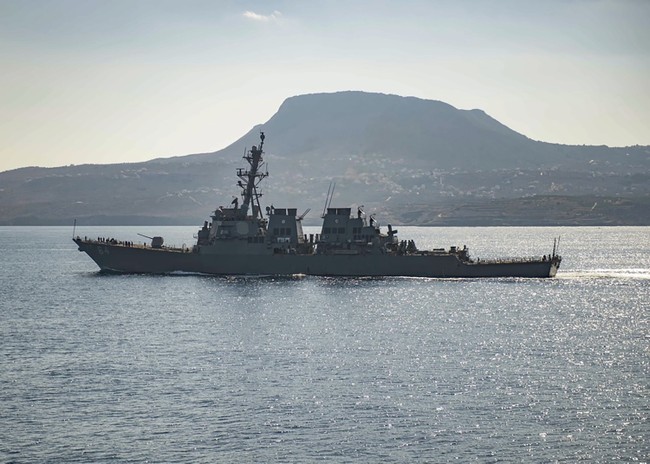
When Project Freedom, the operation to neutralize Iran’s control of the Strait of Homuz by escorting merchantmen past Iran interdiction, was announced (before it was almost immediately canceled), I wrote that combined with a blockade of Tehran’s own commerce, it would be devastating.
Although considerable resources will be dedicated to protecting ships transiting the Strait, CENTCOM makes it clear that Project Freedom is part of a larger operation, involving the Department of State, to coordinate movement through the narrow waters. This contextually implicit larger operation, for which we have been given no name as yet, is more interesting than Project Freedom itself. For one thing, it implies that not only will the U.S. deny passage to Iranian and other hostile ships, it will also secure the passage of neutral and friendly ships through Hormuz. Project Freedom is the flip side of the naval blockade of Iran, the “open” setting on the valve as contrast to the “close.” If Project Freedom succeeds, the Strait will essentially be controlled not by Iran, but the United States.The USN will essentially turn Iran’s ultimate weapon, a blockade of the Strait of Hormuz, against it.
The cancellation of the plan to escort merchantmen through the narrow waters 50 hours after it was announced was cited as yet another example of the U.S. cluelessness in its conflict with the ayatollahs. But now it seems the effort was only publicly abandoned. In secret, it apparently continued:
American forces have counted nearly 1,000 commercial vessel transits in and out of the Strait of Hormuz in the last two months, according to an official familiar with US Central Command operations, a figure that’s higher than private sector estimates that rely mostly on ship transponders…
The US count likely reflects — at least in part — the rising number of so-called dark transits ships are making with transponders turned off to help avoid detection by Iran, as US forces attempt to get traffic moving again amid a rising outcry about the worsening impact of the strait’s closure on the global economy.
Asked on Friday how much oil was getting out of Hormuz, Trump replied: … “I don’t want to say how many, but a lot,” the president told reporters traveling aboard Air Force One. “A lot of oil is coming into the world that people don’t even know about. And that’s why it’s at $97 a barrel instead of $300 a barrel.”
It was as if Project Freedom was never canceled completely. It just went stealth. At the same time, the Navy’s blockade of Iranian commerce leaving and entering the very same strait has reached historical proportions. One hundred thirty five Iranian ships have now been intercepted over the month and three weeks since the U.S. Navy (USN) announced the blockade. For comparison, the Allies lost 173 much smaller ships in the worst month of June 1942, during the Battle of the Atlantic, and that was unsustainable to the U.S. and the UK.
During the Battle of the Atlantic, the average World War II merchantman measured about 7,000 to 9,000 gross register tons (GRT). By contrast, many of the ships the USN are stopping today are very large crude carriers (VLCC). A typical VLCC holds 1.5 to 2 million barrels, and is from 200,000–300,000 deadweight tons. By any measure, the squeeze on Iran is greater many times over than U-boat campaign that almost brought England to her knees.
The economic damage that the U.S. blockade has caused can well be imagined. In April 2026, Iran exported 29.7 million barrels by sea. After a month of blockade, exports plunged to 2.01 million barrels (a 93% drop). As a recent article put it, “Trump’s Blockade Is Zeroing Out Iran’s Oil Exports.”
Evasion of the naval blockade was restricted to minor shipping corridors. Only four small-capacity vessels bypassed U.S. enforcement. These consisted of Panamax- and Handymax-class tankers. The vessels transported the remaining naphtha cargo exclusively to China.
Additional details can be gleaned from the tracking data. Iran’s maritime oil exports relied on two tankers flying the flag of Cameroon, one tanker flying the flag of Gambia, and one tanker flying the flag of Panama. Washington has not sanctioned any of these four vessels. Other international regulatory bodies have sanctioned only one vessel, with the other three being sanctions-free despite their history of engaging in sanctions circumvention.
If closing the Strait of Hormuz was supposed to have been Iran’s ultimate weapon, it is not working as intended. The ayatollahs might still have justified their strategy of blocking the strait if they could zero out the rest of the world’s traffic. Misery would have company. But while they achieved this at the beginning, their physical hold on Hormuz appears to be weakening over time, as the U.S. Navy gradually reduces their constriction.
At present, the exact nature of the countermeasures being employed to defeat Iranian anti-ship efforts is being kept a secret. But the confidence of the Navy is increasingly obvious in the press releases of the U.S. Central Command:
U.S. forces intercepted multiple Iranian ballistic missiles and drones launched by Iran toward the Strait of Hormuz and Gulf neighbors, June 5. Iran fired seven ballistic missiles toward Kuwait and Bahrain hours after U.S. Central Command (CENTCOM) shot down four Iranian one-way attack drones that were launched toward the Strait of Hormuz. The attack drones posed an immediate threat to regional maritime traffic. U.S. forces subsequently struck Iranian coastal surveillance radar sites in Goruk and on Qeshm Island to defend against further maritime attacks.
Who can hold out the longest? What matters is the trend of these two competing forcees. If the USN blockade strengthens over time while the Islamic Republic’s hold gradually weakens, sooner or later Iran’s ultimate weapon will be turned against it, and it will be in the ayatollahs’ interest to demand a return to free international passage of Hormuz, which the media will doubtless remind us was their demand all along.
Editor’s Note: Thanks to President Trump and his administration’s bold leadership, we are respected on the world stage, and our enemies are being put on notice.
Help us continue to report on the administration’s peace through strength foreign policy and its successes. Join PJ Media VIP and use promo code FIGHT to receive 60% off your membership.