An American who worked for Beijing state media pleaded guilty on Thursday to acting as an unregistered agent of China in helping obtain secrets for the Chinese intelligence service.
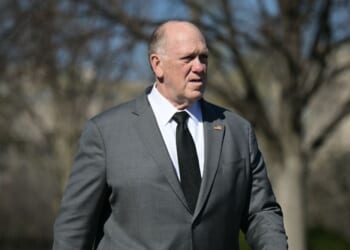
Thomas W. Pauken, 50, was arrested in March and entered the pre-indictment plea in U.S. District Court in Alexandria. He faces a maximum sentence of 10 years in prison, although his cooperation with investigators could lead to a reduced sentence, prosecutors said.
“In effect, Pauken admitted to being part of a conspiracy to obtain sensitive information from the U.S. government for the PRC,” said John Eisenberg, assistant attorney general for national security, using the acronym for People’s Republic of China.
“His actions are a betrayal of this nation and pose an unacceptable risk to our national security.”
According to court documents, Pauken was paid at least $100,000 for working with Ministry of State Security intelligence handlers identified only as “Cathy,” “Richard” and “William.”
From around 2019 to February, he supplied communications gear that was used in helping recruit Americans with access to secrets for the civilian spy service.
FBI Assistant Director Roman Rozhavsky of the Counterintelligence and Espionage Division said Pauken admitted working to infiltrate U.S. political circles for the MSS and “gathered intelligence” on American recruitment targets that was reported to Chinese officials.
“This case illustrates the lengths to which the Chinese Communist Party will go to undermine our democratic institutions and degrade our political freedoms,” Mr. Rozhavsky said.
The plea agreement in the case stated that Pauken would plead guilty to a single count of illegally working as an agent of China. Federal law requires notifying the Justice Department of such work.
District Judge Leonie Brinkema accepted the guilty plea and set sentencing for Sept. 1.
The plea agreement also stated that Pauken cooperated with investigators and agreed not to have any contact with foreign intelligence service officials except with the “express permission of the Federal Bureau of Investigation.”
The cooperation suggests the FBI may seek to use Pauken as a double agent against the MSS.
Court papers say the MSS provided Pauken with taskings such as meeting with potential intelligence recruits and gave them a laptop and cellphone to communicate with the spy handlers.
Pauken, who lived in China and was most recently an editor at the official Xinhua news agency, made several trips to the U.S. from China to meet with people targeted by the MSS.
Since 2010, Pauken also had worked for state media in Hong Kong at China Radio International, China Central Television and China Global Television Network. All the outlets are strictly controlled by the Chinese Communist Party Propaganda Department.
In that role, he operated as a cutout for spy recruits, the documents state.
His work in China was conducted under the name “Tom McGregor,” at the request of his father, Thomas Pauken, a former official in the Reagan administration, because the senior Mr. Pauken did not want to be linked by name to his son’s work in China.
Court papers in the case suggest the FBI initially sought to recruit Pauken as a double agent for the FBI to work against Chinese intelligence.
However, after Pauken let on to Chinese intelligence officials that he had met with the FBI, it appears the double agent operation was scrapped in favor of prosecution.
Other activities that required Pauken to register with the Justice Department as a Chinese agent included selling reports to Chinese people in Wuhan, China, who wanted information about technology and the Department of Justice. The Wuhan clients sought help from Pauken in locating a hacker who could conduct cyber espionage, the documents state.
A statement of facts submitted in court identified the activities of the MSS as including “identifying and influencing the foreign policy of other countries, including the United States,” and gathering sensitive and confidential information.
The target information included U.S. intelligence operations directed at China, corporate and industrial information supporting China, biographical profiles of politicians and intelligence officers, and the political, economic and security policies that can affect China.
MSS human source operations involved trained intelligence officers and nonprofessional cut-outs or co-optees used in recruiting, running and gaining information from people.
“Cut-outs or co-optees can operate under a variety of covers, posing as diplomats, journalists, academics, or businesspeople both at home and abroad,” the statement said.
“These individuals are tasked with spotting, assessing, targeting, collecting, and handling sources or assets with access to classified, open-source, proprietary, or sensitive information that the PRC government can use for economic, political, or military decision-making or advantage.”
Pauken met “Cathy” around 2017. She initially identified herself as working for a Chinese think tank, but he later knew her as an official working for the MSS.
“Cathy primarily communicated with Pauken through WeChat, Signal, Telegram, or in person,” the statement said. “Early on in their relationship, Cathy expressed interest in obtaining classified material from Pauken,” who did not have a security clearance.
Sometime in either 2022 or 2023, Pauken agreed to undergo a polygraph test at Cathy’s direction because his reports were sent to Xi Jinping, the Chinese president.
During the polygraph test, Pauken was asked about 10 questions, including whether he was spying against China and if he worked for the CIA. He answered no.
Court papers did not say how the FBI first discovered Pauken’s activities.
However, Xinhua has long been used by the MSS for intelligence cover for human agents.
U.S. officials have said the majority of Xinhua media workers sent abroad are engaged in intelligence gathering, either as professional officers or as nonprofessional co-optees.