Editor’s note: This is a lightly edited transcript of today’s video from Daily Signal Senior Contributor Victor Davis Hanson. Subscribe to our YouTube channel to see more of his videos.
Hello, this is Victor Davis Hanson for the Daily Signal.
There was a murder in Britain in the town of Hampshire that’s got worldwide news because it’s kind of iconic of the whole problem of immigration and DEI in the Western world.
The facts are not in dispute. A young man who was a student, Henry Nowak, was walking and encountered another, I think, young person.
I think he was twenty-three. Vickrum Digwa, who was a Sikh immigrant, either first or second, generation, it wasn’t specified. And apparently, they exchanged words, and they had some confrontation. We’ll wait to see what surveillance cameras show. But Mr. Dighwa pulled out his ceremonial Sikh sword and used it as a weapon and stabbed Mr. Nowak repeatedly, apparently fatally in the chest.
And when police arrived, Mr. Nowak was on the ground bleeding out, clearly bleeding out and muttering, “I’m dying.”
What was the reaction of the police? Did they render immediate, first aid and restrain Mr. Dighwa? No. No. What they did was they accu– Mr. Dighwa then made up a lie, and we’ll get to that later, that he had been a victim of racism, that Mr. Nowak had, exchanged words that were racial in nature to him that prompted the stabbing.
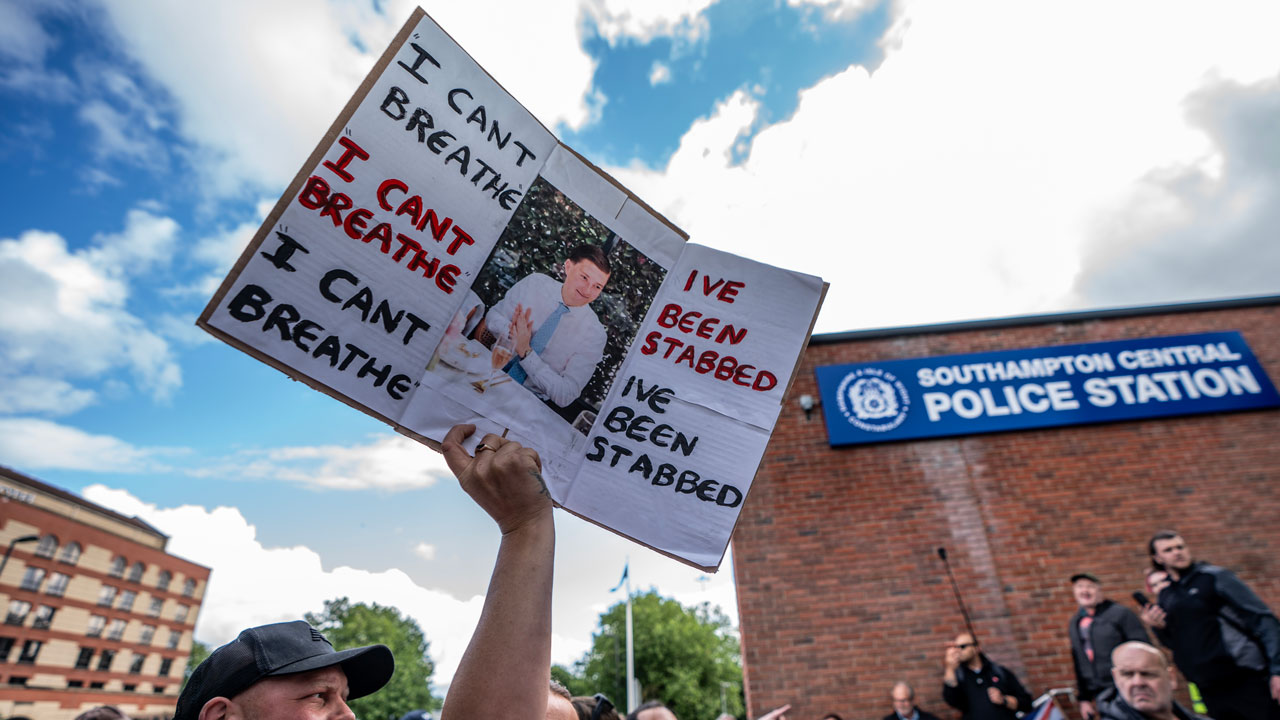
So what did the police do? They put handcuffs on the dying young Mr. Nowak. And of course, he died with the handcuffs without any medical attention at all.
Then, Mr. Dighwa apparently went back to his home, and his mother, and I guess members of his family or somebody, he and his mother then hid the murder weapon, in the house.
And at some point, the police finally caught on after Mr. Nowak died, or they had surveillance, or they had witnesses, that there had been no racial taunts, that that was a complete lie.
And they had watched and, in some ways, abetted the death of Mr. Nowak, who was a white male and was on the wrong side of the oppressor-oppressed binary, apparently.
What are we gonna make of this British insanity?
We’ve had our version here, too. You know, in a very strange way, it is sort of a George Floyd in a really sick reversal.
Mr. Nowak, unlike George Floyd, was not a career criminal. He was not being handcuffed because he was passing counterfeit currency and high on fentanyl and resisting arrest as Mr. Floyd was.
He was dying. He was bleeding out. It’s a little easier to see someone as in extremis when they say, “I’m dying,” and there’s a pool of blood around them than Mr. Floyd when he said, “I can’t breathe.” That’s not to excuse Mr. [Derek] Chauvin necessarily.
But it’s far more egregious for police to handcuff a man bleeding on the ground than to use a standard approved measure to restrain a suspect that was resisting arrest that went south when he stopped breathing.
More importantly, what was the reaction of the public in these two different cases? In the case of George Floyd, you had a career criminal committing a felony, passing counterfeit currency, actively resisting arrest and under the influence of drugs, who tragically died when Officer Chauvin put a knee on his neck, which arguably had been a protocol that had been approved in a number of police departments in the United States.
What was the reaction? The United States blew up for four months. Four months, two billion dollars worth of damage, 35 people killed, 1500 officers injured, arson, federal courthouses torched, police precinct torched, iconic church torched, luminaries like Kamala Harris bragging that this will not stop.
These demonstrations will go on. They should go on, blah, blah, blah, blah. What was the reaction in Britain to Mr. Nowak? Silence.
What can we learn from all this? We’ve talked about the problems with DEI. DEI not only destroys meritocracy and promotes people who did not earn that admission or that hiring based on widely accepted criteria that everybody accepts.
We’re an equal opportunity Western civilization. We are not a mandated equality of result, at least we weren’t until recently.
But there’s another wrinkle to DEI. Once a person is informally or formally, identified as a victim or the oppressed, that serves as a get out of jail card. That is the end of deterrence.
They feel if they got into the university with a SAT score that’s two hundred points lower than someone else, then when they take a class and they don’t do well, the same type of exemptions will apply on and on and on.
And obviously, Mr. Digwa felt that in Britain today, the fact that he was an immigrant of color gave him an exemption to lie, to take a knife out.
Of course, if you have a visible knife in Great Britain It’s a felony. It’s against the law, but an exemption is given because of his, I don’t know, immigration status or for religious reasons.
But he felt that he could use that as a weapon with impunity. He could stab somebody, then he could hit the button word racism, and that would direct the police away from him, the perpetrator, to the dying victim, to the extent they’d even put cuffs, not one bandage, no mouth-to-mouth recitation, nothing.
All they did was handcuff and make his plight worse, and he bled out.
DEI is a very deadly, dangerous phenomenon. Once you identify a group of people not by active oppression but by the color of their skin, and you say no matter what their class is, and I would say the Sikh community in Europe, but especially in the United States, is, as a member of the Indian diaspora, the most affluent immigrant group in the United States right now.
Mr. [Zohran] Mamdani found that out when he said he was going to go after whiter neighborhoods and people pointed out that he is more exclusive if he’s going to talk in collective terms and so-called white people.
It’s also kind of tragic that the Sikh community has been one of the most hardworking, law-abiding communities of immigrants in America and in Europe.
And they’ve had a tendency to look at themselves as individuals, not as collectives. But it would be a shame if the Sikh community did not condemn members of their own community if they’re going to talk in collective terms.
They’re under no obligation to single out Mr. Digwa in Britain. But if they talk about the Sikh community, then they are, and they had.
One of the Sikh leaders in Great Britain said that now the Sikhs were subject to hate crimes. And so, he was trying to take the onus away from the murderer to now his community is victimized.
Wouldn’t it have been better for the Sikh leader to come out and say “Mr. Digwa is not representative of our community.
“We don’t take religious objects and use them as weapons to kill somebody. And when we kill somebody, we don’t lie about it to the police and are responsible that for his plight and falsely make up charges of racism. Much less do we aid and abet a murderer by hiding the murder weapon. We don’t do that.”
Again, they’re under no compunction to say that. But once you collectively say the Sikh community is suffering from people’s threats, then you live and die with collectivism.
And if it’s going to be that you’re collectively victims, then you might want to say that you want to separate yourself as a collective from a murder and people who abetted that murder.
The same thing is happening in the United States. Again, the Sikh community, and I have neighbors and some of my closest friends, they’re one of the most, industrious and hardworking immigrant communities there is.
Recently, though, we had an epidemic of Sikh illegal alien truck drivers. Many of them were caught without valid driver’s license or with driver’s license that were really not legitimate because they did not know the English language, and there was a lot of high-profile, horrendous, catastrophic accidents where they were driving semis and killed innocent drivers.
Sikh community is no obligation to defend them or to say… but once they think they’re going to talk collectively, and they did. They wanted petitions. They said, “This is unfair.”
Once you do that, then you lose that, that moral high ground. It would have been much wiser for people in the Sikh community to say, “We are the most law-abiding immigrant community.
“We do not talk about ourselves in collective terms. We are individuals. These individuals broke U.S. law. They committed a crime, criminal act, by coming into this country illegally, and they were not qualified to drive, semi-trucks in the manner that they did or to drive them at all, and we condemn that.
“They’re not representative of the values of the Sikh community.”
That message did not get out like that. And so it would be tragic if other ethnic groups have looked at the progression of DEI and the exemptions and deterrence that allows to jump on that DEI wagon.
Why would it be tragic? Because public opinion is moving in the opposite direction.
People are tired of victim, victim, victim, victimizer, victimizer, victimizer. They want to go back to individual people and not collectives.
We publish a variety of perspectives. Nothing written here is to be construed as representing the views of the Daily Signal.