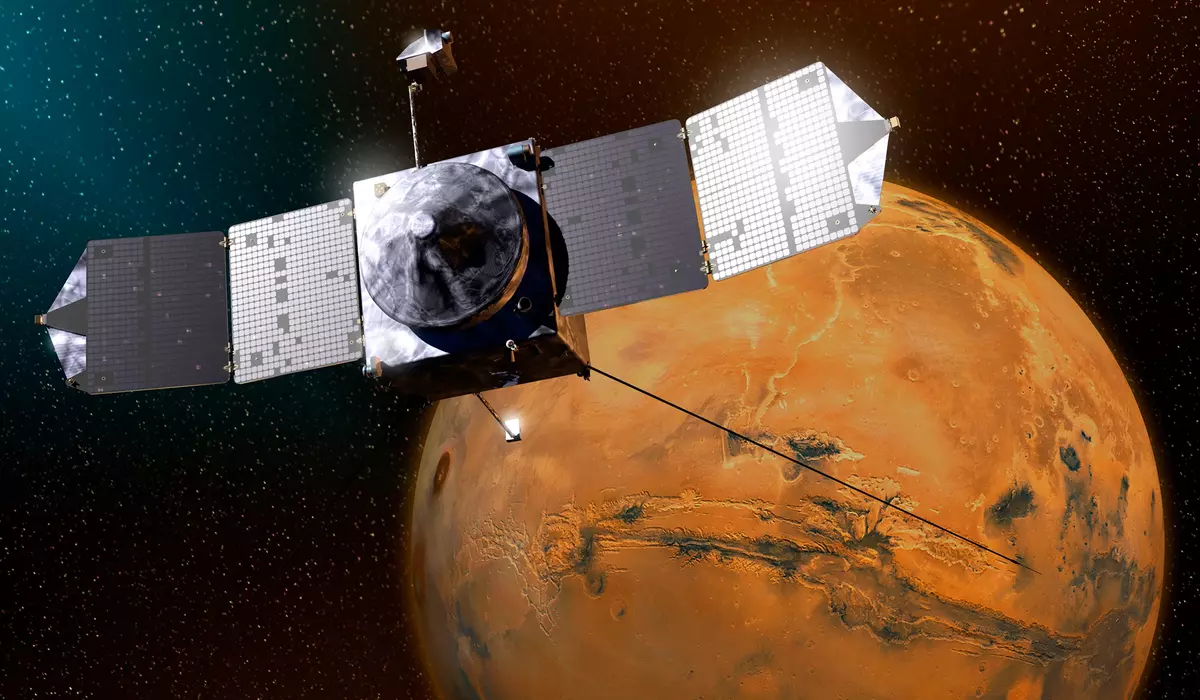
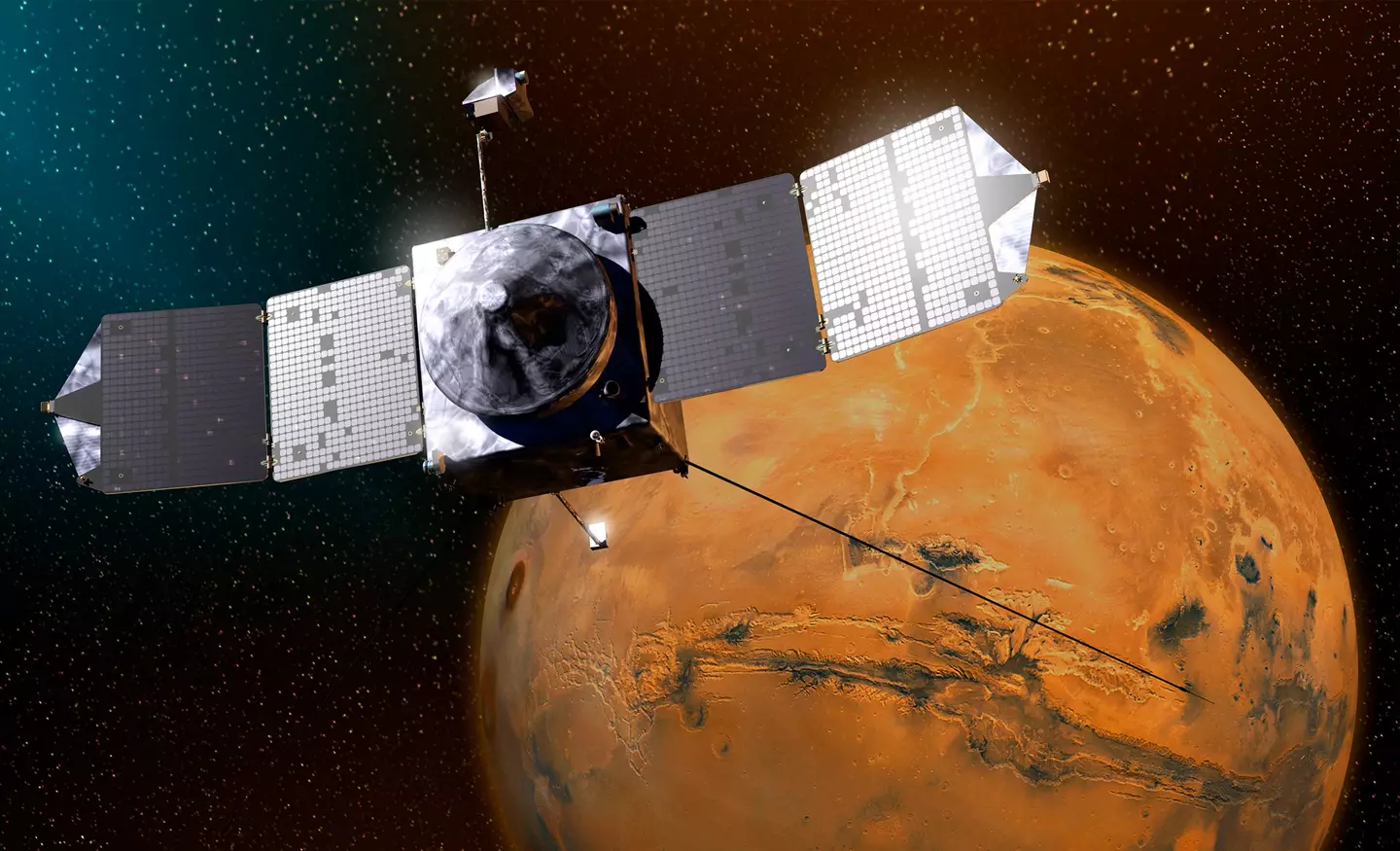
NASA announced Wednesday that its MAVEN spacecraft is unrecoverable more than a decade after it launched to study the Martian atmosphere.
The Mars Atmosphere and Volatile Evolution mission — the first devoted entirely to observing the Martian atmosphere and its evolution — was last heard from on Dec. 6, when it experienced an unexpected loss of signal after passing behind the Red Planet, NASA said. An anomaly review board convened in February to evaluate recovery efforts determined the spacecraft is not recoverable and is no longer capable of performing its science and data relay mission.
Telemetry from MAVEN before the signal loss showed all subsystems working normally. After the spacecraft emerged from behind Mars, NASA’s Deep Space Network detected no signal. A brief fragment of telemetry data indicated the spacecraft had entered safe mode and was rotating at an unusually high rate, suggesting a disruption in its orbit trajectory. The review board concluded the rotation drained the spacecraft’s batteries, causing the communications system to lose power and rendering MAVEN unrecoverable.
The probable root cause of the anomaly remains under investigation, NASA said. A final report from the review board is expected later this year.
“The science MAVEN has given us is key to informing what kind of radiation protection and safety measures we must take before sending humans to Mars,” said Louise Prockter, director of NASA’s Planetary Science Division. “The data collected from MAVEN will continue to provide valuable insight into Mars for decades to come.”
Launched in November 2013, MAVEN spent its primary one-year mission and more than a decade beyond studying Mars’ upper atmosphere, ionosphere and interactions with the Sun to better understand how the planet lost its atmosphere to space — a process scientists say transformed Mars from a potentially habitable world into today’s cold, arid planet.
Among its major findings, MAVEN determined that solar storms significantly accelerate atmospheric erosion, discovered new types of auroras at Mars and became the first spacecraft to directly measure atmospheric sputtering at any planet. In 2018, the mission tracked how a planet-wide dust storm lofted water molecules higher into the atmosphere, causing a surge in water lost to space.
“The MAVEN mission has truly advanced our understanding of the Martian atmosphere and evolution. This dataset has had a tremendous impact on the field,” said Shannon Curry, MAVEN’s principal investigator and a researcher at the University of Colorado Boulder’s Laboratory for Atmospheric and Space Physics. “Our science team is exceptionally proud of all of these amazing discoveries.”
The MAVEN science team produced more than 800 publications during the mission’s lifetime, NASA said. The agency has begun the official process of decommissioning the mission and archiving its full dataset.
This article was constructed with the assistance of artificial intelligence and published by a member of The Washington Times’ AI News Desk team. The contents of this report are based solely on The Washington Times’ original reporting, wire services, and/or other sources cited within the report. For more information, please read our AI policy or contact Steve Fink, Director of Artificial Intelligence, at sfink@washingtontimes.com
The Washington Times AI Ethics Newsroom Committee can be reached at aispotlight@washingtontimes.com.