This morning’s Gospel reading is John 3:16–18:
God so loved the world that he gave his only Son, so that everyone who believes in him might not perish but might have eternal life. For God did not send his Son into the world to condemn the world, but that the world might be saved through him. Whoever believes in him will not be condemned, but whoever does not believe has already been condemned, because he has not believed in the name of the only Son of God.
Today’s Gospel reading speaks directly from the core of our faith, so much so that it has become nearly ubiquitous. It has served as the most prominent evangelical verse in Christianity. For a time, “John 3:16” signs abounded at sporting events. It summarizes our faith so well that it exists practically sua sponte.
And yet, our readings today have layers that offer a compelling vision of the Lord’s grace and love that goes even beyond the literal meaning of these words, and of their necessity for our salvation.
Our first reading from Exodus 34 reminds us of both. Moses returns to Mount Sinai with the blank stone tablets; this is the second time he has carried tablets to the Lord. In Exodus 31, the Lord had given Moses the original tablets of the Law, “inscribed by the finger of God.” Moses had then returned to the Israelites, whom he discovered had created an idol of the Golden Calf and had abandoned their faith in Moses and the Lord. Moses has returned to the mountain to seek the Lord’s forgiveness after begging for it as the Lord contemplated what to do with His “stiff-necked people” in Exodus 33.
The Lord recreates the tablets that Moses smashed in his humiliation and anger the first time. The Lord proclaims His kindness and fidelity, even to a people who keep rejecting Him and falling into sin. Moses asks the Lord to “come along in our company,” as the sole authority and protector of the Israelites, so that they may finally become a nation of their own. Shortly after this reading, though, the Lord warns Moses about the many ways in which the Israelites might – and eventually will – go astray (Exodus 34:11-16):
Obey what I command you today. I will drive out before you the Amorites, Canaanites, Hittites, Perizzites, Hivites and Jebusites. Be careful not to make a treaty with those who live in the land where you are going, or they will be a snare among you. Break down their altars, smash their sacred stones and cut down their Asherah poles.[a] Do not worship any other god, for the Lord, whose name is Jealous, is a jealous God.
“Be careful not to make a treaty with those who live in the land; for when they prostitute themselves to their gods and sacrifice to them, they will invite you and you will eat their sacrifices. And when you choose some of their daughters as wives for your sons and those daughters prostitute themselves to their gods, they will lead your sons to do the same.
This turns out to be prophetic. The Lord set aside the Israelites as a nation apart from other nations, a people dedicated to the Word of God that would serve as priests to other nations to evangelize His Law. Rather than adhere to the Lord’s mission, the Israelites instead chose to become a nation of the world instead of a nation of the Word. Rather than proselytize the Law and follow the mission of the Lord, they chose to make treaties with the nations for worldly power and wealth, even as prophets continually warned of the consequences. The Israelites chose kings rather than recognize the Lord as their sole prince, intermarried for political gain, and set up altars to idols to curry favor with nations they were meant to convert instead.
And yet, the Lord remained faithful. John explains why in this passage, and with a specific context: “For God so loved the world that He gave His only Son[.]” John did not write that God so loved His people Israel, nor that God so loved the priestly class, or the common people, or even the poor, although the latter gets plenty of attention throughout the Gospels and both testaments. God so loved the world that He sent His only Son as its necessary sacrifice for its salvation from eternal damnation. God so loved the world.
It was for that reason that the Lord warned Lot and his family to escape the destruction of Sodom and Gomorrah. It was for that reason that the Lord tasked Noah to build his ark. The Lord so loved the world, even as it corrupted itself after the fall of Adam and Eve from grace and in the midst of its hubris and sin, that He forged a nation from the descendants of Abraham and Jacob to rescue the world through His Law and His Word. In each case, the Lord’s instruments advanced the cause but the mission kept failing due to our corruptible natures.
But God so loved the world that He sent an incorruptible Israel, a new Moses, a new Adam, the Word Incarnate. The Lord did not send Jesus to conquer the world or to reinflate a failed worldly kingdom, but instead to found a new church through which salvation could be found. This church would reverse the dynamic, providing missionary evangelization with the power of the Holy Spirit at its core to bring the Law and the Word to every nation of the world that the Lord loves so. And knowing that we still would remain a stiff-necked people addicted to sin and narcissism, He sent His only Son to pay the penalty for sin for all who choose to accept Jesus as their Lord and Savior.
God remains faithful and constant in His love for us, not just a few of us or certain parts of the world, but the whole world. He calls us back constantly to His word through Jesus Christ, in our hearts and through the missionaries of His church, allowing each of us the choice of salvation. We cannot perfect ourselves, but He loves us so much that we need only to accept the Lord’s love and allow Him to perfect us in His time and manner.
This past Easter, our parish sang this hymn to celebrate the joy and mystery of John 3:16. This is not our choir, but it is a marvelous version. I hope you enjoy it.
Previous reflections on these readings:
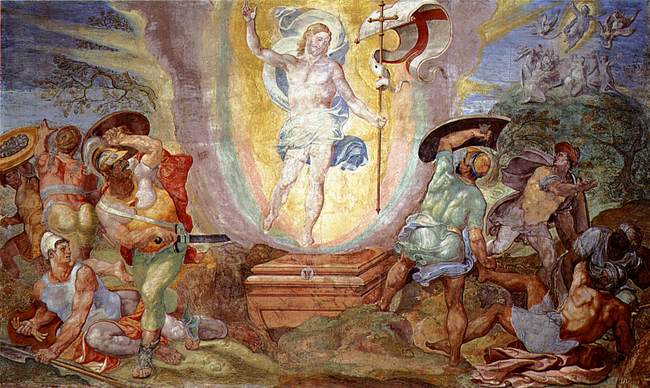
The front page image is “The Resurrection of Christ” by Hendrick van den Broeck, c. 16th century. On display in the Sistine Chapel, at The Vatican. Via Wikimedia Commons.
“Sunday Reflection” is a regular feature that looks at the specific readings used in today’s Mass in Catholic parishes around the world. The reflection represents only my own point of view, intended to help prepare myself for the Lord’s day and perhaps spark a meaningful discussion. Previous Sunday Reflections can be found here.
Editor’s Note: Our Sunday Reflections are free to all readers, but our VIP members help keep this platform going for everyone. Join the effort by using the promo code FIGHT to get 60% off new memberships and upgrades to VIP Gold and VIP Platinum!