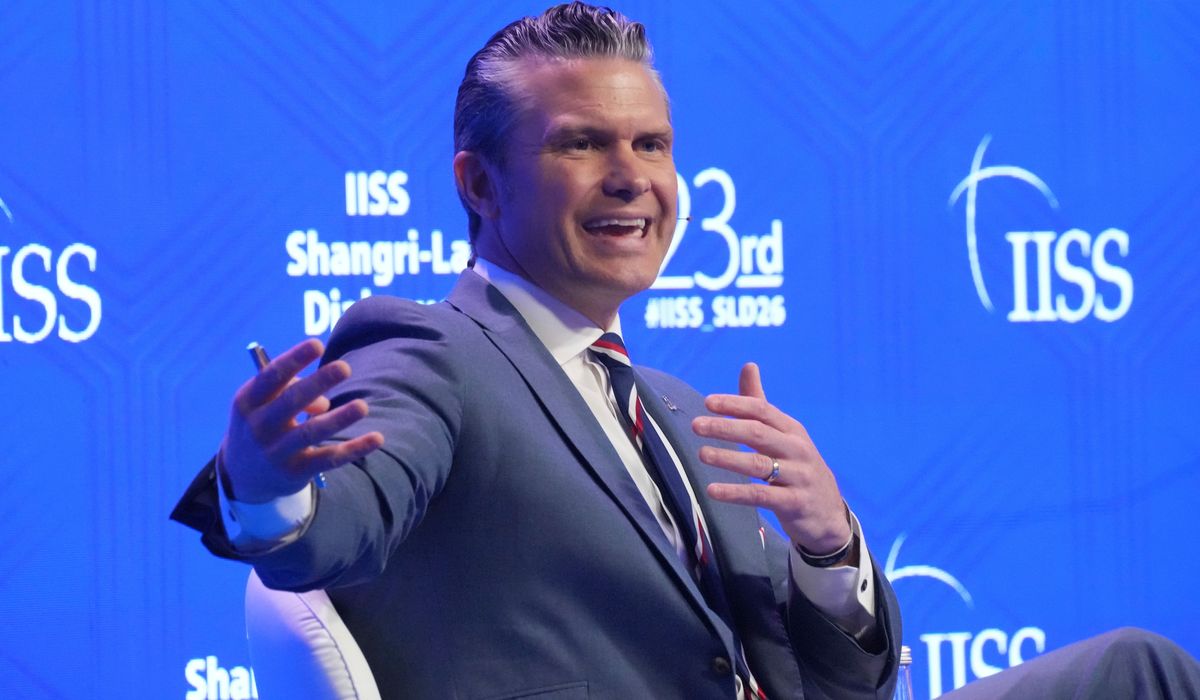
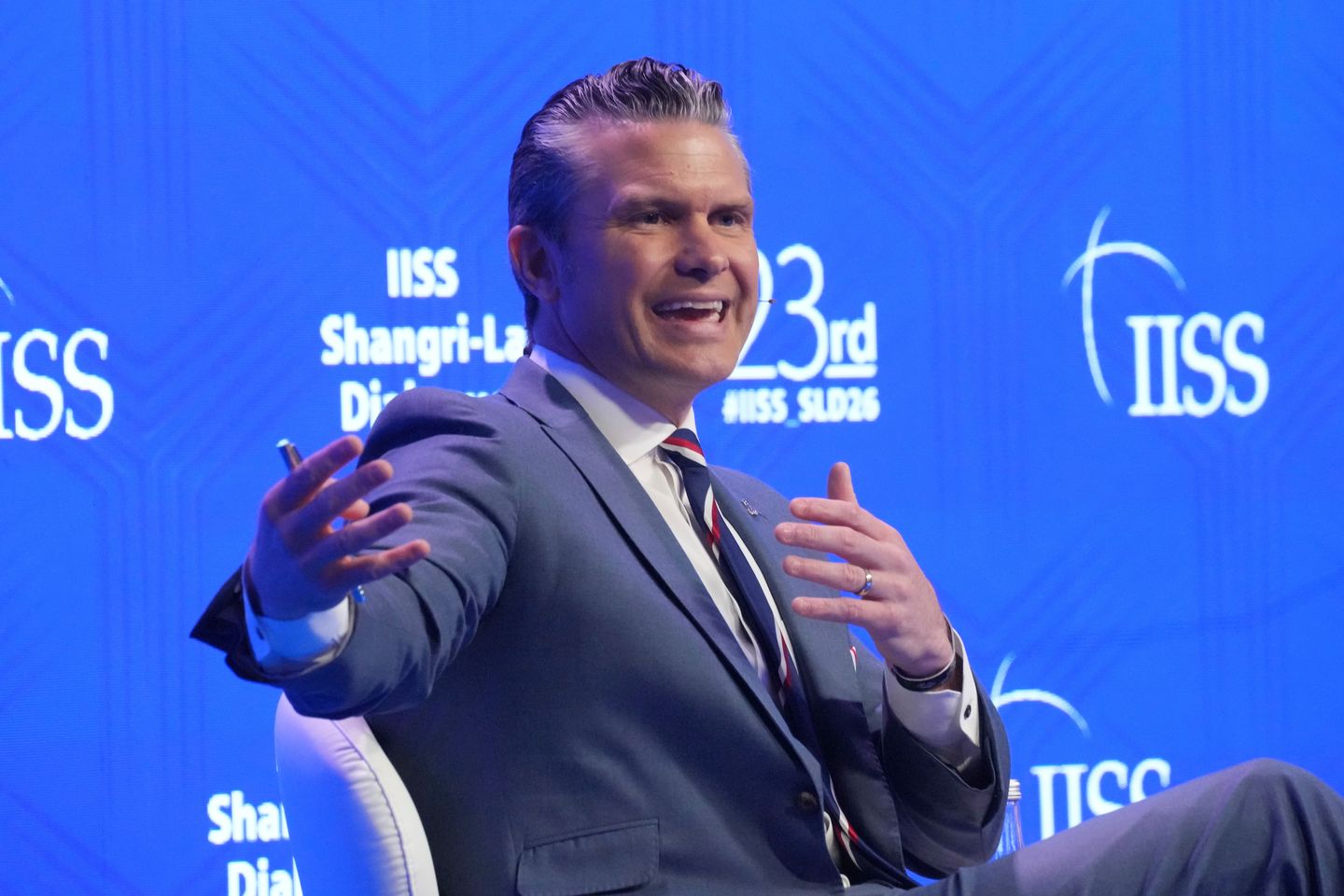
The U.S. will prevent China from dominating the Indo-Pacific by enhancing military power and increasing backing from regional allies but with less confrontational rhetoric, Defense Secretary Pete Hegseth said in a major speech Saturday.
Mr. Hegseth also told reporters in Singapore at a defense leaders’ conference that U.S. policy toward Taiwan remains unchanged but sidestepped questions about whether U.S. arms sales to the island are being held up to curry favor with China.
Increased U.S. dialogue with Chinese officials and military-to-military discussions also will seek to promote “clarity” of U.S. intentions and reduce the risk of conflict, the secretary said at the annual Shangri-La Dialogue.
“It’s our essential responsibility at the department to ensure that the president is always negotiating from a position of unquestionable strength in order to sustain peace here in the Pacific and around the globe,” Mr. Hegseth said in outlining what he called an “America first, peace through strength” policy.
Dialogue with China is “not a sign of capitulating in either direction, but a practical guardrail” to improve ties, he said.
Military exchanges with China in the past have been criticized by some as producing little in the way of better understanding or action.
Despite a buildup of American and allied military power in the region, military dominance in Asia is no longer U.S. policy in favor of what Mr. Hegseth said is a realistic, balance-of-power approach with China in maintaining regional peace and stability.
“What we seek and what the president has constantly articulated is a genuinely stable equilibrium that works for Americans as well as our ally, a favorable but durable balance of power in which no state, including China, can impose its hegemony and hold the security or prosperity of our nation and our allies in question,” he said.
The new approach reflects recent demands from Beijing for the U.S. to adopt “respect” for the Chinese communist system.
Balance of power was a central feature of the Cold War and was rejected under President Ronald Reagan in favor of rolling back and ultimately defeating the communist Soviet Union.
American power will be used to maintain a balance of power that Mr. Hegseth described as “not too disruptive,” Mr. Hegseth said, noting relations with Beijing are better than in the past.
U.S. interests in the Pacific are significant but will now be “scoped and reasonable” to support the balanced approach respecting sovereignty, allowing commerce to flourish and granting nations the freedom to form dominance, the secretary said.
“This is the balance America upholds and will not allow others to overturn,” he said.
Stepped-up defense spending by regional allies is also key to what the secretary called the America First security policy in Asia.
Those building up their militaries in the region include South Korea, Japan, the Philippines, Australia and India, he said.
Regional states have been alarmed by China’s historically large military buildup and the expansion of its military activities in the region and beyond, Mr. Hegseth said.
A Pacific dominated by a regional dominant power like China would undermine the power balance the U.S. is seeking to preserve, he said.
“The Department of War is working with the utmost focus to prevent any such unraveling,” Mr. Hegseth said.
The secretary said America is a Pacific power and will maintain that muscle to back its interests in the region.
“Now, to get that job done, we are changing the playbook. The era of performative outrage is over where Washington issues loud diplomatic protests that signal virtue but do not project capabilities,” he said.
“Going forward, we will be intentional about how and when we communicate, and we will lead first and foremost with actions.”
U.S. military forces will focus on deploying lethal capabilities, strategic discipline and businesslike cooperation instead of “empty rhetoric and peacocking,” Mr. Hegseth said.
U.S. adversaries will then be faced with American hard power, collective military readiness and strong resolve, he said.
“Those who long for peace must prepare for war. From my first platoon to the first island chain. Let that remain at the forefront of our minds, because we all long for peace,” he said.
The first island chain is the flashpoint of Chinese military expansion from its coast through the line of islands stretching from Japan through the South China Sea.
On Taiwan, Mr. Hegseth was asked by a reporter after the speech why he scaled back rhetoric on China and did not mention the island democracy.
Last year at the conference, Mr. Hegseth warned that a Chinese attack on Taiwan was “imminent.”
“I think our message today was very much in sync with precisely where the president wants to go, which is we’re going to be strong, but we can speak softly while carrying that big stick and be very clear about the fact that there are places where we can work together with China,” Mr. Hegseth said, adding that “we respect their ambitions.”
He added, “We know that they have a significant military buildup that comes with considerations we have to take as a sovereign nation to ensure that we’re prepared for any possible contingency. And at the same time, our position hasn’t changed on Taiwan.”
Mr. Hegseth did not respond when asked if the U.S. plans to hold back a pending $14 billion arms package to Taiwan.
President Trump said in May after his summit in Beijing that he’s considering holding up the arms package and plans to talk to Taiwan’s President Lai Ching-te about it.
Defensive U.S. arms sales are mandated under the 1979 Taiwan Relations Act to prevent the island from being annexed by China.
Mr. Hegseth also praised Mr. Trump’s meeting with Chinese President Xi Jinping as setting a new chapter in relations to “deconflict.”
The new approach “doesn’t necessarily signal a sea change in those relations or how they see the world, and that’s what the president said also, but it’s what I think everyone would like to see in that context,” the secretary said.
On Iran, Mr. Hegseth said any agreement with the Islamic republic to end the war and open the Strait of Hormuz will be reached only if it’s a “great deal for our country” and global security.
Mr. Trump said Iran can make a deal or deal with the U.S. military in stepped-up operations.
“And we are prepared, we’re postured even stronger today than we were on Day One to address it that way, if we have to, but he’d prefer not to,” Mr. Hegseth said.
America aims for a complete reversal of Iran’s nuclear program, he said.