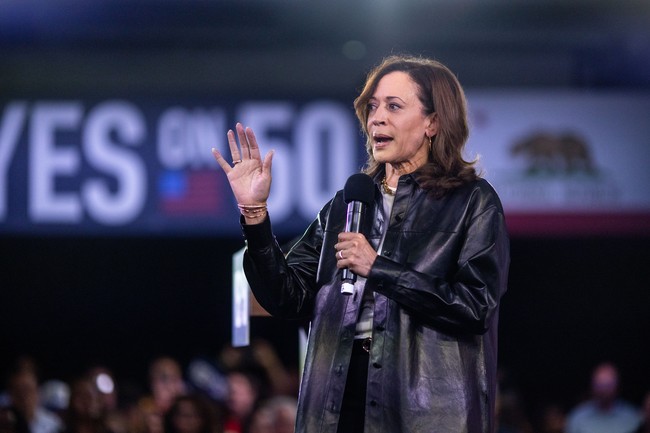
Kamala Harris demanded its release. The American media industry openly wondered what Democrats were hiding. DNC chair Ken Martin kept insisting that the report wasn’t ready for publication, almost two years after the seminal event in the 2024 cycle exposed Democrats’ chicanery around Joe Biden’s cognitive decline and their subsequent rush to anoint Harris as the nominee.
Two weeks to the day after Harris demanded its release, Martin finally caved. CNN got the first look at the unfinished report, along with Martin’s semi-distancing from the product. Martin expanded on his Pilate-washing on X/Twitter as well as on the DNC website:
Read more about what I have to say here: https://t.co/9wochQttN5 pic.twitter.com/2REle6FPY3
— Ken Martin (@kenmartin73) May 21, 2026
When I commissioned a comprehensive review of the 2024 election, I started a process to answer those questions while interrogating where our party has systemically and historically fallen short. I didn’t want that process led by anybody directly tied to the 2024 cycle – either the campaign or the consultants involved – and I did not want to put my own thumb on the scale for what might be produced. What I did ask for were actionable takeaways for the future. I wanted real, in-depth, specific recommendations to improve our allocation of resources, tech, data, organizing, media strategy, and more. I chose someone who I thought could produce this type of report.
When I received the report late last year, it wasn’t ready for primetime. Not even close. And because no source material was provided, fixing it would have meant starting over, from the beginning – every conversation, every interview, every data set. …
I am not proud of this product; it does not meet my standards, and it won’t meet your standards. I don’t endorse what’s in this report, or what’s left out of it. I could not in good faith put the DNC’s stamp of approval on it. But transparency is paramount. So, today I am releasing the report as I received it – in its entirety, unedited and unabridged – with annotations for claims that couldn’t be verified.
Ahem. Isn’t this evidence of institutional failure itself? Martin has had eighteen months to pull this together, which should be plenty of time for this kind of analysis. Lest we forget, Reince Priebus not only conducted a similar autopsy for the RNC after the 2012 election, he published its results in ten months (August 2013), along with an action plan he actually implemented in time for the midterms in 2014. Martin had plenty of time and money, and now he wants to pretend that it’s not his fault that he couldn’t finish the report as Democrats get ready for the next election cycle,
What about the report itself? People can directly access the 192-page report, but it’s not easy to parse, thanks to the lack of effort in finishing the product. It’s unfinished in another sense, too: there is apparently no mention of Joe Biden’s cognitive decline or the effort to cover it up in the autopsy. The words “cognitive,” “dementia,” “senile,” and “mental” make no appearance in this document. The June 2024 debate barely gets a mention at all, and the report completely ignores its impact and what it revealed about Democrats’ attempts to sell a sick old man as “Sharp As A Tack™”:
Before the candidate switch, the pollsters never reviewed ad copy or content – and commented how they did not see ads until after they were airing, in some instances reading about the ads in the media. They also reported they had little insight into the data provided to leadership from the analytics team.
As the June 2024 debate neared, there were discussions about polling around the debate and after the convention. The polling team was informed the plan was for them to poll three times during the general election, and the post-convention polling would count as one of those three polling waves. They attributed this minimalist approach to research to members of the media team not believing polling data was essential to decision making.
The debate obviously changed many things. The dial-testing during the debate demonstrated the weakness of the President’s performance, and a post-debate survey was scrapped.
Whoever wrote this passage must have majored in Passive Voice Deflection while attending Progressive U. “The debate obviously changed many things,” the author(s) write, without ever explaining what changed or why, even though the necessity of that switch was the single biggest problem Democrats faced.
The autopsy never addresses the “candidate switch” in detail either, choosing to ignore the back-room “switch” that took place and the option Democrats had in using the convention to choose their nominee by a representative vote. This literally never gets discussed in the report, despite it being the single biggest DNC process issue in the 2024 cycle. Instead, they warn that the next nomination may have to go to an open convention:
Democrats will have a rigorous, efficient, and fair nominating process for 2028, but it is entirely possible there it will be a protracted contest – perhaps finally resolving in a July convention. If this is the case, Democrats may have a nominee who needs to bring the party together, a staff and team exhausted by the process, and urgency in standing up a national campaign.
This is exactly what occurred in 2016, when Secretary Clinton cinched the nomination in Philadelphia 104 days before the election and then discovered there was little infrastructure in place to help her win.
The report adds a note to this last claim that the timeline is inaccurate and the claims are “contradicted in public reporting.” The Clintons had their own operation ready to go; the Clinton Foundation served as Hillary’s campaign-in-waiting for a decade before she won the nomination. Furthermore, Hillary had wrapped up the nomination before the convention, as long as the superdelegates didn’t bail out and force a second ballot at the convention. Hillary had plenty of time to organize and prepare; she just did a piss-poor job of both, convinced that voters owed her the office and that she had successfully “disqualified” Trump, a strategy that failed Democrats for well over a decade.
That does get a mention in the report, albeit brief and delusional:
The retrospective evaluation of Donald Trump’s presidency was too positive. Given the ability of right-wing entities to slash and smear the Vice President, it was essential to prosecute a more effective case as to why Trump should have been disqualified from ever again taking office. The grounds were there, but the messaging did not make the case.
Come on, man. Democrats ran on nothing other than Orange Man Bad, and they spent two years setting it up. Democrat DAs in New York City and Atlanta tried prosecuting Trump out of the race; Merrick Garland’s DoJ did the same thing through special counsel Jack Smith. Democrat AGs tried keeping Trump off the ballot with their absurd 14th Amendment arguments about “insurrection,” all in an effort to disqualify Trump. It all either failed or backfired, and the report grudgingly acknowledges why:
Third, the inability to impact Trump’s favorability was a major failure of the campaign. His retrospective job approval was too high. The Republicans had a defined framework for attacking the Vice President, but the Democrats did not have a defined or consistent theory for attacking Trump or how to maneuver to disqualification.
Among the issues not mentioned: Harris’ choice of running mate. Walz’s name only comes up three times, all three as a reference to the “Harris-Walz campaign.” The report also appears to avoid discussion entirely of Harris’ media strategy or her decisions to avoid reporters or journalists. In short, the report goes out of its way to ignore all of the real faults and errors made by Democrats while nibbling on the edges by discussing ad campaigns and ground organization.
The only useful passage in this report, captured by CNN political analyst Aaron Blake, is advice that the current hard-Left progressive Democrat Party will never accept:
One phrase repeatedly gets mentioned derisively, and that’s “identity politics.”
It’s repeatedly cast as a crutch that Democrats need to move away from, in favor of kitchen-table issues like affordability and middle-class appeal.
The report says Stein’s huge win showed how to “focus less on abstract issues and identity politics, and connect with voters on the issues they say matter most, including the economy, disaster relief, and addressing housing affordability.”
It says Sen. Jacky Rosen of Nevada and now-Sen. Ruben Gallego of Arizona showed how “year-round presence, economic messaging, and addressing cost-of-living concerns resonate more than identity politics.”
It tells Democrats who want to win male voters to deploy male messengers and “don’t assume identity politics will hold male voters of color.”
And it casts Stein, Gallego and Sen. Elissa Slotkin of Michigan all as candidates who were able to speak effectively to middle-class voters, rural voters, and/or Latino voter in ways other Democrats could not. It also greatly credits Rosen’s tireless political operation and her ties to Nevada’s all-important service industry.
The message seems to be: Find candidates who match their states or districts and have actual appeal to middle-class voters in their areas.
Take a look around at the leading Democrat midterm candidates and nominees, and one can understand why Martin didn’t want to publish that advice. Democrats are doubling down on identity politics, not to mention socialism (and in Graham Platner’s case, national socialism). By the way, the autopsy contains exactly zero references to socialism, and only ten to progressives – none of which deal with ideology.
This isn’t just a “dismal picture” for Democrats, as Blake calls it. It’s a fundamentally dishonest picture as well.