The May 19 Pontic Greek Genocide Remembrance Day commemorates the systematic extermination of approximately 353,000 Greek inhabitants of the Pontus region (Turkey’s Black Sea coast). The genocide was committed by the Ottoman and Turkish nationalist forces between 1914 and 1923.
The methods used during the genocide included massacres, arbitrary executions, deportations, forced death marches into the Anatolian interior, forced labor battalions, forced conversions, sexual violence, enslavement, starvation and cultural eradication, amongst others.
The Pontic Greek Genocide was part of a broader effort by the Ottoman authorities and the subsequent Turkish national movement to eliminate Christian communities (including Armenians and Assyrians) from their ancient homelands.
The region’s name is derived from the ancient Greek word Pontus or Pontos, which simply means “the sea” (specifically the ancient name for the Black Sea, Pontus Euxinus). Pontus, home to Greeks for thousands of years, gave rise to a distinct, resilient group of ethnic Greeks who maintained their own unique culture, folklore, and endangered dialect (Pontic Greek).
Before the genocide, the Christian population in Ottoman Turkey was between 3 and 4 million. The current Christian population in Turkey is estimated at only around 50,000 to 60,000.
The region of Pontus was completely cleansed of its Christian inhabitants as a result of the genocide and the subsequent forcible population exchange between Turkey and Greece in 1923. If Greeks and other Christians wanted to stay in Pontus, then they had to concede to the condition of conversion to Islam.
The Hellenic Parliament officially recognized the Pontic Greek Genocide by establishing 19 May as a National Day of Remembrance. Several countries, including Armenia, Sweden, and the Netherlands, have since recognized it. Turkey, however, still aggressively denies the genocide.
The descendants of the genocide survivors live in Greece and other countries around the world. They seek official, international recognition for the genocide that befell their ancestors.
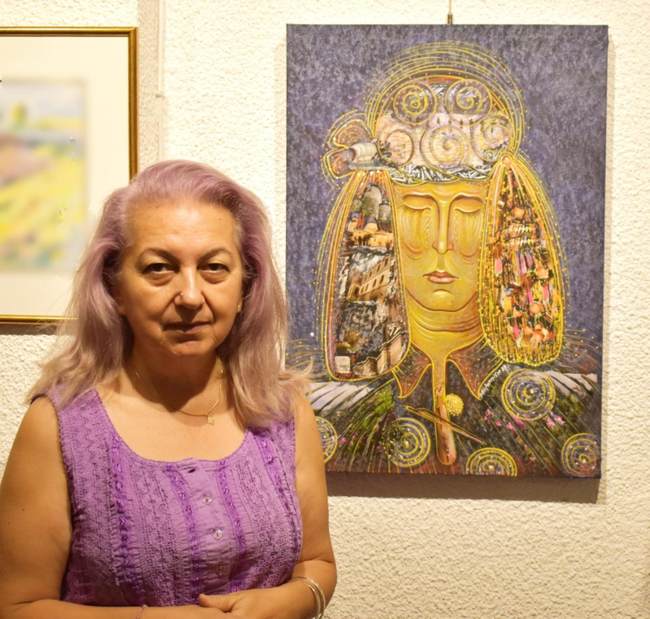
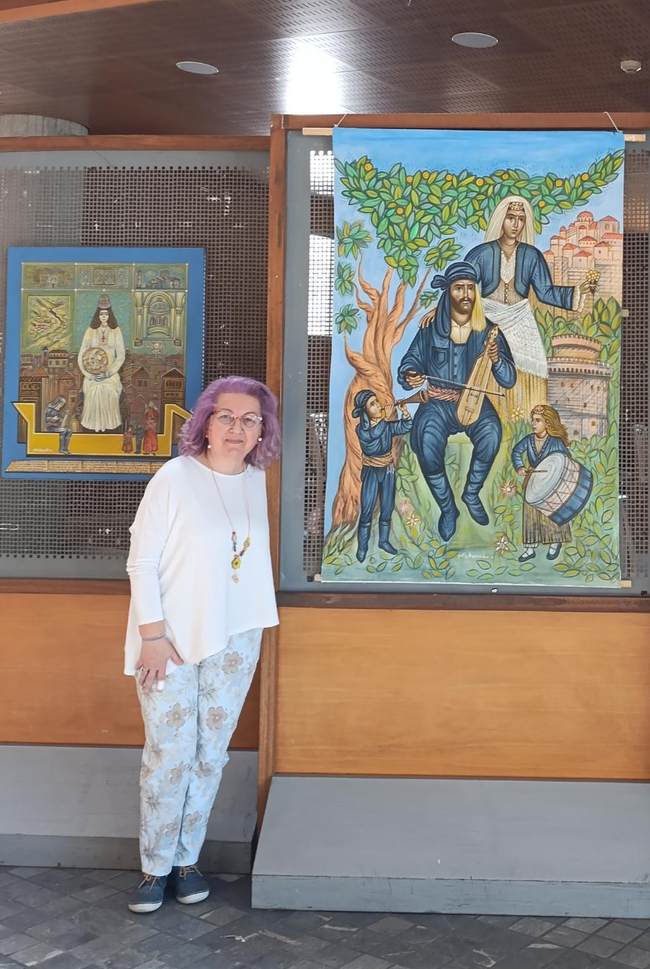
One of them is a well-known artist in Greece, Sofia Amperidou. Her work mainly concerns Greek history and culture, particularly in Pontus, her ancestral homeland. She can be found on Facebook and her website.
In an interview with me, Amperidou said that her father’s parents were born in Pontus and were targeted during the genocide by Turks.
My father’s parents were born and raised in the village of Kaya-alan (or Kayalan) in the mountainous region of the province of Kerasounta [Giresun]. My grandmother Maria, née Photiadis, was born in 1900 and my grandfather Athanasios Aberidis in 1890. They were farmers and owned 200 crowns of land. They were hardworking people and lived with dignity. They were also a family with deep religious faith.
My grandfather’s father, Papa-Yiannis, was a priest in one of the three churches that existed in the village. Most likely in the upper neighborhood of Kayalan where they lived, where the church of Agios Georgios was located. In the center of the village there was the church of Panagia and in the lower neighborhood there was Agios Theodoros. The village had three schools: a sixth-grade school in the center and a third-grade school in each of the two neighborhoods. And these alone testify to the centuries-old dominance of the Greek element, the cultural tradition and the intense religious life. Very often my grandmother spoke about her Turkish neighbor with love but also pain and tears in her eyes. She remembered her words at the time of parting when she said to her: “How will we live now without you… You are leaving and you will take the holy icons with you, along with God’s blessing…”
My ancestors were peaceful and peace-loving people. They loved freedom and protected their fellow human beings. My great-grandfather received a letter from the then Turkish government for the conscription of the men of the village aged from 15 to 55 years old. He then informed the village and all the men fled to the mountains. The result was that the army arrested my grandfather and beat him to death. I was inspired by this event and created my work “The Invisible Martyrs of Pontus.” Of course, my grandfather’s case was one of the thousands of those priests and monks who brutally and unjustly lost their lives during that period.
My grandmother Maria lost her sister, Sofia, at the age of 16 due to the hardships and sufferings of the endless marches of exile during the genocide. She was very sad about her death and when I was born, my family named me after this girl. A name heavy with history…
Amperidou says that her Pontic family members came to Greece when the Lausanne Convention was implemented for the compulsory exchange of Greek and Turkish populations in 1923.
“In world history, it is the only compulsory exchange of populations that was imposed,” she adds. “Of course it was inhumane. Initially they arrived at the port of Piraeus and from there they were taken to a village in Thesprotia. However, they did not like the conditions of the area and in a few months, they came to the Prefecture of Pieria.”
Pontic Greeks speak an ancient Greek dialect, also known as Romeyka. Philosophers and notable thinkers who spoke Pontic Greek (or earlier dialects of the area) include the philosopher Diogenes of Sinope, the geographer-philosopher Strabo of Amaseia, the theologian Evagrius Ponticus, and the early Christian writer Marcion of Sinope, amongst others.
“The Pontic dialect is not just a linguistic idiom; it is a leading element of the cultural identity of the Greeks of Pontus. At the same time, it functions as a connecting link with antiquity and the Byzantine culture of the Empire of Trebizond [Trabzon],” says Amperidou.
“The Pontic dialect comes to us today through Pontic songs and fairy tales or other books written in the Pontic dialect. In the last 10-15 years, significant effort and systematic teaching by certified Pontic teachers have been made and the comforting thing is that the new generation is following the lessons with keen interest. However, I believe that this is not enough. It must somehow be introduced into public schools, and experiential workshops. It is not enough to know some words or understand the lyrics of songs. A way must be found to use it in everyday life or, more correctly, to think directly in Pontic and to discuss it.”
Amperidou says that she has been painting since childhood and more intensely since adolescence. Art was a creative refuge for her, and she used whatever materials she was able to find such as tree leaves, pebbles and shells:
In 1985, at the age of 21, I started learning Byzantine painting at the Metropolis of Katerini. I loved the philosophy of Byzantine art, its colors and symbols, which inevitably transformed into my paintings. I worked for several years as a hagiographer for a living, collaborating with other hagiographers. For fifteen years, I had my own workshop in the center of Thessaloniki, where I created many icons of saints and paintings.
At the same time, since 2002, I started teaching hagiography in cultural centers of municipalities in the prefecture of Thessaloniki. For the past decade, I have taught adults and children from the age of six, which is particularly interesting.
I started creating my first works with Pontic themes in 1994. By 1998, I had created some small-scale works that gained the public’s interest. I received many positive impressions and feedback. Then, maturing as a person and as an artist, I wanted to express through my art the thoughts and feelings that I felt from my grandmother’s stories about the homeland of Pontus.
Furthermore, the study of history and literature piqued my interest and without particularly understanding them, my overall work focuses on Pontus. In my work, my Pontic origin is not just a reference to the past. It is the living root that nourishes every line and brushstroke in my work. Through figures and symbols, I try to bridge the ‘yesterday’ of my ancestors with the ‘today’ of our own reality. I use memory as material to give substance to absence and nostalgia.
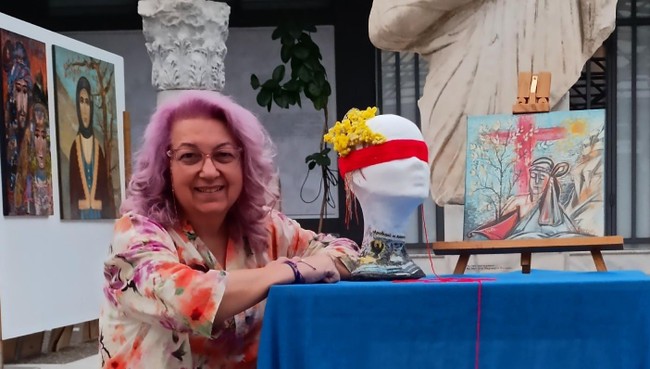
Amperidou says she has visited Pontus a few times, mainly to participate in international painting festivals in Trebizond:
I also went to Kerasounta, where my ancestors come from, once to see the place that my grandmother always told me about and never returned. I was very moved and sad because there was no house or monument to see there: only a building that was clearly built on the foundations of a church. Entering the building, which had two rooms, there was a strong smell of a stable. The paradox was that on one wall there was a school board, so I guess that the church building was converted into a school and then the school into a stable. During my visits to monumental monasteries such as Agios Ioannis Vazellonas and Agios Georgios Peristereotas, I saw that those monasteries had experienced enormous destruction. And the few remains were left to the mercy of the weather.
Many religious buildings across Turkey were converted into Muslim mosques. More recent examples of this are found in the city of Constantinople, which was the center of the Greek-speaking Christian world. Hagia Sophia, a temple famous for its enormous dome, and the Chora Monastery that carried the influence of the Palaeologan Renaissance. Those churches for decades functioned as museums. And tragically, Hagia Sophia in Trebizond is also no longer a church – half of the temple functions as a museum and half as a mosque today!
The most paradoxical thing is the tourist exploitation. Turkey recognizes the value of these monuments, so presents them as its own heritage. We know well that in the territory of today’s Turkey these are top buildings of ancient Greek and Byzantine civilization, long before the Turks appeared in the region as they came from Central Asia after the 11th century AD.
Today, the Turkish government does not allow a single Orthodox Church to operate in Pontus. Almost all churches there have either been destroyed or left to rot due to neglect. Even the words “Pontus” and “Pontic” are not tolerated by Turkish government officials. They prefer to use “the Black Sea” instead. Amperidou thinks that these are attempts by the Turkish government to erase the Pontic Greek memory and heritage from its indigenous homeland.
“The treatment of Pontic cultural and religious heritage by Turkish governments after 1923 is characterized by systematic silencing, alteration and in many cases, destructiveness,” she says. “Thousands of churches, monasteries and schools were abandoned. Many were destroyed or looted. They were turned into stables, warehouses or mosques. This is obviously a plan for the national Turkification of the region. It is part of an attempt to eliminate the historical memory of the region. A policy of changing the names of villages, towns and locations that had Greek-Pontic roots is being implemented, replacing them with Turkish names. In recent years, there has been a trend of preserving monuments (such as Panagia Soumela) mainly for tourist purposes. It is evident that the overall policy remains focused on silencing Pontic identity and eliminating every trace of the Greek presence in Pontus.”
Pontic people who now live in Turkey have largely been Islamized. Yet many of them have Greek ancestry. Their Greek or other non-Turkic ancestors were forced to convert to Islam, a reality many of them are either unaware of or in denial.
“Communication with Muslim Pontic people today is both easy and difficult,” says Amperidou. “It may even be a significant social phenomenon that after decades of silence, contact is restored through social media where bridges of linguistic and cultural communication are built. The exchange of cultural goods (such as music, songs, and dances – the common roots of Pontic Greek cultural heritage) bring people together despite the kilometers of distance. I believe that the Pontic Greek dialect is the strongest point of contact. In addition to preserving ancient Greek elements, you can see how it becomes the connecting link for those who are searching for their roots with common surnames and other information about their ancestors. With all of the above and together, the food culture becomes a mirror of people on both sides of the Aegean – a mirror, however, I would say is surrounded by obvious sadness and nostalgia.”
Amperidou regularly participates in art exhibitions. Notably, she has illustrated the fairy tales entitled “The Journey of Cypriot Woman.” It speaks to the theme of the Greekness of Cyprus and “The Virtue of Smyrna,” a story written by children about Turkey’s 1922 Destruction of Smyrna, by “Kryfo Scholio” in Limassol, Cyprus. She also prepared an illustration of the “Drawing Notebook” with the heirlooms of the Pontic Association “Saint George Peristereotas.”
“In the coming period I hope to complete something that I have been preparing for a long time, and which is related to illustration,” she says. “I would like to point out that it is such an honor for me and my work to be invited to exhibit in many different places in Greece and abroad. I am moved by the interest, especially of the younger generations, who through my work discover the little stories which I have been inspired to create and which are part of the great history of Pontus. My work itself has become a vehicle of communication that conveys messages and connects people and epochs.”
Over a hundred years after the genocide, the government of Turkey still proudly denies the Pontic Greek genocide, prosecutes its own citizens who publicly acknowledge it and seeks to cover up its crimes. Amperidou thinks the world does not know enough about the Pontic Greek genocide:
In the West, the Armenian Genocide has received wider recognition, while the Pontic Greek Genocide is in its early stages. Serious efforts are being made by academics who are well-versed in the subject. The pathologies of the organized Pontic space and certain political expedients create confusion and shadows. The road is long and universal recognition requires many actions. People in Turkey should gain access to sources and archives beyond the educational system that exists in the country and, above all, seek critical thinking skills. From the news, we learn that thousands of Turkish citizens in recent years have discovered their Greek origins through DNA tests and are now exploring their family tree. I think that surprises await us in the coming years.
Editor’s Note: Do you enjoy PJ Media’s conservative reporting that takes on the radical left and woke media? Support our work so that we can continue to bring you the truth.
Join PJ Media VIP and use promo code FIGHT to receive 60% off your membership.