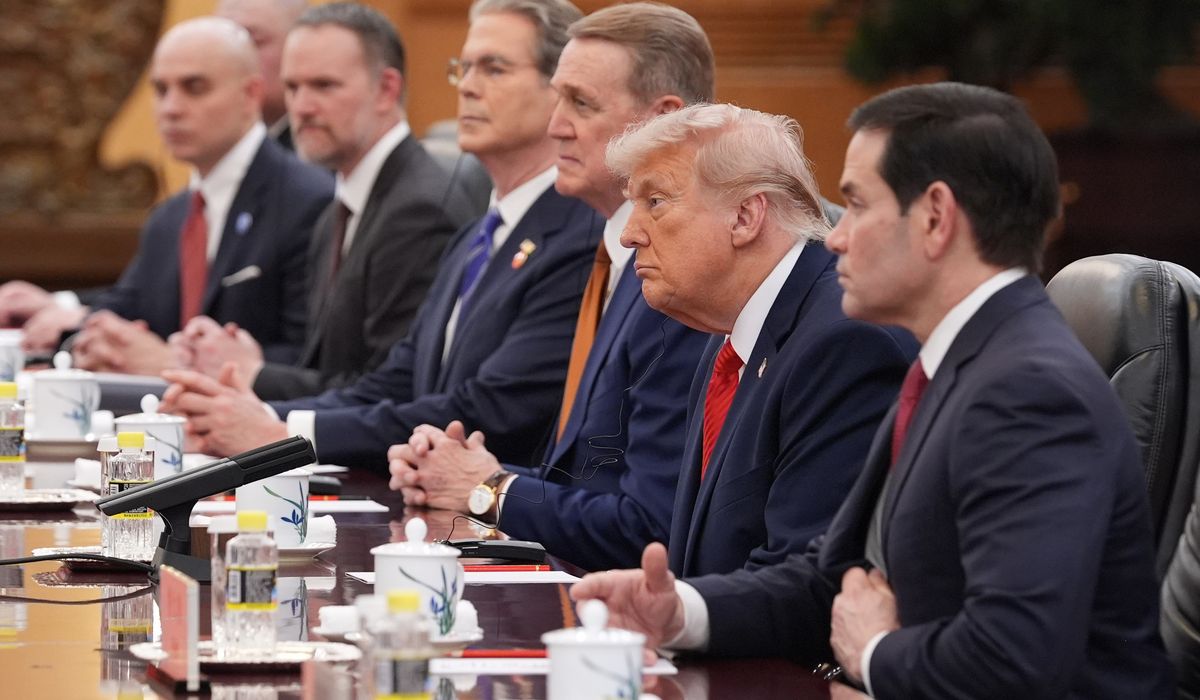
President Trump and Chinese President Xi Jinping on Thursday agreed on the need to reopen the Strait of Hormuz, and Beijing showed an interest in buying more American energy to reduce its reliance on the Middle East chokepoint, the White House said.
A Trump administration summary of Mr. Trump’s high-stakes meeting with Mr. Xi in Beijing said the two sides “agreed that the Strait of Hormuz must remain open to support the free flow of energy,” although it remains unclear whether the U.S. side secured any firm commitments.
“President Xi also made clear China’s opposition to the militarization of the strait and any effort to charge a toll for its use, and he expressed interest in purchasing more American oil to reduce China’s dependence on the strait in the future,” the White House readout said. “Both countries agreed that Iran can never have a nuclear weapon.”
Beijing is a strategic partner to Tehran, and China is by far the biggest purchaser of Iranian oil, so the Middle East conflict and Iran’s clampdown on the Strait of Hormuz looms over Mr. Trump’s visit.
Iran has maintained an effective blockade of all Western-linked ships transiting the Strait of Hormuz since early March. The blockade has throttled global energy markets, with hundreds of ships and millions of barrels of oil trapped in the Persian Gulf.
The Chinese side did not publicly commit to any immediate action on the strait.
SEE ALSO: Xi tells Trump that U.S., China should be ‘partners, not rivals’
“The two heads of state exchanged views on the Middle East situation and other major international and regional issues,” foreign ministry Guo Jiakun said after the Trump-Xi bilateral meeting. “On the Strait of Hormuz, China’s position is consistent and clear.”
To date, Mr. Xi’s rhetorical commitments “cost China very little,” said Craig Singleton, a senior China fellow at the non-partisan Foundation for Defense of Democracies.
“The harder test is whether Beijing pressures Tehran, curbs Chinese purchases of Iranian oil, or helps Washington turn general language into observable outcomes,” he said. “So far, China appears willing to support de-escalation in principle, not carry out Trump’s Iran policy in practice.”
In the past, China has stressed the need to open the strait and opposed its “militarization.”
The Trump administration wants Beijing to pressure its Iranian partners into accepting a deal with favorable terms for the U.S., so it is dialing up pressure on Chinese banks and refineries buying Iranian oil.
On the other side, the Chinese may use the strait as leverage to get the U.S. to accept more favorable stances on issues such as Taiwan, which China considers to be a breakaway province.