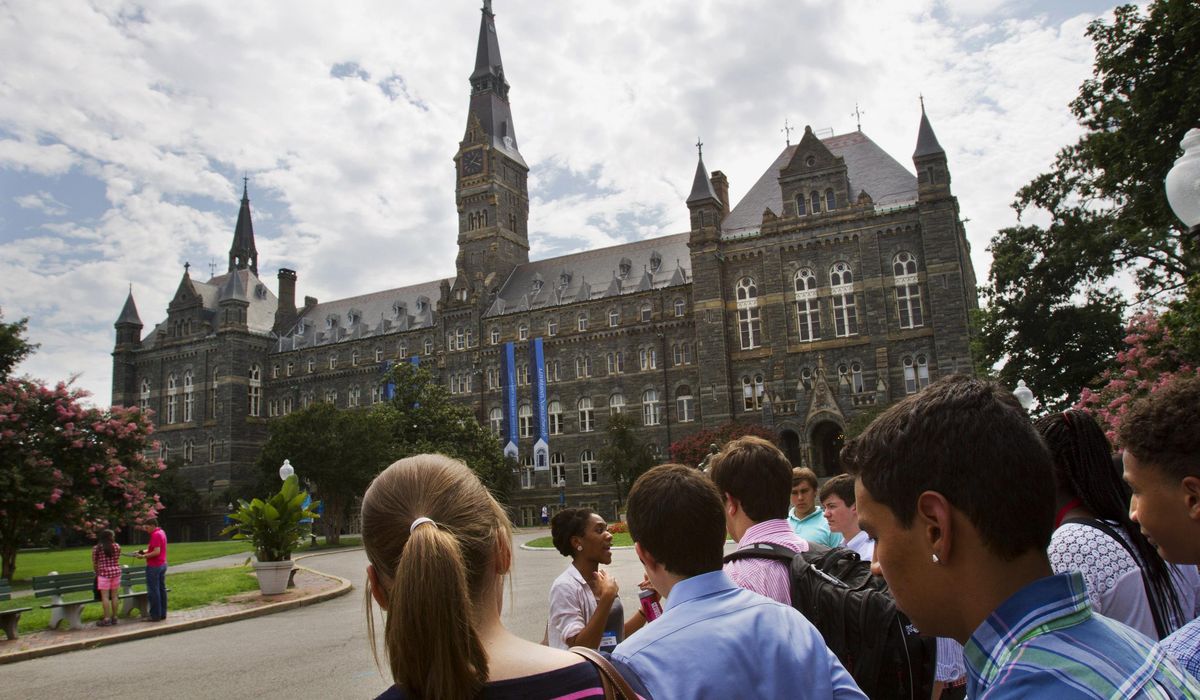
Georgetown University’s six-figure contract with a Qatari government group to host conferences on Islamophobia has raised questions about whether the university violated federal law by failing to register as a foreign agent.
In a letter released Thursday, the Brandeis Center asked the Justice Department to investigate the “secret” $630,000 agreement, which requires the university to consult on speakers and conference themes with the Islam and Muslims Initiative, an organization supported by the Qatari Foreign Ministry.
Evan Slavitt, Brandeis Center general counsel, said in a letter to acting Attorney General Todd Blanche that “putting on a series of conferences to support the Qatari point of view falls squarely within the scope” of the Foreign Agents Registration Act.
“These so-called conferences and events are simply the presentation of speakers deemed acceptable to Qatar to promote Qatar’s point of view in the United States,” Mr. Slavitt wrote in the Wednesday letter. “Indeed, by running the money through an ostensibly objective institution, it goes to the heart of what the law was originally intended to address — the secret creation of propaganda under the direction of a foreign nation.”
The June 2024 contract embedded in the House Education and the Workforce Committee’s March report on campus antisemitism was exposed in a Tuesday article in The Washington Free Beacon.
“Georgetown’s obligations under the contract — consulting with a Qatari government-linked body on speaker selection, accepting Qatari funding, and hosting events at Qatar’s direction — satisfy the legal definition of acting as a foreign agent under FARA,” the Brandeis Center said in a Thursday statement.
Under the three-year contract, Georgetown’s Bridge Initiative, a multiyear project aimed at combating Islamophobia, agreed to hold events on the “Globalization of Islamophobia” in the District.
Mr. Slavitt argued that the work outlined in the contract constitutes “political activities” under FARA.
In addition, he said Georgetown meets the law’s definition of an “agent of a foreign principal” by acting as a “publicity agent” for the Qatari Foreign Ministry and disbursing funding on its behalf.
“GU has little discretion on this spending; it spends on the speakers that Qatar designates and pays for events. Thus, it is simply the disbursing agent on behalf of Qatar and would be within the reach of that [FARA] subsection,” Mr. Slavitt said in the letter.
A Georgetown spokesperson defended the agreement, saying the allegations in the Brandeis letter “cherry-pick individual lines from the contract to create a false impression and exclude critical context.”
The spokesperson pointed out that the contract stipulates that the Qatari Foreign Ministry “may not direct the Bridge Initiative’s research, scholarship, or teaching, or receive the benefits thereof” and that “nothing in this Agreement is intended to or should be construed to restrict the academic freedom of the University.”
The contract also states: “The Ministry shall not bear any responsibility for the activities and programs of the University or for any content or any related work, and exercises no role relating to governance, administration or operation in relation to the work of the University.”
The request for an investigation comes amid concerns over foreign influence at universities, led by Qatar, the leading international funder of U.S. higher education.
The Muslim nation has sunk $8.8 billion into U.S. universities since 1986, including $1.1 billion in 2025, as shown on the Education Department’s foreign funding portal launched in February.
Georgetown has accepted $1.46 billion in foreign funding during that time, ranking ninth among U.S. universities. Qatar is the largest contributor to the D.C. college by far at $1.1 billion.
The funding supports Georgetown University in Qatar, located in Doha’s Education City. Other universities operating satellite campuses within the complex include Northwestern, Texas A&M and Carnegie Mellon.
“Qatar has spent untold amounts of money embedding itself in American higher education, and what this contract reveals is exactly how that influence works in practice: a foreign government quietly shaping what gets said and who gets to say it at events held in our nation’s capital,” Kenneth Marcus, CEO of the Brandeis Center, said in a Thursday statement.
“Our foreign agent laws are designed to address situations just like this, and we must ensure accountability in order to protect the interests of students,” he said.
Housed at Georgetown’s Prince Alwaleed Bin Talal Center for Muslim-Christian Understanding, the Bridge Initiative seeks to study, document and counter Islamophobia, but some of the project’s associations have raised concerns about antisemitism.
“Georgetown’s Bridge Initiative has hosted, promoted, or defended several figures whom the regime in Qatar has also boosted,” The Washington Free Beacon article said. “They include Bridge Initiative advisory board member Dalia Mogahed and anti-Israel cleric Omar Suleiman, both of whom have promoted terrorism against the Jewish state, as well as Brooklyn Imam Siraj Wahhaj, an unindicted co-conspirator in the 1993 World Trade Center bombing.”
Mobashra Tazamal, the Bridge Initiative’s associate director, said in a December 2024 year-end wrap-up on the project’s website that the “defining Islamophobic event of 2024 was Israel’s ongoing genocide in Gaza.”
The Washington Times has reached out to Georgetown and the Bridge Initiative for comment.