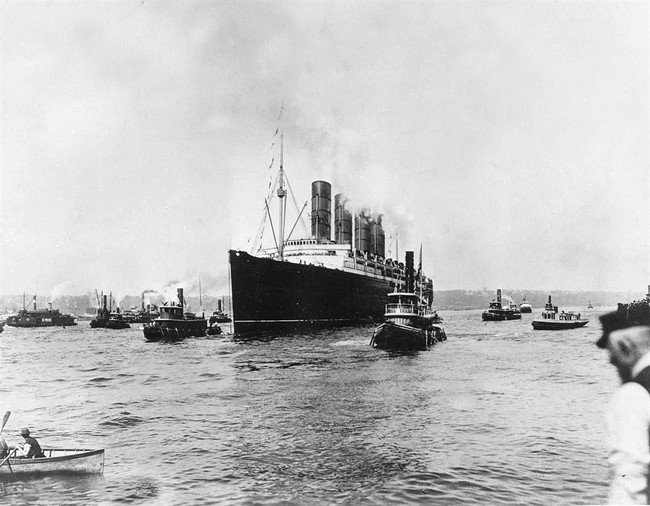
Today marks the 111th anniversary of one of the defining moments of the 20th century: when the RMS Lusitania sank off Ireland on May 7, 1915.
The disaster did more than claim nearly 2,000 lives, including 128 Americans; it helped move American opinion away from neutrality, tightened the diplomatic noose around Germany, and pushed the United States closer to World War I.
Before the attack, many Americans still saw the war in Europe as a distant catastrophe. President Woodrow Wilson publicly defended neutrality while Great Britain and Germany fought an increasingly ruthless economic and military struggle.
Britain used its formidable navy to blockade Germany and cut off materials, while Germany answered by declaring the waters around the British Isles a war zone and expanding submarine attacks against ships bound for Britain.
Lusitania, owned by the Cunard Shipping Line, was launched in 1906 to carry passengers on transatlantic voyages. The British Admiralty subsidized the ship’s construction with the understanding it would be pressed into military service if war broke out. After World War I began in 1914, Lusitania remained a passenger ship, although it was secretly modified for war.
By February 1915, German naval commanders knew British merchants were arming their ships and that both merchant and passenger ships were transporting weapons and supplies from the United States to Europe.
As a result, Germany declared the waters surrounding the British Isles a war zone and stopped following international naval “prize laws,” which warned ships of a submarine’s presence. This break from naval protocol angered and troubled the United States and the European Allies.
The Lusitania left New York Harbor on May 1, 1915, carrying 1,959 passengers and crew on its way to Liverpool. The German Embassy had placed newspaper warnings cautioning travelers that ships entering the war zone could be targeted.
Most passengers boarded anyway, believing a civilian ocean liner remained too visible, too prestigious, and too full of civilians to be treated like a military target.
Days before Lusitania was scheduled to leave New York for Liverpool in early May 1915, the Imperial German Embassy in Washington D.C. placed ads in American newspapers reminding Americans that Britain and Germany were at war. They warned potential travelers that “vessels flying the flag of Great Britain or of any of her allies are liable to destruction” and should be avoided.
Since it was assumed Germany would still allow passengers to get into lifeboats prior to an attack, the cautions were largely ignored.
On the afternoon of May 7, German submarine U-20 spotted the ship off the southern coast of Ireland. Kapitänleutnant Walther Schwieger, U-20’s commander, ordered a torpedo fired into the Lusitania’s starboard side. Seconds later, a second explosion tore through the liner, causing the ship to badly list; lifeboats were difficult to launch, and the massive vessel sank in only 18 minutes.
A torpedo struck and exploded amidships on the starboard side, and a heavier explosion followed, possibly caused by damage to the ship’s steam engines and pipes. Within 20 minutes the Lusitania had sunk, and 1,198 people were drowned. The loss of the liner and so many of its passengers, including 128 U.S. citizens, aroused a wave of indignation in the United States, and it was fully expected that a declaration of war would follow, but the U.S. government clung to its policy of neutrality.
American anger quickly followed; Wilson’s administration sent sharp diplomatic protests to Germany, demanding an end to attacks on civilian vessels.
As word spread about Lusitania’s tragic fate, so did the outrage. American citizens were saddened and stunned but not ready to rush to war. President Woodrow Wilson wanted to proceed with caution and remain neutral while former President Theodore Roosevelt demanded swift retaliation.
Germany defended its aggression, claiming Lusitania had carried weapons and war supplies and was therefore fair game. As they continued to divert blame, British propaganda against them snowballed. Throngs of vengeance-seeking Brits rushed to enlist, and anti-German riots broke out in London.
Said Winston Churchill, First Lord of the Admiralty, “The poor babies who perished in the ocean struck a blow at German power more deadly than could have been achieved by the sacrifice of 100,000 men.”
German officials, fearful of pulling the United States into the war, temporarily scaled back unrestricted submarine warfare. The sinking also became a powerful propaganda weapon; British and American posters, speeches, and headlines used the disaster to portray Germany as reckless toward civilian life.
Questions surrounding the Lusitania never fully disappeared: British officials long denied the ship carried materiel for the war, but later investigations confirmed it did transport millions of rounds of rifle ammunition and other military cargo. Critics also scrutinized Captain William Thomas Turner, commander of the Lusitania, for reducing speed in foggy conditions and not zigzagging to avoid submarines.
The sinkings of merchant ships off the south coast of Ireland and reports of submarine activity there prompted the British Admiralty to warn the Lusitania to avoid the area and to recommend adopting the evasive tactic of zigzagging, changing course every few minutes at irregular intervals to confuse any attempt by U-boats to plot her course for torpedoing. The ship’s captain, William Thomas Turner, chose to ignore these recommendations, and on the afternoon of May 7 the vessel was attacked.
The dramatic accusation involved Winston Churchill, then First Lord of the Admiralty. Later, Churchill was accused of intentionally leaving the ship exposed to draw America into the war.
In the midst of the Dardanelles-Gallipoli crisis, the tragedy seemed incidental to some. Yet for a century, rumors swirled that Lusitania was deliberately sacrificed by the British, chiefly Churchill. His alleged aim was to so infuriate the Americans as to bring them into the war against Germany. More recently, critics charged that Churchill’s Admiralty purposely contrived to steer the ship into harm’s way.
The complaint against Churchill reached critical mass in Colin Simpson’s The Lusitania (1972). This popular work was selected by four book clubs and excerpted in the Reader’s Digest and Life. Simpson’s charges have frequently been repeated, especially since the arrival of the Internet. As recently as 2014, a book on Franklin Roosevelt, The Mantle of Command, casually alleged that the Churchill had a role in the loss of the “ill-fated American liner.”1
No evidence exists that proves a deliberate sacrifice; the simpler explanation remains grim enough: submarine warfare, wartime cargo, imperfect decisions, and terrible timing met on one deadly afternoon.
The Lusitania alone didn’t bring America into World War I. Germany’s return to unrestricted submarine warfare in 1917 pushed tensions higher; then came the Zimmermann Telegram. Arthur Zimmermann, foreign secretary of the German Empire, secretly proposed an alliance with Mexico against the United States, promising support for Mexico to reclaim Texas, Arizona, and New Mexico if America entered the war.
In January of 1917, British cryptographers deciphered a telegram from German Foreign Minister Arthur Zimmermann to the German minister to Mexico, von Eckhardt, offering United States territory to Mexico in return for joining the German cause. To protect their intelligence from detection and to capitalize on growing anti-German sentiment in the United States, the British waited to present the telegram to President Wilson. Meanwhile, frustration over the effective British naval blockade caused Germany to break its pledge to limit submarine warfare. In response, the United States severed diplomatic relations with Germany in February.
On February 24 Britain released the Zimmermann telegram to Wilson, and news of the telegram was published widely in the American press on March 1. The telegram had such an impact on American opinion that, according to David Kahn, author of The Codebreakers, “No other single cryptanalysis has had such enormous consequences.” It is his opinion that “never before or since has so much turned upon the solution of a secret message.” On April 6, 1917, the United States Congress formally declared war on Germany and its allies. The Zimmermann telegram clearly had helped draw the United States into the war and thus changed the course of the war, which ended with an armistice, an agreement in which both sides agree to stop fighting, on November 11, 1918.
British intelligence intercepted the message and shared it with Wilson’s administration. Once America learned Germany had discussed helping a foreign power attack American territory, neutrality became almost impossible to defend.
Congress declared war on Germany on April 6, 1917. American troops, money, industry, and food helped tip the balance toward Allied victory. The Lusitania had gone down nearly two years earlier, but its memory remained part of the chain of events that brought America into the conflict.
Over a century later, the story still carries weight because it shows how fast a distant war can become an American crisis. One torpedo didn’t decide everything by itself, but it changed the emotional and political weather in the United States. The Lusitania sank in 18 minutes, and its impact lasted generations.
Manney Note: The Lusitania’s sinking was a tragedy, and I don’t mean to minimize its significance, but I can’t help but think, would Rep. Ilhan Omar (D-Minn.) read World War I aloud as “World War Eye”?
The Lusitania sinking and the Zimmermann Telegram remind us how quickly civilian deaths, intelligence failures, and strategic arrogance can redirect a nation’s future. PJ Media VIP digs deeper into the historical decisions and consequences many classrooms barely touch today. Get 60% off with promo code FIGHT.