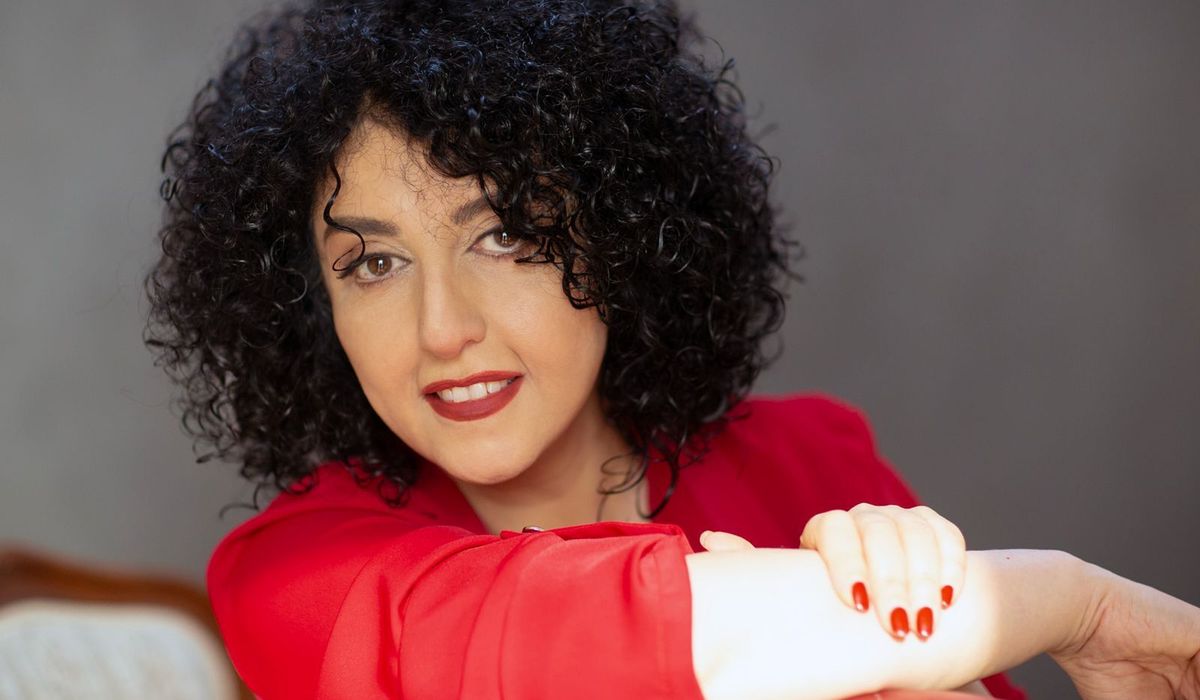
BEIRUT — Imprisoned Nobel Prize laureate Narges Mohammadi was being examined by Iranian government-appointed medical experts Wednesday for the second time since she was hospitalized last week, a move her brother said he hopes would lead to her transfer to a hospital in Tehran.
Mohammadi was rushed on Friday from prison to a local hospital in the northwest Iranian town of Zanjan after she fell unconscious. She remains in critical condition, and her family says security officials have so far prevented her transfer to the capital where she could get better treatment.
Her brother Hamidreza Mohammadi, who is based in Oslo, said the medical examiners had previously recommended her transfer, but the decision was blocked.
“The problem is that somewhere in the system, the intelligence agency has the upper hand and they are the ones who are controlling everything,” he told The Associated Press. He said he hopes the second examination will prompt her transfer, “but if it doesn’t happen, it means they are really intent on killing Narges.”
The 53-year-old rights activist and champion of women’s rights was awarded the Nobel in 2023 while in prison and has been jailed repeatedly throughout her career. Her current imprisonment began in December, when she was arrested in the northeastern city of Mashhad.
Iran’s internet blackout makes it hard for family to get updates
Mohammadi’s family says her health has been deteriorating in prison, in part because she was heavily beaten during her arrest. She suffered a heart attack in March, and has a blood clot in her lung since before her imprisonment that needs blood thinners and monitoring to manage it. The family and her lawyers say security authorities have been denying her proper care.
Since being taken to the Zanjan hospital’s cardiac care unit, Mohammadi’s blood pressure has been swinging between extremely low and extremely high, and she is receiving oxygen to breathe and can’t talk, according to her brother. Because of communication and internet restrictions imposed in Iran since the war began, he said he can’t talk with his family there and has to wait for them to get a connection to send text messages.
Doctors fear the clot could move into Mohammadi’s veins. A brain surgeon in the hospital said the fluctuating pressure could affect not only her heart but also her brain, her brother said.
“It is a really bad condition for Narges now,” he said. He said the Zanjan hospital can’t treat her underlying conditions.
Mohammadi’s children in Paris wait for news
While the world is consumed with the U.S.-Israel war with the Iran and the blockade of the Strait of Hormuz, the Iranian authorities “focus on eliminating the opposition,” Hamidreza Mohammadi said.
Chirinne Ardakani, Mohammadi’s France-based lawyer, warned on Tuesday that Iranian authorities were aiming to “slowly kill her.” The Islamic Republic’s “relentless pursuit against Narges” is meant as “a signal of terror to the entire civilian population,” Ardakani said.
The Nobel committee on Saturday called on Iranian authorities to “immediately transfer (Mohammadi) to her dedicated medical team in Tehran. Without such treatment, her life remains at risk.”
Mohammadi was taken by ambulance from the Zanjan hospital on Wednesday to the judiciary’s medical examiners, accompanied by family members.
He said trying to follow news of her condition has been nerve-wracking for him, his sister’s husband and their children, who live in Paris.
Mohammadi’s 19-year-old twins, Kiana and Ali, have not seen their mother for over 10 years.
“They are devastated. They have experienced a lot of hard times. This time they are just afraid they would not hear their mother’s voice again,” Hamidreza Mohammadi said.
Meanwhile, he waits for any news from Iran.
“My body and brain say no, but I know it might be the last chance I have.”