First, it was a second impending ice age. Then, we were going to fry the Earth to a crisp.
Now, as the saying goes, what’s old is new again, and Al Gore needs everyone to be afraid of “global cooling.”
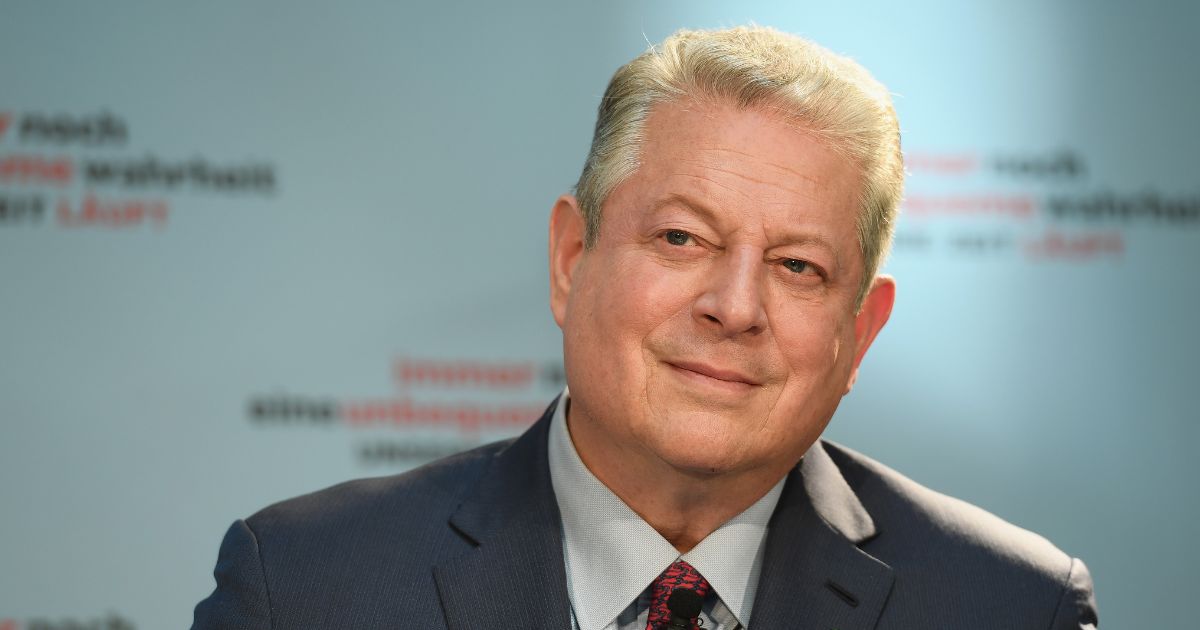
Speaking at an event co-hosted by The Hollywood Reporter and the Sustainable Entertainment Alliance, Gore was part of an on-stage interview where he reminded people about the Sword of Damocles otherwise known as global warming.
I mean, global cooling.
You can watch the entire discussion below, which The Hollywood Reporter uploaded Friday:
“And by the way, that move that I mentioned, ‘The Day After,’ about the Gulf Stream shutting down, well, this morning in one of the English newspapers is a whole big article summarizing the recent dire warnings of the scientists who found yet more confirmatory information that this is a very real threat within the next 25 years,” Gore said.
The interviewer eventually followed up with: “And if there is a tipping point here, where the gradual threat of climate change becomes immediate, where if that happens and the Gulf Stream ceases to exist as we know it, we’re in an ice age in like 10 years.”
“No, no, no,” Gore responded. “But, it would be bad. It would be very bad on a scale that is beyond anything we can compare it to today.”
So there you have it. It’s time to update the doomsday clock.
Look, I’m not going to pretend to know nearly enough about climate science to proffer an actual take on the substance of Gore’s remarks.
But what I do know, especially as a Christian, is that we should, in fact, do everything we can to best steward the Earth that God has given us. Up to that point, I actually think Gore and I are somewhat aligned.
Where we diverge is in how far we should go in the name of being good stewards, because there’s a distinct difference between being pro-planet and anti-human — and Gore and his ilk often flirt with the latter.
Again, if you’re saying that we should better steward this planet, sure, have at it. I agree.
But if you’re saying that mankind is actually some sort of a disease or cancer to this planet, as climate alarmists often do? That’s a hard disagree.
Once the conversation shifts from stewardship to sacrifice — where the implied solution is fewer people, less prosperity, or a diminished quality of life — you’re no longer talking about environmental care in any balanced sense. You’re talking about a philosophy that places humanity in opposition to the very world it inhabits.
That’s a fundamentally different view of what human life is worth. A framework that treats people as liabilities rather than bearers of value will inevitably justify tradeoffs that most ordinary people would never consciously support.
And practically speaking, that mindset tends to produce bad outcomes.
Policies rooted in alarmism and abstraction often ignore the real-world costs they impose, especially on the most vulnerable. Energy becomes more expensive, development slows, and entire communities are told to accept decline in the name of a future that always seems just out of reach.
Stewardship, properly understood, should aim to protect both the environment and the conditions that allow human beings to flourish within it. When those two goals are treated as mutually exclusive, something has gone far, far off course.
Which brings it back to that image invoked earlier: the Sword of Damocles.
The danger isn’t just whether the sword ever falls — it’s the fact that it’s always hanging there, suspended, shaping every decision, every priority, every sense of what the future holds.
Even if the most dire predictions never fully materialize, a steady diet of apocalyptic rhetoric has consequences. It breeds anxiety, distorts judgment, and pressures societies into choices made under the weight of fear rather than clarity.
Stewardship doesn’t require a sword overhead to be taken seriously. And if the case for caring for the planet can only be sustained by keeping that blade perpetually in view, it’s worth asking what, exactly, is being protected — and at what cost.
Advertise with The Western Journal and reach millions of highly engaged readers, while supporting our work. Advertise Today.