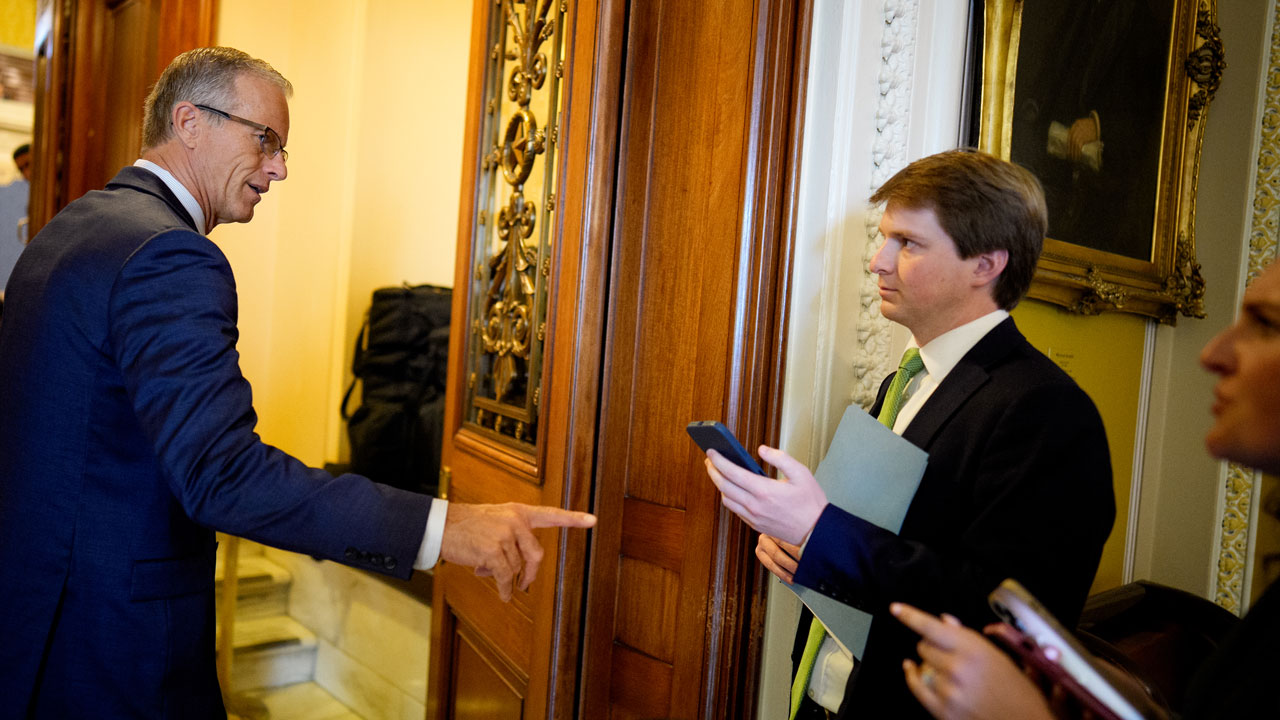
Senate Majority Leader John Thune, R-S.D., is blocking a push by Sen. Lisa Murkowski, R-Alaska, to force a Republican vote on authorizing the use of military force against Iran beyond the 60‑day window set by the 1973 War Powers Act.
Thune has so far declined to schedule a vote on Murkowski’s proposed authorization for use of military force even as the conflict polls poorly among voters and concerns mount within the GOP conference about congressional oversight.
A recent poll by the League of American Voters found support for the war at just 50% among voters in a key swing state, underscoring the political sensitivities surrounding formal congressional approval.
“We’re listening carefully to what the members of our conference are saying,” Thune told reporters before senators departed Washington for a weeklong recess.
Asked whether he would allow a vote on Murkowski’s measure, Thune said, “At this point, I don’t see that.”
He added, however, that “getting readouts from our military leadership on a somewhat regular basis will be helpful in terms of shaping the views of our members about how comfortable they are with everything that’s happening there and the direction headed forward.”
A senior Republican aide confirmed Monday that Thune has not scheduled a vote on Murkowski’s authorization.
According to The Hill, sources familiar with the matter said Murkowski is unlikely to get a vote because her resolution is not privileged. To qualify for privileged consideration under the War Powers Act, she would have needed to introduce the resolution within 30 days of the conflict’s onset, guaranteeing floor consideration and passage with a simple majority.
Without privileged status, Murkowski would also need Thune’s consent to place the measure on the already crowded Senate calendar.
Despite Thune’s resistance, Murkowski has continued pressing colleagues to reassert Congress’ role in authorizing the conflict.
Speaking on the Senate floor last week, she said a formal authorization would “establish a framework” requiring President Donald Trump to come to Congress with “clearly defined political and military objectives.”
“It would require metrics for success, notice of any changes in objectives, and exit criteria. It would ultimately ensure that Congress is engaged,” Murkowski said.
If Murkowski ultimately succeeded in passing such a resolution, it would bring the naval blockade of Iranian ports and any future military strikes into compliance with the War Powers Act.
Behind the scenes, Murkowski has been seeking support from Sens. Thom Tillis, R-N.C.; John Curtis, R-Utah; Todd Young, R-Ind.; and Josh Hawley, R-Mo., all of whom have warned that Congress must authorize the conflict if it extends beyond 60 days.
Tillis told reporters last week that the Trump administration has not yet provided sufficient detail to justify authorization beyond that deadline.
“I think that we need details. We need to know what the strategic objectives are. What does success look like? What is the build‑out for the budget request?” Tillis said, noting a “significant increase” in funding tied to the conflict.
Curtis has said he will not support additional funding absent formal authorization from Congress.
“I have been clear: I will not support continued funding for the use of force without Congress weighing in,” Curtis said in a statement shared with The Hill.
Young, speaking last month at the Semafor World Economy conference, said it was “time to wrap” up the war with Iran “as quickly as we can.” He later said the administration should work with Congress on an authorization if a ceasefire collapses and military strikes resume.
Still, Murkowski faces an uphill battle within her own party.
Sen. Rand Paul, R-Ky., and Sen. Susan Collins, R-Maine, have broken with Republican leadership to support war powers resolutions aimed at ending U.S. military involvement in Iran. Paul recently voted for Democrat‑sponsored measures seeking to limit Trump’s authority; all Democrats except Sen. John Fetterman, D-Pa., supported them.
Collins, who had voted five times against similar efforts in the past, reversed course after concluding that the president’s authority under the War Powers Act expired May 1.
“The 60‑day trigger is a very important one. At that point, Congress has to authorize the military action to continue,” Collins said two weeks ago. “I will not support extending the hostilities beyond that 60 days except for wind‑down activities.”
If three additional Republicans join Collins and Paul, a war powers resolution to end the conflict would pass the Senate, delivering a bipartisan rebuke to the administration.
Any such measure would still need to pass the House and be signed by the president to carry the force of law.