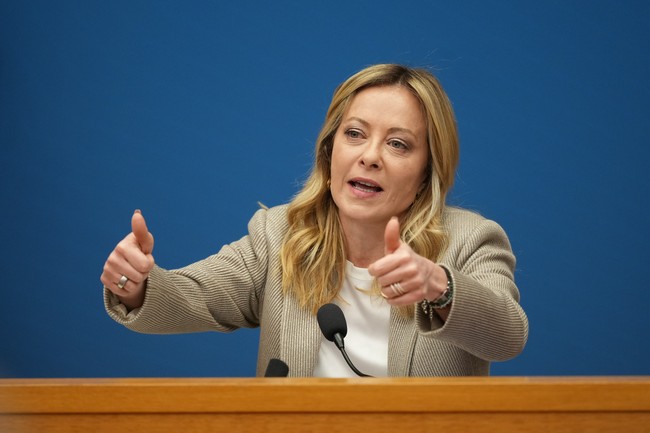
Italian Prime Minister Giorgia Meloni didn’t throw a public fit over President Donald Trump’s possible withdrawal of U.S. troops from Italy. She didn’t pound the table, pretend Rome controls Washington, or act like American soldiers belong to Europe by birthright.
Meloni, speaking to reporters, indicated that she was concerned about a U.S. withdrawal, would oppose such a decision, and highlighted that Italy had honored its obligations, apparently referencing American frustrations with NATO allies.
“It is clearly a decision that does not depend on me and one that I personally would not support,” she said.
“But there is one thing I would like to make clear, Italy has always honored its commitments.”
She gave a businesslike answer, saying the choice doesn’t depend on her, and she personally wouldn’t agree with it. For a European leader, that almost sounded refreshing.
Meloni, who serves as president of Italy’s Council of Ministers, also argues that Italy has honored its NATO obligations, a point that deserves fair treatment. She didn’t sound like another European scold demanding U.S. protection while treating American concerns like an accounting nuisance.
Italy hosts important U.S. forces and bases, and Rome clearly understands what American military presence means for security, deterrence, and influence across the Mediterranean.
President Trump’s side of the argument still carries serious weight; the United States has carried too much of Europe’s defense burden for far too long, and Trump has made clear that American power isn’t a free public utility.
NATO Secretary General Mark Rutte said European countries have “gotten the message” from Trump, which may be the politest way possible to say Washington finally got tired of writing checks while allies offered speeches.
“Yes, there has been some disappointment from the U.S. side, but Europeans have listened,” Rutte told reporters at a European Political Community summit in Armenia.
“They are now making sure that all the bilateral basing agreements are being implemented,” he said.
NATO member Spain has said that military bases on its territory cannot be used for the war with Iran. But Rutte said other NATO countries such as Montenegro, Croatia, Romania, Portugal, Greece, Italy, Britain, France and Germany were implementing requests for the use of bases and other logistical support.
Rutte also said “more and more” European nations were pre-positioning assets such as minehunters and minesweepers close to the Gulf to be ready for a “next phase”.
Trump’s reported troop cuts in Germany have already rattled Europe, and he has suggested more withdrawals could follow, including from Italy and Spain. The reaction tells its own story; European capitals can debate burden-sharing careful language for years, but the moment American troops might leave, the room becomes serious.
Funny how quickly theory becomes concerns when the shield starts moving toward the exit.
Meloni’s answer was careful because she knows two things can be true at once: Italy benefits from U.S. forces, and America has every right to ask whether those deployments still serve American interests under current terms. She didn’t frame the issue as betrayal; instead, she framed it as a disagreement.
In the diplomatic world of today, where leaders often confuse drama with principle, her restraint stood out.
U.S. Secretary of State Marco Rubio is scheduled to travel to Rome from May 6 to May 8, 2026, for meetings that include Italian officials. His visit comes when the troop question hangs over the conversation, even if everyone smiles for the cameras.
Rubio’s job shouldn’t be to reassure Europe that nothing has changed; his job should be to make clear that plenty has changed, and Europe helped make the change necessary.
Meloni handled the question better than many European leaders would have. She defended Italy’s interest without sounding entitled to American sacrifice. Still, Trump’s pressure has exposed NATO’s old problem again: American strength keeps Europe safer, but American patience isn’t endless. Allies who want U.S. protection need to treat U.S. concerns as more than background noise.
Trump’s message to Europe isn’t isolationism; it’s leverage. Meloni understands the value of American troops in Italy, while Trump understands the value of forcing allies to count the cost.
Both leaders are looking at the same map; only one of them has to answer first to the American people.
The old foreign policy crowd loved arrangements where America paid, Europe lectured, and nobody asked too many hard questions. President Trump has changed that conversation, and PJ Media VIP is where we can say it plainly. Use promo code FIGHT to get 60% off and support sharp, honest coverage that doesn’t faint every time Trump asks allies to carry their share.