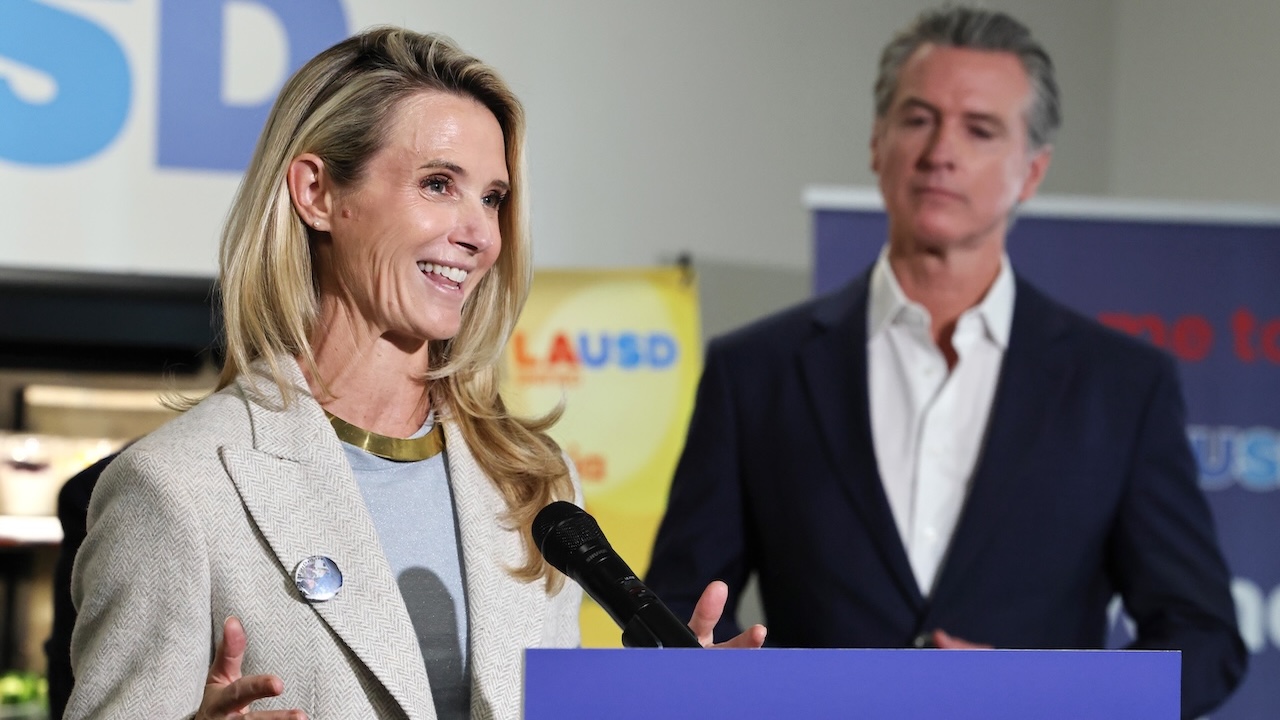
California Gov. Gavin Newsom is positioning himself with characteristic flair for a national run in 2028, but at least one major obstacle stands in his way: his radical wife.
Movie-star good looks, smooth delivery, and nearly a decade as California’s governor have made Newsom the early Democrat front-runner. He has spent the Trump years delivering fierce attacks on the administration while dropping hints about the White House.
Yet, presidential success requires more than style. Candidates need a spouse who humanizes them, softens edges, builds bridges to skeptical voters, and projects steadiness in crisis. America’s most effective first ladies have quietly performed that work.
Abigail Adams gave candid counsel. Eleanor Roosevelt served as FDR’s eyes and ears. Jackie Kennedy brought grace after tragedy. Dolley Madison showed resolve in 1814: As British troops advanced on Washington, she refused to flee until George Washington’s portrait was cut from its frame and saved. These women often compensated for their husbands’ shortcomings with warmth, courage, and relatability.
Newsom needs that asset. His California record is elite failure writ large: homelessness exploding, businesses and families fleeing in record numbers, punishing taxes, rolling blackouts, and cities turned into open-air drug markets and tent encampments. These failures repel voters beyond coastal enclaves. His own gilded lifestyle only heightens the detachment. A wife who could connect authentically and show quiet strength would help mask those liabilities.
Instead, he has Jennifer Siebel Newsom.
Siebel Newsom consistently comes across as sharper, more condescending, and more ideologically extreme than her husband. Where successful first ladies softened edges, she sharpens them. She cannot be kept in the background.
The latest example came right after the third assassination attempt on President Donald Trump. On April 25, 2026, a gunman breached security at the White House Correspondents’ Dinner in a clear bid to kill the president.
A day later, Trump sat for a tense “60 Minutes” interview with Norah O’Donnell. When she read from the alleged shooter’s manifesto calling Trump a “pedophile, rapist, and traitor,” he pushed back forcefully. In any normal climate, an attempt on the elected leader’s life would prompt basic decency or shared rejection of violence.
Siebel Newsom responded differently. Within hours, she posted on X that her family watched, “shocked.” She ignored the assassination attempt and instead attacked Trump’s “level of contempt” toward the female journalist, his “pattern of misogyny,” and its effects on boys and men. An attempt on the president’s life became another lecture on patriarchy. The timing exposed a profound disconnect: when the nation faces real peril, California’s first partner chose moral scolding aimed at the victim.
This fits her pattern. A resurfaced clip shows her describing a family trip through Southern red states as a mission to expose her children to racism, misogyny, and sexism so they could “be the change.” Ordinary Americans became exhibits for her Bay Area kids. The condescension stunned observers like Scott Jennings—especially from a state drowning in its own dysfunction.
She has labeled Jordan Peterson “alt-right extreme” hate speech and demanded tech censorship. In 2022, she dismissed evangelicals and conservatives as trapped in a “silo”, dragging America backward. Tens of millions of religious Americans were written off as obstacles. That is not empathy—it is contempt.
Her activism—gender as a spectrum, dolls for boys, pronoun stories, anti-patriarchy lectures—comes with serene certainty while California families endure the highest cost of living, unreliable power, and streets full of tents and needles.
Her nonprofit, The Representation Project, has paid her roughly $150,000 annually plus millions more to her company, while taking donations from interests with state business. The optics scream elite double standards.
Effective first ladies rarely insulted broad swaths of the country. They offered steadiness in crisis. Siebel Newsom amplifies coastal elitism, never more glaringly than by pivoting from an assassination attempt to score points against its target.
Newsom’s children have reportedly urged him to delay presidential ambitions for family time. They may sense how toxic their mother’s clips will be nationally.
Newsom faces a clear liability: a wife whose persona feels more radical than his record and whose instincts in crisis reveal a deep disconnect from ordinary Americans. He cannot sideline her without losing his activist base. Those viral moments—the red-state tour, Peterson attack, evangelical dismissal, and post-assassination lecture—will loop endlessly in primary states. Voters spot condescension. Jennifer Siebel Newsom radiates it.
Gavin Newsom is a smooth operator. Yet no polish can overcome the constant reminder from his closest partner that much of America—and the survival of its president—is viewed with disdain by the coastal elite.
In the end, his national story may be less about a flawed record than failing to overcome his wife.