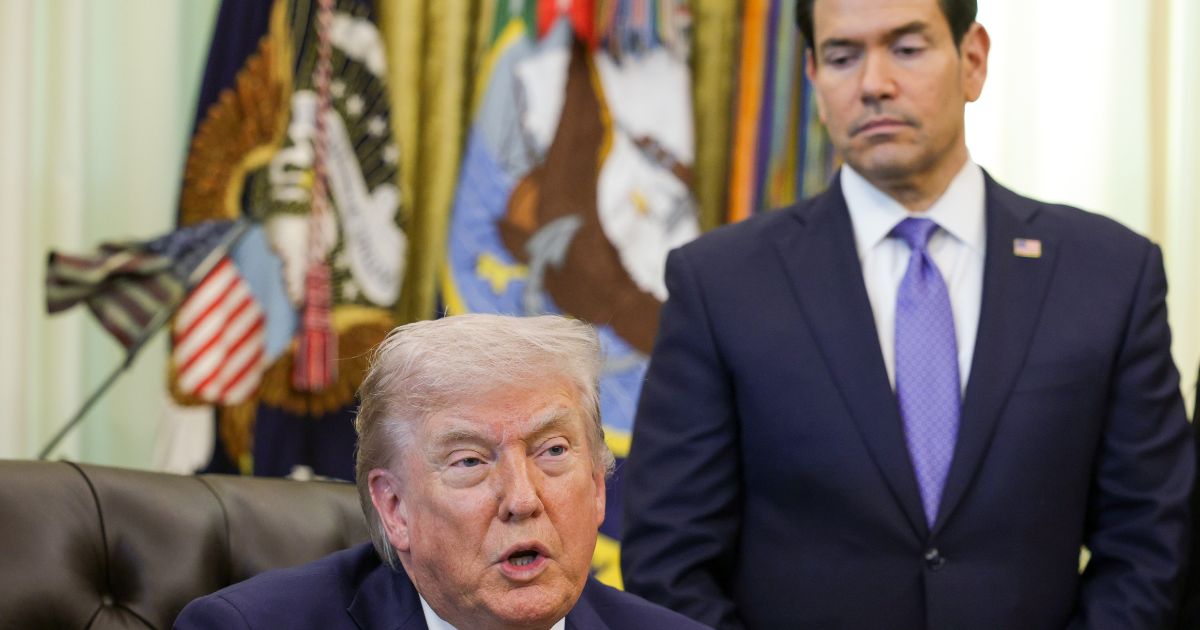
President Donald Trump dislikes Iran’s proposal to kick talks about Iran’s nuclear program down the road in order to strike a bargain that will reopen the Strait of Hormuz, according to a new report.
Trump said he is not satisfied with the proposal, which also requires the U.S. to end its blockade of Iranian ports, according to The New York Times. The report was based on sources with information from a Monday White House Situation Room meeting.
Iran has refused to budge on American proposals to stop its nuclear program and surrender its existing stores of enriched uranium.
“The United States will not negotiate through the press — we have been clear about our red lines and the president will only make a deal that’s good for the American people and the world,” Olivia Wales, a White House representative, said in a statement.
The report said the administration is split over what comes next.
Proponents of continuing the blockade say Iran will be forced to talk if the measure continues for two more months, meaning Iran’s energy sector would be heavily weakened.
Opponents say that with the Islamic Revolutionary Guards Corps essentially running the country, its hardliners will not bend unless military action resumes.
Some within the administration say Iran will never bend on its nuclear program, meaning a deal to reopen the strait might be the best the U.S. can get.
Secretary of State Marco Rubio said in a new interview that negotiating with Iran is a diplomatic can of worms.
Asked about the difficulties, he said, “Well, other than the fact that the country’s run by radical Shia clerics — that’s a pretty big impediment. The other is that they’re deeply fractured internally, and that — I think that’s always been the case but I think it’s far more pronounced now.”
Rubio said there is a “tension — and you always have in that system — between the Iranians who understand let’s be hardliners but let’s also balance that with the need to run a country and the hardliners who don’t care and have this apocalyptic vision of the future.”
“So as much as anything else, one of the impediments here is that our negotiators aren’t just negotiating with Iranians. Those Iranians then have to negotiate with other Iranians in order to figure out what they can agree to, what they can offer, what they’re willing to do, even who they’re willing to meet with,” he added.
Rubio said that what Iran intends by reopening the Strait of Hormuz is not necessarily simple.
“If what they mean by opening the straits is, ‘Yes, the straits are open as long as you coordinate with Iran, get our permission or we’ll blow you up, and you pay us,’ that’s not opening the straits. Those are international waterways. They cannot normalize nor can we tolerate them trying to normalize a system in which the Iranians decide who gets to use an international waterway and how much you have to pay them to use it,” he said, adding, “So that’s an example of how detail matters here.”
“One thing is to say you’re open to opening the straits, but do you mean opening the straits and going back to the way it should be, the way it’s always been, or are you talking about opening the straits to a system you’re trying to create which would be completely unacceptable — not just to us, but to the whole world?”
Rubio noted that “the nuclear question is the reason why we’re in this in the first place.”
“If Iran was just a radical country run by radical people but — it would still be a problem, but they are revolutionary. In essence, they seek to expand and export their revolution, not just what they do in Iran — that’s why they’re with Hizballah in Lebanon and that’s why they supported Hamas, that’s why they supported the militias in Iraq. They don’t just seek to dominate Iran, they seek to dominate the region. And imagine that with a nuclear weapon,” Rubio remarked.
“There’s no doubt in my mind that at some point in the future if this radical clerical regimes remain in charge in Iran, they will decide they want a nuclear weapon. And what they were trying to do, before the President took action, is to hide behind this conventional shield of drones and missiles and a large navy, hide behind that, an impenetrable conventional shield, so they can do whatever they wanted with their nuclear program. That fundamental issue still has to be confronted. That still remains the core issue here.”
Rubio said Iranian negotiators are “serious about figuring out how can they buy themselves more time.”
“We can’t let them get away with it. They’re very good negotiators. They’re very experienced negotiators, and we have to ensure that any deal that is made, any agreement that is made, is one that definitively prevents them from sprinting towards a nuclear weapon at any point.”
Advertise with The Western Journal and reach millions of highly engaged readers, while supporting our work. Advertise Today.