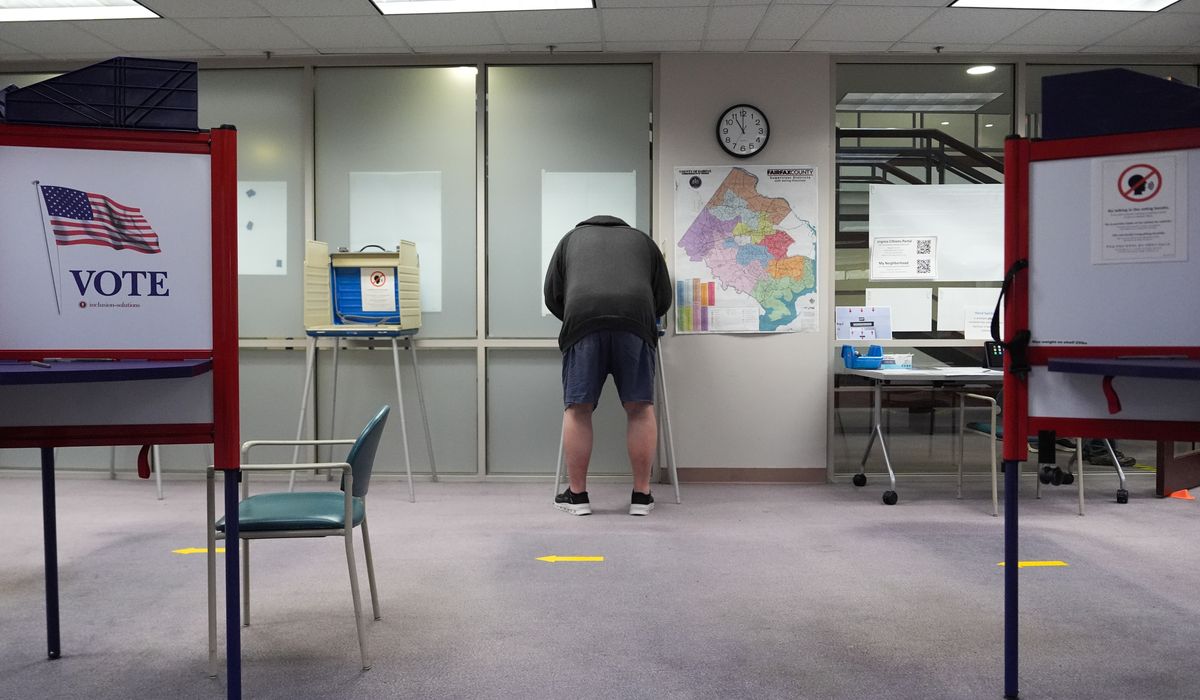
Virginia’s redistricting brawl, which will end in Tuesday’s special election, remains a cliffhanger despite Democrats outspending Republicans by tens of millions of dollars in support of the referendum.
Polling, and a tally of early and mail-in voting, show a closely divided electorate when it comes to support for redrawing the state’s congressional lines in favor of Democrats.
Republican district turnout had produced 565,062 votes as of Thursday, compared to 534,586 ballots cast in Democrat-leaning districts.
Both parties have poured tens of millions of dollars into advertising ahead of the special election, but Democrats have far outspent the GOP as they seek voter approval to carve out additional U.S. House seats that could help their party reclaim the House majority in the November midterm elections.
According to the analytics firm AdImpact, proponents in favor of redistricting, mostly funded by dark money groups that aren’t required to disclose donors, spent $50.5 million on advertising in favor of redistricting.
By comparison, advertising against redistricting, some of it also funded by dark money groups, amounted to $19.6 million.
AdImpact officials said the $70.1 million in ad spending so far makes it the third-most expensive non-presidential contest in Virginia’s history.
The stakes couldn’t be higher for both parties.
If voters approve the new congressional map, it will wipe out four of the five Virginia congressional districts now held by Republicans and could help erase the GOP’s two-seat majority in the House in November.
Virginia’s six Democrat-held districts and five Republican-held districts would be erased and replaced with 10 congressional districts that lean Democrat and just one district likely to elect a Republican.
It can be enacted only if voters approve a constitutional amendment in the special election.
The state’s midyear redistricting battle is an abrupt about-face from the recent creation of the bipartisan Virginia Redistricting Commission. In an overwhelming bipartisan vote in 2019, the General Assembly moved to amend the state Constitution to give the map-making job to a commission. Virginia voters approved the change in November 2020.
Previously, the legislature drew the new district maps and approved them through the normal legislative process.
The ballot question seeks to allow the General Assembly to temporarily redraw new congressional districts “to restore fairness in the upcoming elections.” The amendment would return Virginia to the standard redistricting process every decade after the 2030 census.
The redistricting supporters are hoping anti-Trump angst will drive voters to the polls in Democrat-heavy districts. The main Democratic group backing redistricting, Virginians for Fair Elections, raised about $64 million through April 10, compared to $20 million raised by the GOP group, Virginia for Fair Maps. Most of the money came from outside the state.
The bulk of the pro-redistricting money, totaling more than $38 million, came from House Majority Forward, the issue advocacy arm of the House Democrats’ super PAC.
The money from Virginia for Fair Maps came mostly from individual donors, with a few big spenders, among them the Republican advocacy group American Potential, which donated $250,000.
Top Democrats and Republicans, among them Speaker Mike Johnson, Louisiana Republican and House Minority Leader Hakeem Jeffries, New York Democrat, have been barnstorming Virginia to rally their respective voters.
The Democratic National Committee put out an ad days ahead of the special election featuring former President Barack Obama, who urged Democratic voters to get to the polls.
“By voting yes, you can push back against Republicans giving themselves an unfair advantage in the midterms,” Mr. Obama said.
Despite a major advantage in spending, Democrats hold only a very narrow edge in the contest, according to a Quantum Insights poll released Thursday. It found redistricting was backed by 51.2% of supporters and opposed by 46.9%. When voters were told “more explicitly” that the amendment would create 10 Democratic-leaning districts and 1 GOP district, support dropped to 49.6% and opposition rose to 47.3%.
Virginia is part of a multi-state redistricting brawl triggered last year when Texas Republicans, at the urging of President Trump, voted to redraw their state’s legislative map to give the GOP five new House seats.
Republicans have netted a 3-seat advantage in redistricting so far that has taken place in California, Missouri, North Carolina, Ohio, Texas and Utah, according to Ballotpedia, which is tallying the redistricting fight. Redistricting efforts in Georgia, New York and Louisiana remain subject to litigation and court decisions.
The fight to gain the upper hand in redistricting won’t end on Tuesday.
Florida’s Republican Gov. Ron DeSantis has called the state legislature for a special session beginning April 28. Mr. DeSantis will ask the GOP-led Florida House and Senate to consider a handful of measures, among them a proposed map that redraws the congressional district lines in the state to give the GOP additional House seats.