Three guesses, and the first two don’t count.
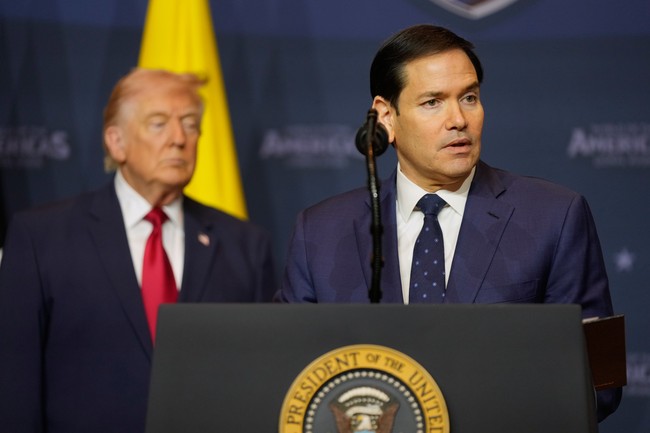
The Wall Street Journal raises the question of the Rabid Dog That Was Not Allowed to Bark In DC in its analysis of the ceasefire brokered by Marco Rubio between Israel and Lebanon. Reporters Omar Abdel-Baqui and Dov Lieber concede that the pact engineered by the Secretary of State comes as a “historic step” between the two countries, especially since Lebanon has never recognized Israel’s status as a state. However, they wonder just how these negotiations can take place in the absence of “one of the main belligerents”:
The possibility of direct talks between the leaders of Israel and Lebanon as announced by President Trump on Thursday would mark a historic step for two neighboring states that have been technically at war for 78 years.
But the talks would leave one of the main belligerents on the sidelines: Hezbollah, the U.S.-designated terrorist group that has been at war with Israel off and on since the 1980s. …
The temporary cease-fire creates space for the U.S. to continue peace talks with Iran, the main backer of Hezbollah. Tehran has insisted that a cease-fire in Lebanon is a precondition for holding more discussions with America over its nuclear program, weapons systems and its power over the Strait of Hormuz. The U.S. said the Lebanon cease-fire is unrelated to Iran talks.
Without Hezbollah at the negotiating table, the cease-fire and the possibility of a successful Israel-Lebanon peace agreement would be on shaky ground.
As it happens, though, this question essentially answers itself. Or, more accurately, Abdel-Raqui and Lieber answer their own question by recounting all of the ways in which Hezbollah has obstructed Lebanon from complying with any peace agreement or ceasefire reached with Israel:
In 1983, the countries signed a peace agreement, which fell apart after Hezbollah and other factions opposed it. Another U.S.-backed peace effort in 1993 broke down, owing to opposition from Syria, which then dominated Lebanon, and the impossibility of security guarantees with Hezbollah. A November 2024 deal was supposed to lead to the Lebanese government’s demilitarizing Hezbollah, and Israel’s withdrawal from southern Lebanon and halting strikes on Lebanon. None of those objectives were achieved.
Gee, what might be the common element to all of these failures? Could it be the terror network that serves another country and which tasks itself with the destruction of Israel? Hmmmm.
This framing misses the point anyway. The reason Lebanon wants to deal with Israel is to finally push Hezbollah and the Iranian occupation out of their country, and they’re not strong enough to do it on their own. Iran’s terror regime has finally been weakened to the point where ending their occupation is a possibility, but only with an outside force. Iran and Hezbollah have lost their ground lines of communication through Syria; Israel has spent the last three years demolishing Hezbollah leadership and financing; the US has finally acted in force to bring the IRGC to its knees, militarily and financially.
This is not the time to negotiate with foreign terrorists occupying your sovereign territory to launch wars on behalf of their patrons in Tehran. This is the time to negotiate with the two strongest forces in the region – the US and Israel – to demolish the foreign terrorists and ensure they never come back. How difficult is that to see?
Plus, there is another factor in play now that didn’t exist before: Donald Trump. Israel got forced into a bad ceasefire agreement by the Biden Regency in 2024 that relied on nothing more than Beirut’s oft-repeated promises to disarm Hezbollah itself. The Bidenistas blamed Israel for fighting the war that Hamas, Hezbollah, and Iran launched in the October 7 massacres and wanted to return to the status quo ante, where Iran’s proxy armies created pressure that Democrat administrations could exploit for their “two-state solution” fantasies, especially regarding Gaza.
Trump’s foreign policy, and his willingness to use massive military force against threats to Americans and their allies, changed the calculus for both Joseph Aoun and Benjamin Netanyahu. The Israelis may not be thrilled with another ceasefire that stops them short of outright destruction of Hezbollah, but they know that this is a much different ceasefire, too. Trump intends to use American force as a backstop to fulfilling 43 years of lip service about the Iranian occupation of Lebanon:
A senior Israeli official told The Jerusalem Post that, unlike in the past, the United States now intends to actively lead efforts to disarm Hezbollah and is prepared to use American resources to achieve this goal. “Trump wants this to happen, so this time the US will be far more involved,” the official said.
The official added that the current ceasefire terms are significantly better than those in November 2024, describing the situation as “much improved,” mainly because Hezbollah has suffered a substantial blow this time, including significant casualties, and because Israeli forces are present on the ground.
“Forces are deployed from Naqoura to Syria and will not withdraw. In addition, Iran is in a much weaker position in terms of its ability to support the organization’s recovery.”
This time, with Iran’s regime nearing a catastrophic collapse and all of Hezbollah’s lines of communication to the regime demolished, the combined forces of Israel, Lebanon, and the US may succeed in finally pushing Hezbollah out. Lebanese President Joseph Aoun pledged today to send the regular army to southern Lebanon in coordination with the IDF to firmly establish Lebanon’s sovereignty all the way to the border:
Meeting a group of Lebanese lawmakers, Lebanon’s President Joseph Aoun endorses continued direct negotiations with Israel and says that his country is working to secure the withdrawal of Israeli forces, to bring back Lebanese citizens held by Israel and to solve border disputes.
Aoun says “direct negotiations are crucial… and the gateway to advancing the negotiations” with Israel.
The Lebanese Armed Forces “will play a fundamental role after the withdrawal of Israeli forces,” Aoun says, promising they will deploy to the Israeli border and will reassure residents of southern Lebanon, “after their return to their villages and towns, that there will be no armed forces other than the army and the legitimate security forces.”
That’s why Hezbollah was not invited to participate in the talks. It’s also why Israel is not constrained by the ceasefire if Hezbollah violates it. Hezbollah did not get a seat at the table because Iran doesn’t get to dictate terms in Lebanon any longer. The IRGC regime may not get to dictate terms in Iran for much longer, for that matter. So why invite its terror proxies to discuss their own destruction?
Editor’s Note: For decades, former presidents have been all talk and no action. Now, Donald Trump is eliminating the threat from Iran once and for all.
Help us report the truth about the Trump administration’s decisive actions to keep Americans safe and bring peace to the world. Join HotAir VIP and use promo code FIGHT to get 60% off your VIP membership.