Jerusalem is a city where archaeology and tradition often clash, where the sacred meets science. Surprisingly, sacred traditions regarding the sites of key moments in the life of Jesus Christ, some being venerated for centuries, turn out to be entirely plausible in an archaeological sense, while others, not so much.
The famed Via Dolorosa (The Way of Suffering), Christ’s last torturous walk carrying the cross, and where many Christians believe the passion of Jesus played out in a series of “stations” of the cross, is almost certainly on the other side of old Jerusalem. The route was finalized in the 18th century. Most archaeologists believe Jesus was sentenced at Herod’s Palace (near the Jaffa Gate) rather than the Antonia Fortress (where the route begins).
Some of the stations have no biblical basis and are based on later traditions or non-approved texts. Station 6, where Veronica is said to have wiped the face of Christ, leaving a clear imprint of his face on her veil, is one example.
That’s the Holy Land. Part sacred lore, part razzmatazz, as Christian tourists began flocking to Jerusalem and other sites like Bethlehem, the Sea of Galilee, and Canaan. Early Christians (third to fifth centuries) were often misled by Arab traders looking to make some quick coin, and referred to fictitious sites, being told, “Here’s where he died,” and “here’s where he performed his miracles.”
Emperor Constantine sent his aging wife, Helena (she was in her 70s), to the Holy Land to identify and preserve the sites associated with the life of Jesus. At the time, Jerusalem had been rebuilt as the Roman colony Aelia Capitolina, and many Christian sites were either forgotten or covered by Roman temples.
Helena is credited with identifying three primary locations, over which Constantine ordered the construction of massive basilicas: The Church of the Nativity in Bethlehem; the Eleona Church (Mount of Olives), built over a cave where Jesus was said to have taught his disciples; and the Church of the Holy Sepulchre, where Christ’s tomb was said to be.
Helena tore down a temple to the goddess Venus, and construction was begun on the magnificent Church of the Holy Sepulchre. Emperor Hadrian had constructed the Temple of Venus on a site he believed would make Christians forget their religion. He couldn’t have been more wrong.
Ironically, Hadrian ended up preserving the underlying first-century tombs when he built his pagan edifice. The third-century basilica was built over the same stone platform that Hadrian used to build his temple.
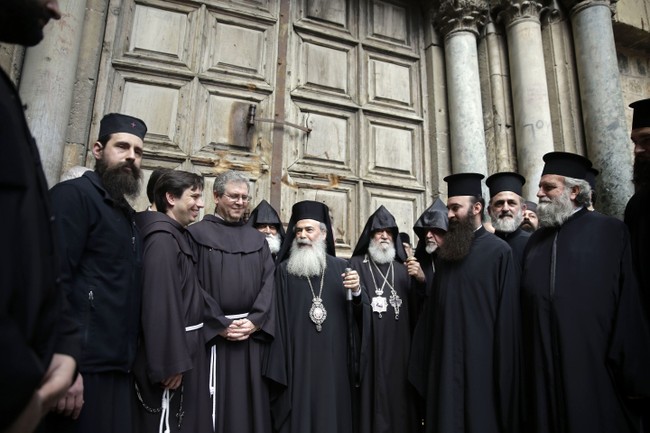
The floor of the church was hiding an incredible secret. There were decades of in-fighting between the three religious communities charged with managing the church: the Orthodox Patriarchate, the Custody of the Holy Land, and the Armenian Patriarchate. “When these groups finally came to a consensus in 2019 that the Church of the Holy Sepulchre required renovations to replace the site’s 19th-century floor, a team of Italian architects with La Sapienza University saw their opportunity,” writes Popular Mechanics.
“With the renovation works, the religious communities decided to also allow archaeological excavations under the floor,” Francesca Romana Stasolla from the Sapienza University of Rome noted to The Times of Israel.
Those excavations have uncovered a garden as described in the Gospel of John. “At the place where Jesus was crucified, there was a garden, and in the garden a new tomb, in which no one had ever been laid.” (John 19:41)
During the time of Jesus, this quarry was a burial site “with several tombs hewn in the rock.” It wasn’t the only such site in Jerusalem, but when Constantine—the first emperor of Rome to convert to Christianity—was in power, this quarry was the one exalted by early Christians as the site of the burial, so the emperor ordered the construction of the first iteration of the Church of the Holy Sepulchre there (the church would suffer numerous attacks over the centuries, before its current form was constructed by Crusaders in the 12th century).
What Stasolla’s team found was that, in the time between when the quarry was originally mined during the Iron Age and the construction of the church atop it, the area to which the burial site is attributed had (at one time) been used for agriculture, based on the discovery of 2,000 year-old olive trees and grapevines.
“Low stone walls were erected, and the space between them was filled with dirt,” noted Stasolla.
The impact of Jesus Christ on the city of Jerusalem and on ancient Rome must have been extraordinary. Given that the city of Jerusalem has changed hands several times over the last 2,000 years, it’s amazing that any relics or sites venerated today have historical legitimacy in the eyes of Christians and archeologists.
“The real treasure we are revealing is the history of the people who made this site what it is by expressing their faith here,” Stasolla told the Times. “Whether someone believes or not in the historicity of the Holy Sepulchre, the fact that generations of people did is objective. The history of this place is the history of Jerusalem, and at least from a certain moment, it is the history of the worship of Jesus Christ.”
Where history meets the divine, we find a certain clarity in faith and a strengthening of belief.
Recommended: When ‘Racism,’ Real Or Imagined, is a More Egregious Crime Than Murder
PJ Media will give you all the information you need to understand the decisions that will be made this year. Insightful commentary and straight-on, no-BS news reporting have been our hallmarks since 2005.
Get 60% off your new VIP membership by using the code FIGHT. You won’t regret it.