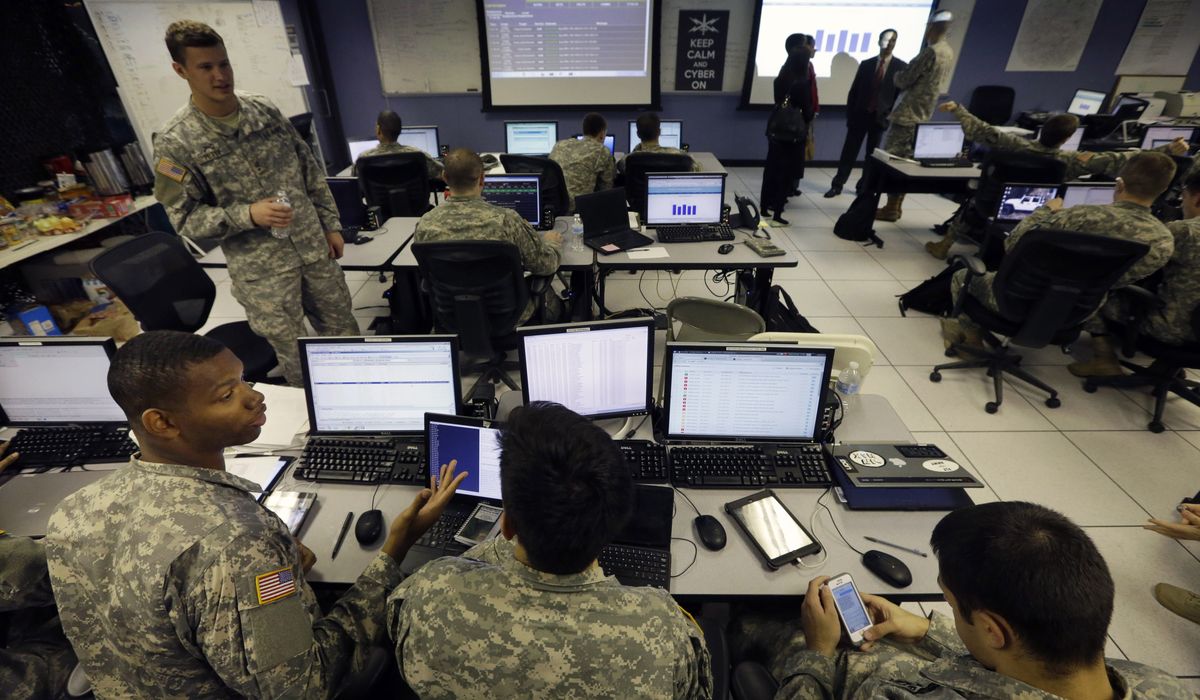
The U.S. military has used artificial intelligence in active combat operations against Iran, and the race is now on to build the infrastructure needed to protect AI while forward deployed in conflict.
The physical data centers relied upon by AI systems are becoming a new, high-value target in modern warfare. Potential attacks are dynamic and can involve precision missile strikes or cyberwarfare designed to cripple a center’s information flows.
Analysts say both the U.S. and Iran have attacked data centers as targets in the Persian Gulf region during recent exchanges. In the initial stages of the conflict, forces struck a data center responsible for banking transactions that sources say were the primary means of paying Iran’s Islamic Revolutionary Guard Corps (IRGC).
For its own part, the IRGC has reportedly threatened to retaliate by hitting the Stargate AI data center in the United Arab Emirates if American forces bombed Iran’s electricity grid.
The bottom line is that centralized data processing facilities are now a higher priority on the target list of any conflict, and the U.S. defense technology industry is responding.
Dan Wright, CEO of the San Francisco-based AI hardware company Armada, says his goal is to make it harder for U.S. adversaries to target the AI capabilities of American forces.
Armada has developed a deployable, fully functional data center called the “Galleon.” Company marketing materials say the “Galleon redefines edge computing by combining portability with unparalleled performance.”
“In defense, we used to talk about stockpiling weapons, stockpiling tanks, stockpiling missiles,” Mr. Wright told The Washington Times in an interview. “We need to stockpile AI in a box, is how to think about this, in strategic locations around the world.”
U.S. Navy Adm. Brad Cooper, commander of U.S. Central Command and the man responsible for overseeing operations in the campaign against Iran, said in a video statement in March that his command has fully integrated drone and AI warfare into their operations.
The technology is generating a massive new ocean of information, often tied to the array of cheaper and easier-to-use drone platforms proliferating on the battlefield.
“These systems help us sift through vast amounts of data in seconds so our leaders can cut through the noise and make smarter decisions,” Adm. Cooper said. “Humans will always make final decisions on what to shoot and what not to shoot and when to shoot. But advanced AI tools can turn processes that used to take hours and sometimes even days into seconds.”
The issue and need for forward-deployed computing power is one of speed and remote connection.
Armada has already fielded a Galleon deployable data center with the U.S. Navy, acting as an intelligence server onboard a warship.
“Technologies like modular data centers and edge computing enhance our ability to operate securely and effectively in remote, at-sea environments,” Rear Adm. Carlos Sardiello, the commander of the U.S. Navy Fourth Fleet and U.S. Naval Forces Southern Command, said after an exercise in which a Galleon was tested last year.
The ability to have AI-level computer power as close as possible to the frontline or whatever real-world problem is at hand — what’s referred to in industry speak as “the edge” — cuts down on the time for communication of what is often massive amounts of data.
That can make the difference between life and death in military applications.
Tyler Sweatt, CEO of the Virginia-based software company Second Front Systems, compares the situation to his own real-life experience as a U.S. Army veteran of the Afghanistan war.
“In 2006, at a small austere outpost in Eastern Afghanistan, we got delivered these sensors, sort of fake rocks to go bring out. The promise was these will alert you if somebody’s coming,” Mr. Sweatt said in a recent interview with The Times.
“About two days later, we get in a little bit of a gunfight,” he said, explaining that it wasn’t until about “a day and a half after that” that he got a “call from the person on the other end of the sensor telling me, ’People are coming to this very gunfight!’”
The problem, according to Mr. Sweatt, wasn’t that the equipment didn’t work. It was the time it took for information to be relayed back to the U.S., processed and then sent back to alert soldiers on the ground that a threat had been identified.
On the modern battlefield, the amount of information has drastically increased over the past 20 years, putting unprecedented strain on Low Earth Orbit satellite communication networks designed to manage the flow of such information.
Mr. Wright, the CEO of Armada, says that “by 2028, two-thirds of all data is going to be generated and processed outside of traditional data centers at the edge.”
“You’re seeing more done with drones, more done with sensors, the rise of the internet of things is just exploding,” he told The Times.
But with these systems becoming targets as well, security of both the information and the mobile data center itself will become critical.
Mr. Sweat, of Second Front Systems, says it is “absolutely paramount that we balance mission impact and security.”
“There’s a ton of testing that occurs. We can’t lose that,” he said. “We’ve gotta find ways to make it not as bureaucratic and more practical.”
The current Galleon system is using the commercial market for much of its testing, deploying systems into austere environments all over the world and integrating software that can support better survivability, from extreme weather to next-generation drone attacks.
“It’s not just the hardware, it’s the software,” said Mr. Wright. “There’s AI alerts anytime there is an issue with this, whether it’s a temperature issue, a humidity issue, or there’s a drone coming towards this thing.”
The system can be programmed to trigger a counter drone technology or even perform a full destructive “wipe” of onboard information while sending the information to a different deployable data center in the network.
Mr. Sweatt cautioned against waiting for a complete solution before deploying. He and others are advocating for a distributed system early in the military’s adoption of mass data processing and AI on the battlefield.
Threats and environments will change, he argues, and organizations that have building block infrastructure in place will be able to adapt.
Mr. Sweatt sees a future only a few years away in which military staff planning an operation can make changes in real time as they receive information, allowing those changes to instantly populate “across to the entire command.”
“It’s pulling data in, it’s updating, charts that used to be manual, a big campaign plan or decision making — decision science across an operation, that all is able to happen in real time,” he said. “Sensor to strategist, to staffer, to planner that allows for a kill chain to really flatten.”
All of this rests in the hands of decision makers choosing what to purchase for troops on the front line.
“The authorizations are there. The technology is there. The capability is there. AI now operates at the edge,” said Mr. Wright. “It is a procurement decision to go ahead and deploy this technology where you need it most, where the data is created.”