SEOUL, South Korea – Déjà vu, anyone?
North Korea test-fired 10 short-range ballistic missiles into the Sea of Japan Saturday, five days after South Korea and its U.S. allies kicked off their annual spring war games.
Seoul’s Joint Chiefs of Staff said they detected the launches at around 1:20 p.m.
“Our military maintains a firm readiness posture while closely sharing North Korean ballistic missile information with the U.S. and Japanese sides amid a heightened surveillance posture against additional launches,” Seoul’s Joint Chiefs said, per Yonhap News Agency, in a template statement.
The missiles splashed in the Sea of Japan, east of the peninsula.
For tests of ballistic missiles, Pyongyang follows common global protocols, firing them on a west-east trajectory so the Earth’s rotation grants them extra boost.
Experts say North Korea conducts test firings for two reasons. One is to gather technical data; one is to make political points.
Currently, North Korea is highly likely to be gathering data from live war. Since January, it has been firing tube and rocket artillery from Russia’s Kursk Oblast into Ukraine.
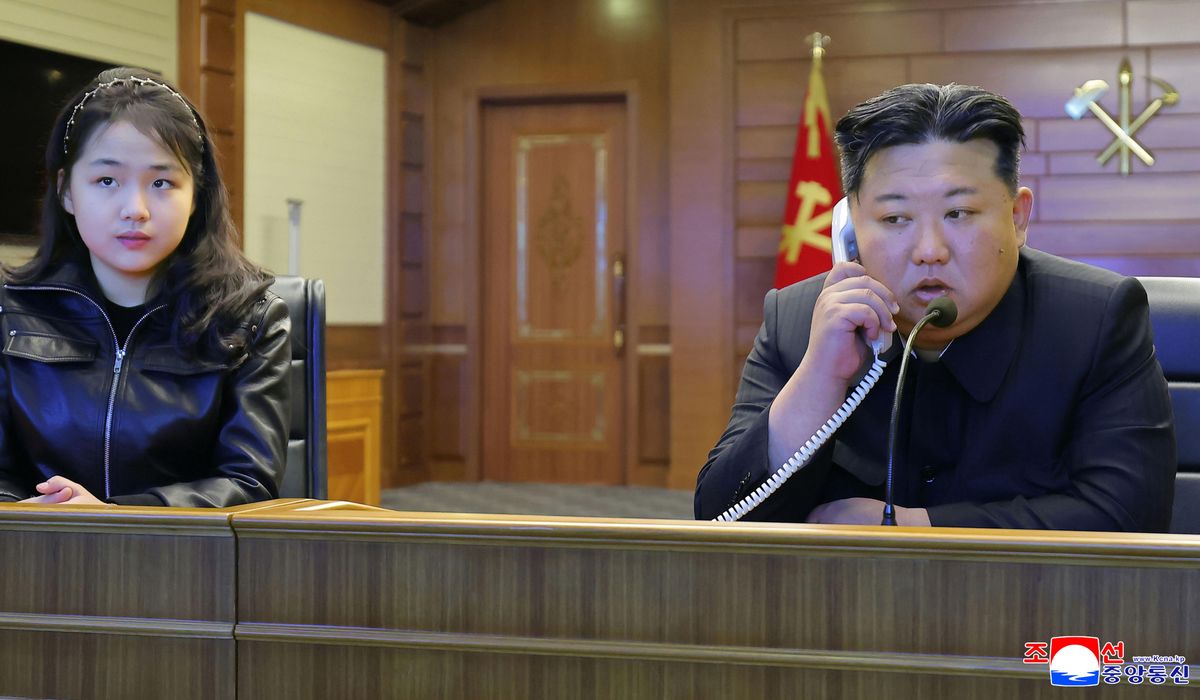
Saturday’s missile shoot followed angry rhetoric aimed at the annual “Freedom Shield” drills by Kim Yo Jong, the sister of North Korean leader Kim Jong Un. Pyongyang insists that the exercises, which Washington calls “defensive in nature,” are actually practice for an invasion.
Ms. Kim warned, in a statement in state media on Tuesday, the day following the drills’ commencement, that they could “lead to terrible consequences that are unimaginable.”
Her fortunes rose in February at the once-every-five-years Workers Party Congress, where she was promoted director of the party’s General Affairs Department.
Though the powerful Ms. Kim, who frequently pens bylined columns on inter-Korean relations, warned that Freedom Shield “will further destroy regional stability,” life in South Korea continues as usual.
The population has long been immunized to North Korean threats, and all three actions — the start of spring military drills by the two allies, followed by the North’s response in the form of barrages of rhetoric and missiles — had been predicted.
Events follow the same course virtually every year, though this spring, the drills take place against the backdrop of an ongoing Israeli-U.S. aerial campaign against Iran.
Indo-Pacific-based U.S. assets — missile interceptors in South Korea and U.S. Marines in Okinawa — are currently redeploying to the Middle East, where Iran’s will to fight remains unbroken.
The redeployments have raised quiet concerns about the U.S. ability to fight a two-front war, and come at a time when a major power shift is underway in the defense of the Korean Peninsula.
Seoul moves to take the lead in conventional defense
The all-domain drills encompass both computer simulations and “Warrior Shield” field exercises. Some 18,000 troops are engaged, with training running from March 9 through March 19.
While the “Allies drill-North Korea responds angrily” scenario was predictable, a new dynamic is animating the war games this year.
The Spring 2026 drills are being used to stress-test South Korea’s domestic capabilities, notably in sophisticated areas such as long-range strike, command and control, and intelligence, reconnaissance and surveillance.
The assessments, made by the U.S. side, are part of the planned conditions-based transfer of wartime operational control of South Korean troops from U.S. to South Korean command.
The Lee Jae-myung administration, which took office in summer 2025, has announced that it wants wartime “OPCON Transfer” to take place by the end of its term, 2030.
The concept has a long history, but current Seoul-Washington policy stances suggest it may, finally, happen.
OPCON transfer was first brokered by the liberal Roh Moo-hyun administration (2003-2008), which sought sovereign control of its own forces.
However, it was subsequently slow-walked by successive conservative administrations in Seoul, who feared it would greenlight reduced U.S. commitments to the peninsula.
As matters stand, Korean troops would fight under the orders of the Combined Forces Command, a joint structure led by an American four-star general, with a South Korean deputy.
Exactly how OPCON transfer — the exact conditions to be met have never been made fully public — would proceed, and what might happen to CFC if and when it does, is unclear. Whether U.S. troops would fight under Seoul’s wartime command is another concern that gives Korean conservatives the vapors.
Regardless, OPCON transfer’s stars are aligning on both sides of the Pacific.
In South Korea, the liberal Mr. Lee occupies the presidential Blue House, while his party comfortably controls the National Assembly. This leaves the conservative opposition largely impotent.
Meanwhile, the Trump administration is pressuring allies worldwide to increase defense spending and upgrade capabilities. It has made clear it wants Seoul to take an increasing share of the conventional defense burden, while sheltering Korea under the U.S. nuclear umbrella.
What is unknown is how far South Korea’s military is proceeding toward satisfying U.S.-set conditions.
“The main thing here is the conditions,” U.S. Forces Commanding General Xavier Brunson said during a webinar organized by the Korea Defense Veterans Association and the Korea-U.S. Alliance Foundation last December. “We cannot say we’re going to slide away from the conditions just so that we can get this done in time.”
Full details of what constitutes the conditions have never been made public.