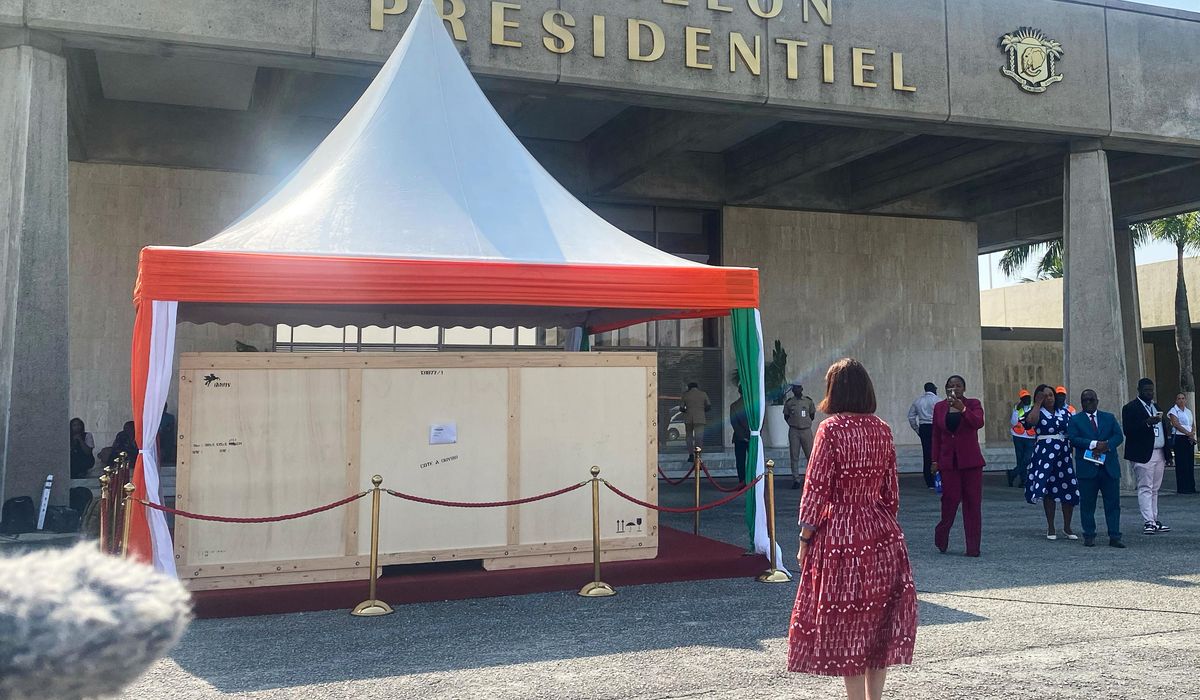

ABIDJAN, Ivory Coast — France returned a sacred talking drum looted during the colonial period to Ivory Coast on Friday as part of a nearly decade-old effort by the French government to return cultural artifacts to African nations.
It was the first such return by France to Ivory Coast, and was part of a broader campaign among European and Western governments to return treasured objects after decades of resistance.
The Djidji Ayôkwé, a massive carved wooden drum once used by the Atchan people of the Abidjan region to communicate between villages, was looted by French colonial authorities in 1916 and is among at least 140 looted artifacts Ivory Coast has asked France to return.
“This is a historic day and a moment of justice and remembrance,” Ivory Coast Culture Minister Françoise Remarck said at an event to receive the artifact at the Félix Houphouët-Boigny International Airport.
The wooden drum – whose name means “panther-lion” – measures about 11.5 feet (138 inches) long and weighs roughly 950 pounds. Historians say it played a key role in warning villages about forced labor recruitment organized by colonial authorities.
French President Emmanuel Macron first announced plans to repatriate cultural artifacts to African nations in 2018 following a report he commissioned from academic researchers that recommended doing that. The French Parliament last year adopted a special law allowing the Ivory Coast artifact to be removed from French collections, as part of the broader efforts.
PHOTOS: France returns a sacred drum looted during the colonial era to Ivory Coast
The repatriation process required consultations with Atchan traditional leaders, who traveled to Paris to perform rituals lifting the drum’s sacred status so it could be restored and transported.
For Atchan leaders attending Friday’s ceremony, the drum’s return carries deep symbolic significance.
“After a long stay far from its land, our sacred drum is finally returning to its people,” said Aboussou Guy Mobio, chief of the village of Adjamé-Bingerville. “It is like the missing piece of our history coming back,” Mobio added.
The artifact will undergo a monthlong acclimatization period in a secure location to allow the wood to gradually adjust from Paris’s dry climate to Abidjan’s humid tropical conditions, preventing cracks in the centuries-old wood.
It is expected to go on public display in April at the newly renovated Museum of Civilizations in Abidjan.