I was a typical Irish-Catholic kid from a large, extended Irish-Catholic family, living near each other in a predominantly Irish-Catholic neighborhood centered around a church called St. Lawrence O’Toole. Needless to say, the student population was largely… you guessed it… Irish-Catholic.
Like many Irish-Catholic families of our era and in our area, a print of Da Vinci’s Last Supper adorned one wall of our family dining room. The official presidential portrait of the late John F. Kennedy — the country’s first Irish-Catholic president — watched from the opposing wall, and in between, the only thing that varied on the Sunday dinner menu was the vegetable. You knew you were going to get roast beef and mashed potatoes. What you didn’t know from week to week was whether my mother had a coupon for canned green beans, canned peas, or canned corn.
Dinnertime conversation was not all that different from what you’re seeing right now on PJ Media: commentary on politics, culture, and, often enough, sports — along with heavy doses of parenting in the form of one-liners from my mom or dad.
“I don’t want you hanging out with that Sweeney girl,” my mom would say to my teenage sister.
“You don’t want to get drafted into the Army,” my dad would say to my high-school-aged brother. “Join the Navy or the Air Force. You’ll eat better and you won’t be in the middle of it.”
“It” was the Vietnam War, and my brother heeded our dad’s advice and went into the Air Force. To this day, I think he’s grateful for that piece of dinnertime advice.
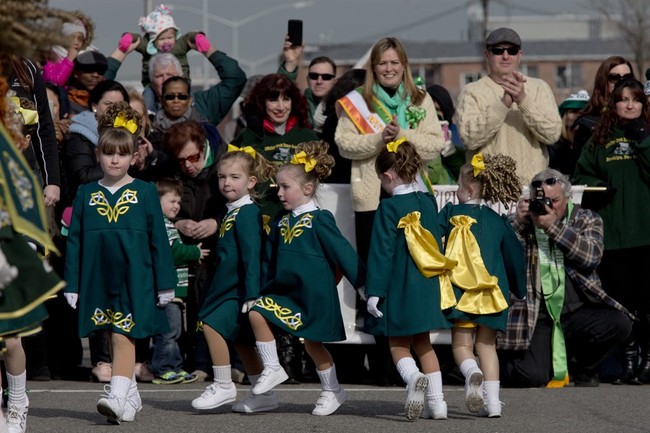
One year, when I came home from school in March, my uncle Fats was sitting at our kitchen table. He must have been on night shift, I thought. I sat with him and we talked about my day. I told him how the Fitzgerald sisters – three of them – were taken from class to class by the nuns while wearing these Irish dance outfits. And they put on a little show for us in honor of St. Patrick’s Day.
To be sure, my family members were no slouches when it came to St. Patrick’s Day, which was more than just beer drinking. For the Irish in my neighborhood, there was food and there were get-togethers, all taking place after the big Downtown parade, of course.
But still, we didn’t wear Irish costumes. My sisters never went to Irish dance classes.
So, I asked Fats why our family didn’t do what the Fitzgerald family did.
“Because I didn’t get my a** shot off in Germany for no Ireland,” he deadpanned. “We’re American.” He said no more, and didn’t have to.
At the time, I still didn’t know the details, but I did know that he stormed the beach at Normandy and fought with his platoon through France and into Belgium, where he was wounded by shrapnel so badly that his platoon left him for dead as they had to move on. Even German soldiers who later encountered his “lifeless” body assumed he was dead and paid him no mind.
Somewhere along the line, a medic found him, and the medical corps later nursed him back to health quickly enough that he was able to rejoin his infantry unit and continue fighting until the end of the war somewhere in Austria.
As an aside, Fats was no longer with us when the mini-series Band of Brothers came out, and I couldn’t stop thinking of him the entire time I watched it. I had so many questions at that point, though I knew he wasn’t in the 101st Airborne, which is what the miniseries was about.
On matters of country, patriotism, and loyalty, while all of our family were like-minded, it seems he was the heart of the family in that sense. There was a deference to him on these matters. And so, on St. Patrick’s Day, we partied — but never lost sight that we were not just Irish, we were Irish-American.
No Slaves
When you go to college for journalism and set out on a career in communications, in my extended family you become a repository for old photos, records, and mementos left behind by our predecessors. No diamond rings, pocket watches, or rare books from a family library—rather, I ended up with military discharge papers, yellowed newsprint articles about long-gone family members, and family tree information.
As a result, by the time my dad died, I had boxes and file folders of material to sort through, which I wanted to do at that point from a therapeutic standpoint. And so I did. That set me on a course to write a conversational family history just for family members to read.
The project led me to the work of cousins who had pieced together some of the family’s history as well. Collaborating, we were able to get as clear a picture as possible of where we came from.
Apparently, I come from a long line of Irish peasants. No royalty here. My ancestors were the fieldworkers, the street cleaners, the railroad laborers, the beat cops. To avoid starving to death in Ireland in the 19th century, they emigrated to America for the American dream – legally.
Assimilation wasn’t just something you did out of a sense of duty. It was something my family aspired to do. To be American was a promotion in their minds because of all the possibilities.
Generation upon generation in my family – and likely yours – paid their dues, paving the way for a better life for the next.
No Reparations
Every now and then you hear talk of and demands for reparations for slavery in America. The request is that the federal government compensate the descendants of slaves who were set free around the time my penniless family got off the boat.
Of course, we know the demand for reparations is a grift. But it’s not one I can take passively.
My family did not own slaves. What the British did to some of my ancestors was as unconscionable as some of the stories you hear about America’s “original sin.”
While I can’t speak for anyone whose ancestors did own slaves, I can say this on my own behalf: if you want reparations for something you never suffered, but your ancestors did, don’t look to me, because I will point to my own lineage. I will show you that my ancestors did not own slaves. Back then, before slavery was abolished in America, my family didn’t own much of anything.
That’s something we don’t talk much about around St. Patrick’s Day, but it’s there. St. Patrick’s Day parades aren’t organized by the elites, the descendants of slave owners. The organizers are typically blue-collar civil servants and rank-and-file workers by day. They’re the descendants of Irish commoners, mostly.
In the U.S., the parade — and all that goes with it — is just as much a celebration of being American as it is of being Irish. It’s an homage to our ancestors for sacrificing so that we could have the better life we do. It’s a reminder that we came from nothing, so there’s no reason for airs.
I handled PR for the Pittsburgh parade for ten years, and we had a saying: “On St. Patrick’s Day, everyone is Irish for a day.” Woke leftists might call that “inclusiveness,” but that’s BS. What it really is, is “Americanness.” We welcomed and welcome anyone who wants to join with us.
That’s a bond based on aspiration and assimilation, not a relationship based on resentment, entitlement, and divisiveness, which are the drivers behind “reparations.”
As the country prepares to celebrate the Irish with more than a few parades this week, when you make a toast with your green beer, make one for Ireland, make another one for America, and make a third one for the things that bring us together as Americans. We’re not as far apart as the left wants you to believe. Not in real life.
Editor’s Note: Support and follow PJ Media this midterm election year. Join PJ Media VIP and use promo code FIGHT to get 60% off your membership.