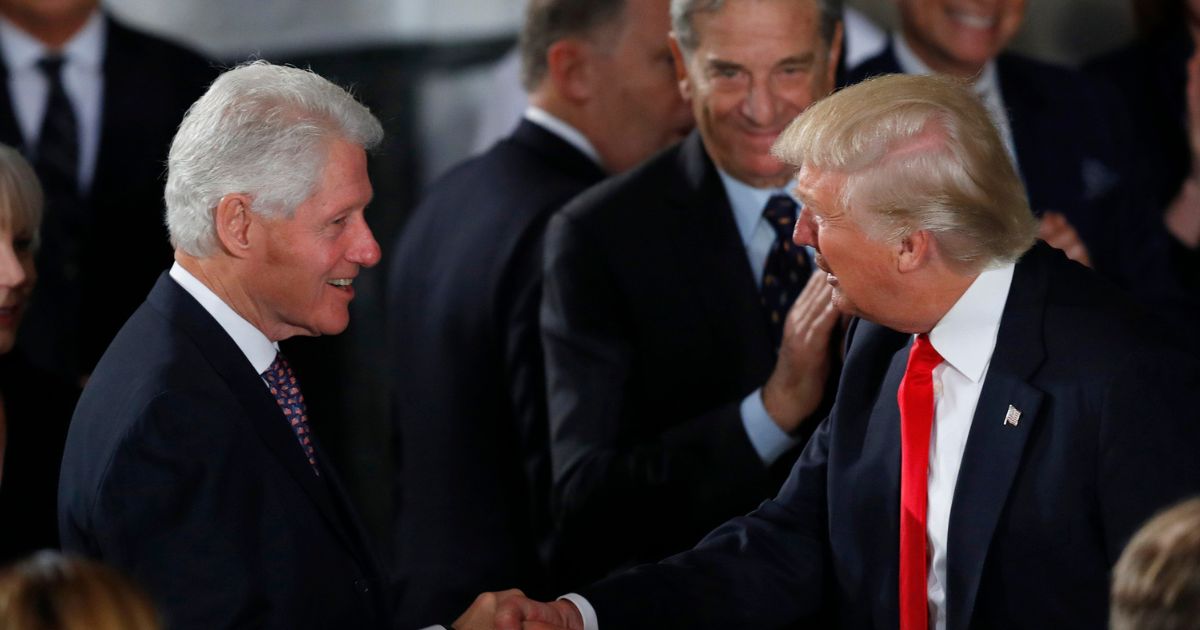
Hardly a day goes by without progressives labeling President Trump a fascist threat to democracy. Viewing his policies and, certainly, his rhetoric as extreme, many liberals refuse his placement on the political spectrum as anything other than a neo-Nazi. Yet, when dispassionately reviewing his administration, his focus is light-years closer to Bill Clinton than to Adolf Hitler.
Although there are differences between that progressively revered president and the progressively disdained Trump, their common ground should be obvious to anyone exchanging knee-jerk vitriol for objective analysis.
But because hatred of Trump is so toxic, Democrats fail to do so and hypocritically attack him for policies nearly identical to those fawned over or even applauded when initiated by one of their own.
Most obviously, as one of the toughest administrations on crime in modern politics, the Clinton presidency should be remembered for a similar approach as Trump’s support of law-and-order. Clinton consistently framed lawlessness as an “out-of-control” national crisis, called for ending “the revolving door of justice,” and repeatedly emphasized that “getting violent criminals off our streets” was a prerequisite for economic and social progress.
Supporting those words, Clinton championed the 1994 Violent Crime Control and Law Enforcement Act, the most significant law-and-order policy of his presidency and arguably the largest crime bill in U.S. history.
That legislation called for the expansion of federal prisons, funding for 100,000 new police officers nationwide, more federal death penalty categories, and even financial incentives for states to impose less lenient “three-strikes” sentencing for violent repeat offenders.
Clinton doesn’t sound much different from Trump on law-and-order issues, and seems even more similar to our current president on unnecessary federal expenditures.
While Trump was heavily criticized for his DOGE initiative to eliminate wasteful government spending, no such attacks were heard in 1993, when Clinton slashed costs and reduced the national debt by cutting over 400,000 federal jobs.
Announcing that the “era of big government is over,” Clinton worked to shift the bureaucracy “away from complacency and entitlement toward initiative and empowerment.” Americans must have a “government that lives within its means,” he said, so it “works better and costs less.”
Yet despite those initiatives, applauded by Democrats, many on the left became unhinged by Trump’s plans to downsize the bloated federal government by reducing waste, fraud, and abuse. Drawing directly from their “Trump is Evil” playbook, critics labeled his efforts as dangerous, authoritarian, and even unconstitutional.
Another example of progressive double-standard hypocrisy is their criticism of Trump’s tariff policies, even though Clinton likewise countered unfair trade practices.
In frequently imposing tariffs as targeted enforcement tools, Clinton favored import duties as part of a rules-based trading system. Like Trump, Clinton framed his tariffs as justified to “stand up for our workers” and as necessary because “free trade only works if everyone plays by the rules.”
Perhaps an even more striking similarity between Clinton and Trump is their shared insistence on border security.
Yet those same Democrats and their media allies attacking Trump’s border actions hailed Bill Clinton when stating that all Americans “are rightly disturbed by the large number of illegals entering our country… that they impose burdens on our taxpayers.”
But no progressive analysis of common ground hypocrisy would be complete without referencing the similarity between Trump’s current actions in Iran and Clinton’s Kosovo campaign during his second term.
Citing escalating civilian atrocities, preventing a wider Balkan war, and enforcing a negotiated peace that Serbia had rejected, Clinton authorized a 78-day bombing campaign against a sovereign nation. And this action, lasting more than two months against Yugoslavia, described as a humanitarian and strategic intervention, was authorized without formal congressional approval and without an immediate threat to the United States.
Sounding much like the rationale for the ongoing Operation Epic Fury, Clinton argued that diplomacy had been exhausted, unchecked violence risked destabilization, and engaging American forces to prevent a wider conflict was his “constitutional prerogative” to conduct foreign relations as commander-in-chief.
Moreover, Clinton’s reasons to engage the U.S. military in Kosovo in 1999 and roughly 20,000 troops in Bosnia four years earlier pale in comparison to Trump’s rationale for eliminating the far greater threat posed by Iran’s nuclear ambitions.
Yet, progressive pushback against Clinton’s actions was virtually nonexistent and certainly nothing remotely like the criticism aimed at Trump for his actions in Iran, the border, tariffs, crime reduction, and curbing government waste.
Ultimately, only by purging their hypocritically divisive double standards will Democrats reach a mindset of respectful political discourse. But the first step on that self-reflective and mutually beneficial journey with Republicans will be difficult.
In doing so, progressives must finally realize that Trump is far less a MAGA threat to democracy than a leader who often shares their common ground. And anyone thinking that will be easy might want to buy a bridge… in Brooklyn.
The views expressed in this opinion article are those of their author and are not necessarily either shared or endorsed by the owners of this website. If you are interested in contributing an Op-Ed to The Western Journal, you can learn about our submission guidelines and process here.

Advertise with The Western Journal and reach millions of highly engaged readers, while supporting our work. Advertise Today.