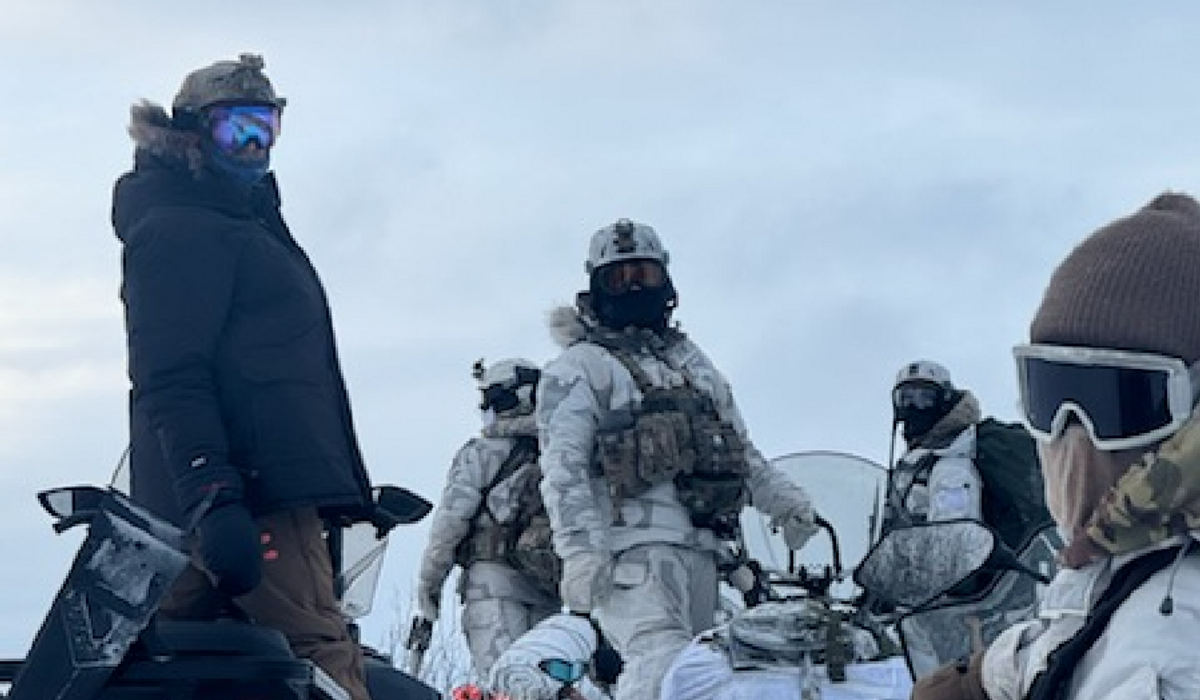

Part one of two parts.
FAIRBANKS, Alaska — At 20 degrees below zero, most things start to fail.
The Pentagon is pouring billions of dollars into new technologies that can survive, and excel, in that extreme cold, with an eye toward potential Arctic combat. The goal is to close an Arctic capabilities gap with adversaries Russia and China.
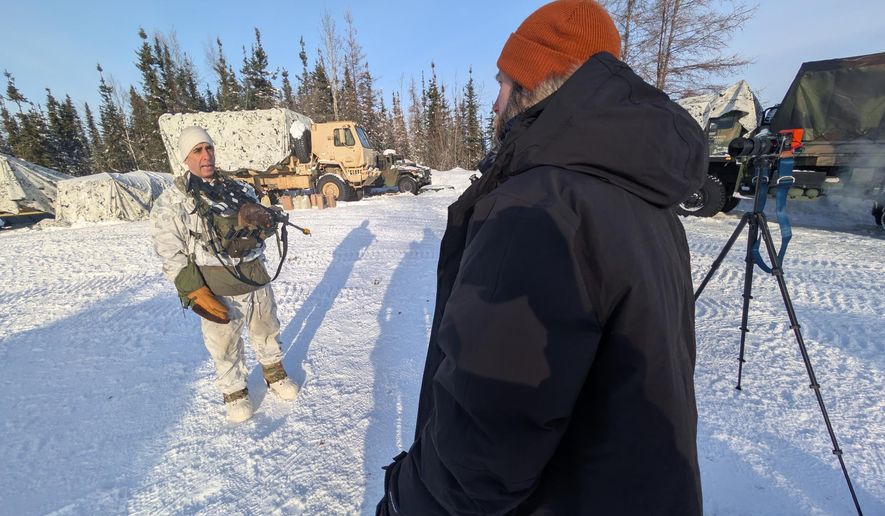
John T. Seward interviews Col. Chris …
more >
The harsh reality of the Arctic can’t be fully understood from Washington. In February, during the U.S. military’s Arctic warfare training, a winter storm accompanied temperatures that rarely warmed to more than minus 10 here.
A pale, clear blue sky betrayed a bitter cold as soldiers from the 1st Infantry Brigade Combat Team, 11th Airborne Division, were trying to defeat their neighboring unit, the 2nd Infantry Brigade Combat Team, in a simulated conflict at the Joint Pacific Multinational Readiness Center Rotation 26-02.
SPECIAL
COVERAGE: Arctic Notebook
The exercise brought together service members from the U.S., Canada, Norway, Sweden and Finland as they worked in what the 11th Airborne Division described as “one of the world’s harshest and most strategically significant environments.”
The Washington Times was invited to embed with the 1st Infantry Brigade Combat Team and witness firsthand the challenges of operating and simply surviving in one of the planet’s most inhospitable locations.
Arctic in focus
Several key factors have come together to bring the Arctic to the forefront of national security strategy across the West. In Washington, President Trump has insisted that the U.S. military must have unfettered access to ice-covered Greenland, the semiautonomous territory of Denmark, to increase its reach in the theater.
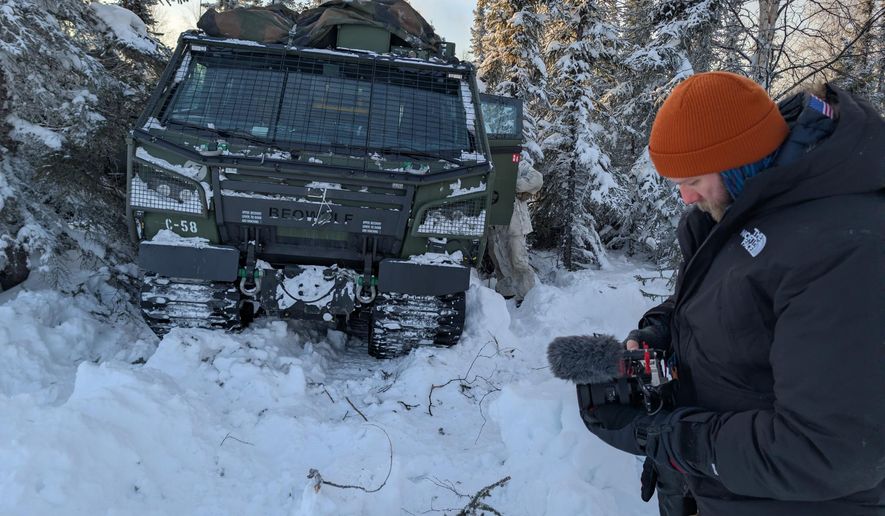
John T. Seward shoots photos and …
more >
The U.S. and its European allies recognize the broader importance of bolstering their presence in the Arctic to counter Russia’s heavy footprint, especially given Moscow’s unmatched fleet of more than 40 icebreakers, six of which are nuclear-powered.
The U.S. has three such ships.
Mr. Trump last month hailed a major Arctic security agreement that he said is coming together. It will give the U.S. full access to Greenland and help the U.S. and its partners counter Russian and Chinese influence. Under administrations of both parties, the U.S. for years has warned that the Arctic of the future would be a vital 21st-century battle space in an era of great power competition.
That day has arrived.
“In this era of great power competition that we’re starting to enter, our adversaries are starting to take advantage of those open sea routes and may start trying to grab pieces of real estate in the Arctic,” said Col. Chris Brawley, commander of the 1st Infantry Brigade Combat Team. “Having a force like the 11th Airborne Division that’s capable of operating in the Arctic is essential to America’s national security.”
Melting sea ice is opening maritime traffic lanes in the Northwest Passage, a key route connecting the far northern Pacific and the North Atlantic region.
The Arctic, and Alaska in particular, are central to U.S. national security for other reasons. The state’s Fort Greely is home to the Ground-Based Midcourse Defense System, America’s primary missile defense system. Fort Greely and other Alaskan outposts are expected to be key components of the Trump administration’s proposed Golden Dome missile shield, an ambitious project to protect the continental U.S. from modern missile threats.
Having units accustomed to working in the region is crucial for the U.S.
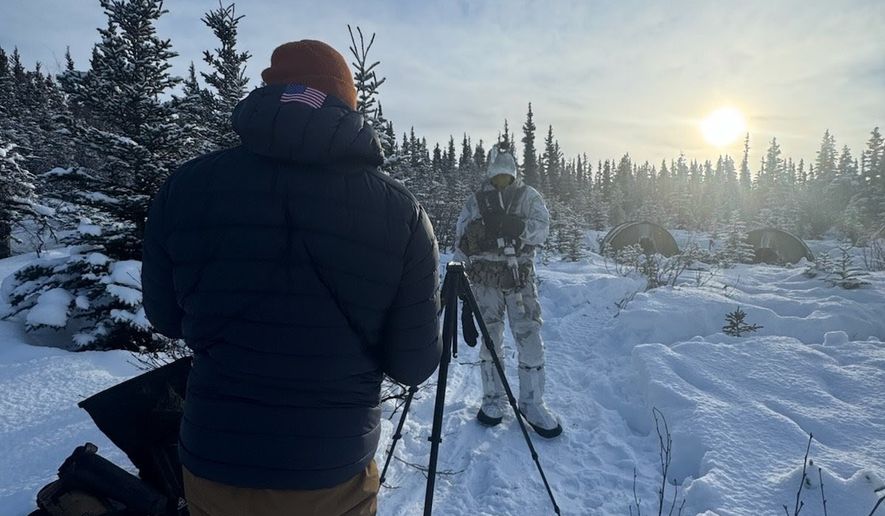
John T. Seward interviews the detachment …
more >
“My brigade, we’re actually better off the closer it gets to minus 40” Col. Brawley said. “Most other units will shrink and wither at those temperatures, but this unit, we prefer it. We have a distinct advantage when it’s minus 40 or thereabouts.”
‘You just let the elements take over’
The Arctic is a brutally challenging region.
Soldiers’ night vision starts to go dark as batteries freeze. Gun lubrication goes gummy and causes weapons to jam. Batteries in small high-tech drones last half as long. The dry, unconsolidated powder snow becomes an obstacle in its own right, blocking the passage of any large-wheeled vehicles in many areas.
The primary challenge of warfare in the Arctic is fairly obvious, but dealing with subzero temperatures for days on end is hard to replicate outside the far north.
“It’s a little bit like operating in space,” Col. Brawley said. “You need special training, and you need special equipment.”
It also poses challenges that don’t change even as technology advances.
As his Cold Weather All-Terrain Vehicle powered over the snow and across the battlefield, Col. Brawley described his study of the Finnish-Soviet Winter War of nearly a century ago and one of its key lessons: Try to isolate the enemy in extreme conditions.
“If you target their food, target their ability to refuel, the enemy will sort of wither on the vine,” he said. “You just let the elements take over. It’s impossible to survive in this environment without food and without fuel.”
It’s a double-edged sword.
During the simulated conflict, Col. Brawley tapped his partner force, a Canadian battalion — 3rd Battalion, Princess Patricia’s Canadian Light Infantry, based in Edmonton, Alberta — as his critical unit to “cut off” the adversary.
The Canadian battalion walked more than 8 miles through waist-deep snow to make the gambit work. Even with all the appropriate equipment, the cold and snow took their toll.
Brig. Gen. Eric Landry, commander of the 4th Canadian Division, said that even with more than a year’s worth of training specifically for the exercise, risks remained.
Canadians and Americans suffered from what are known as cold-weather injuries, such as hypothermia, chilblains, frostbite and rhabdomyolysis from trudging uphill through unconsolidated powder snow.
In such frigid weather, Gen. Landry said, not much can be done to fight the chill.
U.S. troops averaged more than three soldiers each day removed for cold-weather injuries. Out of the 350 Canadians in the battalion, nearly 50 soldiers were taken out of the fight.
“They held their ground, though,” Gen. Landry said.
“Is it hubris? Is it pride? I don’t know,” he said. “But I can tell you, that battalion commander was not going to tell his brigade commander, ‘Well, I can’t do it.’ He was going to find a way. And they did find a way, but it was costly.”
It paid off and was successful, but a large part of the risk, Gen. Landry said, was the speed at which the unit was expected to perform. Nearly every military leader in Alaska repeated one phrase that hammered home that point: Everything takes longer in the Arctic.
Rules of the North
At 40 below zero, plastics and even metals can become brittle, liquids start to change into solids, and even NATO’s military multiuse jet fuel, Jet Propellant-8, starts to phase-shift into a gel.
That’s why the soldiers in Alaska have developed their “Rules of the North.” The rules say to “prepare as if no one is coming” and to think as if it is never summer, always winter.
Equally important, everything breaks at 40 below zero.
The usefulness of combat drones, for example, is limited by the harsh conditions of the Arctic. It requires new technological developments for the equipment to work. Drones tested at 25 degrees could lose as much as 75% of their flight time in extreme Arctic cold.
“Batteries began as laptop batteries,” said Jungwoo Lee, the CEO of South 8 Technologies.
The company’s batteries were undergoing testing during the training event.
“The chemistry used was designed for laptops that sit on our desks all day, not for any of these extreme environments,” she said.
Extended periods of darkness further increase power demand. Heaters to keep batteries stable can help but take more energy themselves.
South 8 had to develop an entirely different chemistry to produce batteries that still functioned in normal temperatures but could withstand the extreme cold.
“The physics behind it is you have these different materials in the battery: anode, cathode, electrolyte. One of the key problems is the electrolyte, which is liquid-based,” said Ms. Lee, adding that those traditional batteries simply freeze eventually.
“Our material, a liquefied gas electrolyte, is a new material for batteries that simply doesn’t freeze until well below temperatures that you would see here on Earth,” she said.
That may help, but it won’t be enough to solve Arctic security alone.
“Equipment malfunctions happen so much more often,” Neil Shea, an author and Arctic explorer, told The Times. “Everyone is slower. Everything takes longer. But, I don’t think people really account for that.”
The human element is often the weakest link in extreme cold, even when those human beings are trained and prepared.
Col. Brawley’s lead adviser agrees. Command Sgt. Maj. Jeremiah Waggoner said that even though he has worked in some of the “best units in the world,” they wouldn’t stand a chance without training in the Arctic.
“I can even give them the equipment, and it’s going to take them so long to set up a 10-man tent that half the guys are going to have frostbite and freeze,” Maj. Waggoner said. “So it’s the training, it’s the equipment, it is just different up here.”
It’s a culture change as well. The U.S. Army is used to fast-moving operations in which it can establish a foothold and conduct short, sprint-style operations. Arctic operations are inherently supply-intensive and slow.
During a helicopter movement during the exercise, what started as a task to get soldiers, snowmobiles and equipment quickly across the battlefield became a race against the weather — one where everything took longer.
The original timeline slowly shifted as soldiers struggled to load heavy equipment into CH-47 Chinook helicopters: 30 minutes late, then an hour, then an hour and a half, as they tried to problem-solve.
‘Extreme cold weather will kill you’
That helicopter movement highlighted another problem: sweat.
As soldiers rushed to load heavy gear onto CH-47 Chinook helicopters, many of them began to overheat in their layers.
“It’s kind of bred into the infantry. We’re always push, push. But the problem with that up here is if you push really hard and the soldiers start to sweat,” Col. Brawley said. “Then they stop. That’s when we start to see the cold-weather injuries.”
Soldiers in the 11th Airborne Division aren’t waiting on the rest of the Army to solve their problems. One soldier bought a lunch cooler and used it to deploy a radio transmitter that was resilient in the cold, insulating the radios and using the heat they generate themselves to warm the interior and keep the equipment working.
“You are only able to solve these problems if you’re operating in this environment,” said Col. Kyle Spade, 11th Airborne Division’s operations officer. “You can’t solve these problems from a [training center] down in the Lower 48. You have to be here.”
One soldier, a medic who was routinely treating hypothermia and frostbite, started to build their own solution: A Home Depot 5-gallon bucket with a sous vide machine attached to it, warming the water to an exact temperature to slowly rewarm frostbitten skin or keep saline IV bags from getting too cold. It’s a unique problem that most of the Army has never encountered.
“Up here, leadership is unlike any other place because it has to be,” Col. Spade said. “Alaska will kill you. Extreme cold weather will kill you.”