NEWS AND ANALYSIS:
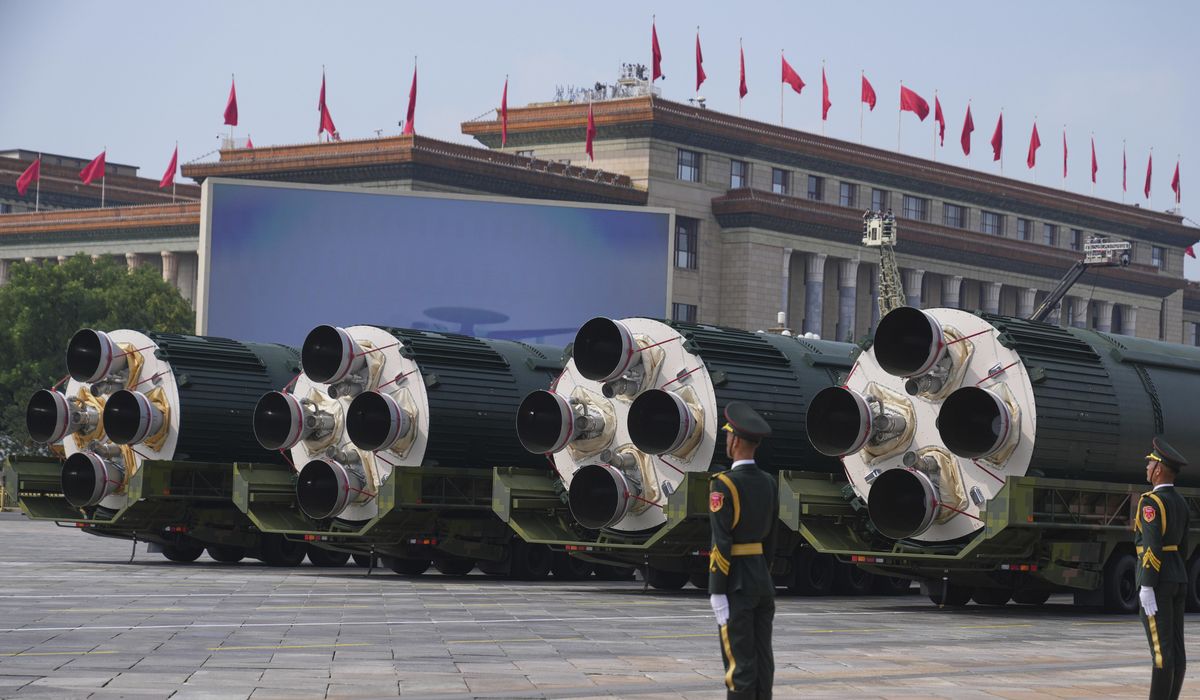
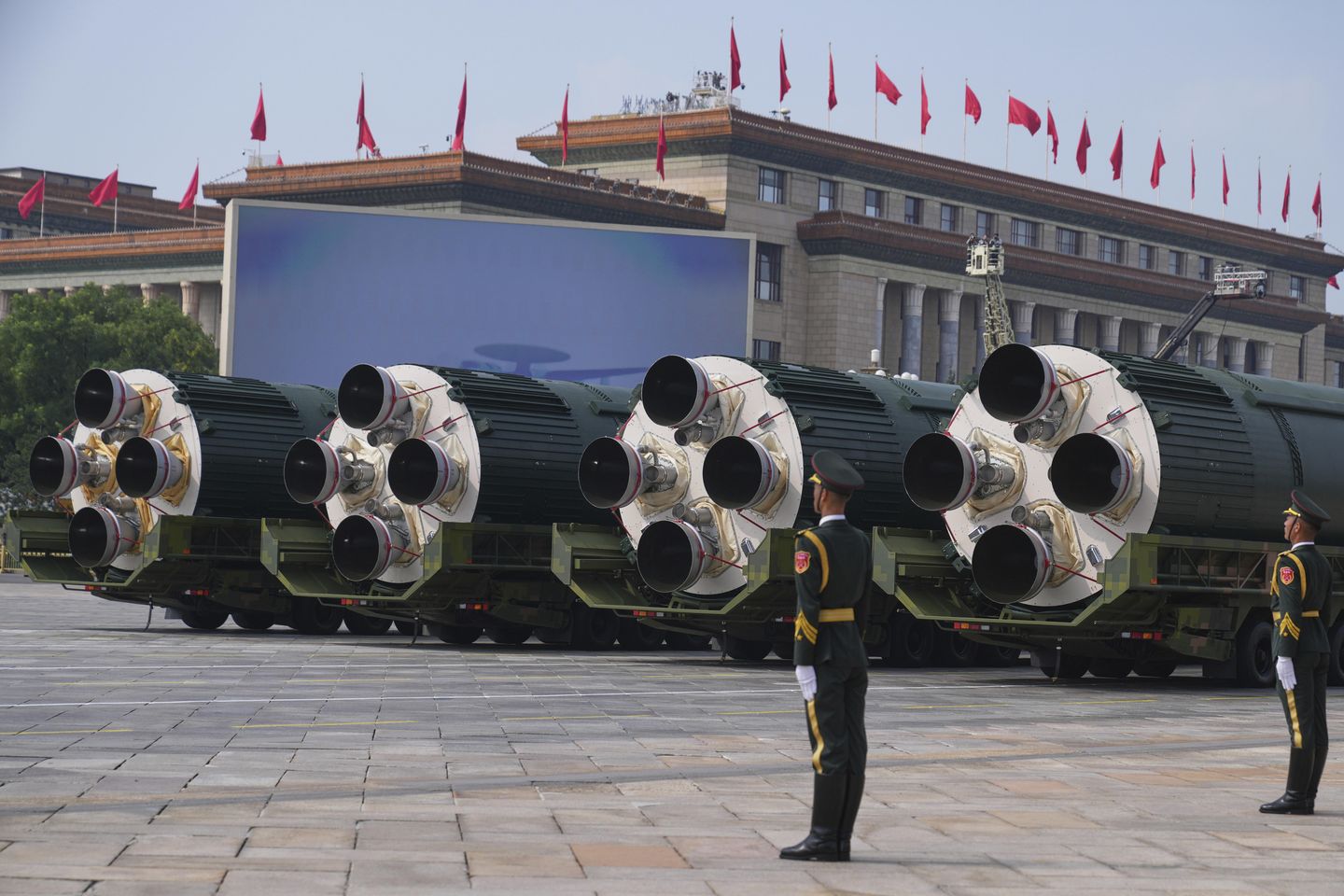
The People’s Liberation Army Rocket Force stores and maintains a rapidly expanding arsenal of nuclear warheads for missiles at mountain facilities in China that are vulnerable to strikes or disruption by the U.S. military, according to a report by a think tank.
The report, based on public data on one of China’s most important strategic secrets, reveals new details on how the PLA stores, tests, guards and transports strategic and tactical warheads from a central facility located in the Qinling Mountains, some 1,200 miles southwest of Beijing.
The study, “Dancer’s at the Knife’s Edge: PLA Rocket Force Nuclear Warhead Management,” was published March 9 by the Air Force’s China Aerospace Studies Institute.
The report is a rare, semiofficial U.S. military assessment of China’s system for handling nuclear warheads — a weapons stockpile that U.S. officials say China has rapidly expanded over the past 11 years.
The main headquarters for warhead storage is in Baoji — the Rocket Force’s Base 67, a central warhead storage facility called Hongchuan.
According to the report, Hongchuan is in charge of moving warheads by rail or road — sometimes by aircraft — to six other bases and then on individual missile brigades around the country during a crisis or conflict.
The report highlights information valuable for Pentagon war planners who would be charged with conducting preemptive strikes on nuclear warhead facilities based on China’s current policy of not mating warheads to missiles until ordered.
Among the potential weaknesses in the Rocket Force’s management of the warheads is that the weapons are stored at a single facility.
“While the facility is hardened and well-guarded against attack, it is a case of highly concentrated risk,” the report said.
Additionally, infrastructure around the facility is limited; only a single narrow road leads into and out of it. The report states that “blocking these roads could seriously delay operations.”
The warhead system is also highly centralized, requiring frequent transport of warheads by road or rail over long distances. These limitations increase “opportunities for accidents or wartime interdiction,” the report stated.
Noting three new land-based intercontinental ballistic missile fields recently built in northern China, the report said opportunities to block the movement of warheads to those ICBMs could increase in the coming years.
Other vulnerabilities of the nuclear warheads system include disorganized and lax storage facilities and procedures that were highlighted by reported health issues among Rocket Force personnel.
“While it does appear that the PLARF has made significant progress here, it is unclear if these problems have been completely solved,” the report said using the acronym for the Rocket Force.
The warhead management system also uses outdated computer systems at some facilities that could be attacked during computer warfare strikes. The military is working on what are called “left of launch” attacks, including cyberattacks that would disable missile control systems before missiles are launched.
The report said, “Heavy use of foreign equipment in certain areas of nuclear management indicates a possible technology chokepoint, particularly for more sophisticated equipment like remote-controlled robotics needed to deal with radioactive materials and clear obstacles.”
China’s nuclear warhead system also relies on American, Swedish, German and French hazmat suits, face masks, oxygen tanks and radiation sensors, including equipment made by Honeywell, DuPont and 3M, the report revealed.
Personnel problems also are said to be evident within the Rocket Force. Recruiting and retaining educated and skilled nuclear warhead managers is “an ongoing challenge” for the PLA, the report said.
The Pentagon has said China’s rapid warhead expansion grew stockpiles from about 250 warheads to more than 600 today. The PLA is expected to field up to 1,500 warheads in coming years.
From 2016 to 2021, the number of Chinese missile brigades increased by about 35% with the majority of new units including nuclear or dual-capable nuclear-conventional missiles, the report said.
Despite the rapid warhead growth, there has been no corresponding increase in nuclear support units.
“It is thus worth asking if a system that was designed in a simpler and smaller-scale time of minimal deterrence doctrine is able to handle this workload — in some cases double the workload of only a few years earlier — or whether such a system would be increasingly stressed, perhaps even to the point of breaking down if prolonged high demands were placed on it in a crisis,” the report said.
The Rocket Force is in charge of one of the world’s largest missile arsenals. The stockpile includes short, medium, intermediate and intercontinental ballistic missiles, cruise missiles, anti-ship missiles and new hypersonic missiles.
Based on Chinese writings, the study noted the difficulties of assessing PLA nuclear weapons controls because of secrecy.
For example, the PLA rarely uses the term “warhead” in public writings or discussion, favoring euphemisms such as “special equipment,” or “national treasure,” that can have multiple meanings in Chinese.
The problem of analyzing nuclear weapons also has been made more difficult by a recent crackdown by Chinese authorities on open sources of information over the past two years, the report said.
Expert: China’s nuclear policy is irresponsible, destabilizing
Communist China is continuing its large-scale expansion of nuclear forces that are viewed as a “breakout” of past limited nuclear power, according to expert Brendan S. Mulvaney.
Mr. Mulvaney, director of the Air Force’s China Aerospace Studies Institute, said in a chapter of a new book that China bills itself as a responsible nuclear power but its secrecy and the combining its nuclear and conventional forces undermine that claim.
The People’s Liberation Army Rocket Force intentionally co-locates and intermingles its conventional and nuclear arms, bases, delivery systems and command and control networks — posing major challenges to the U.S. and other states targeted by the systems, he said.
“You won’t know if it is conventional or a nuclear payload until impact, which is sub-optimal to say the least,” he stated. “This can be seen as irresponsible behavior as it creates challenges not only in counter-targeting during a conflict scenario, but complicate escalation signaling in times of competition and crisis.”
The Rocket Force is the most flexible and robust missile force in the world, both in terms of conventional and strategic nuclear systems, he said.
Further, containing military confrontations before conflicts can escalate to the nuclear level remains a major problem in the current standoff between China and the U.S.
Mr. Mulvaney said it is unclear if China’s leaders understand the dangerous messages being sent by its nuclear activities, or if the destabilization is an intended feature of its nuclear strategy.
“One of the most glaring examples of this is the PLA’s development of fractional orbital bombardment systems,” he said. “Another example of inherently destabilizing behavior is the PLA’s program to develop conventional intercontinental ballistic missiles.”
The orbital bomb system can be used for nuclear strikes, he said.
The actions may increase deterrence for China but the policies also raise the danger of a nuclear war.
“A state targeted by an ICBM may very likely decide it is not willing to wait to find out and proceed on the assumption that an ICBM strike of any sort deserves a launch on warning nuclear response.”
China’s President Xi Jinping also may adopt the nuclear saber-rattling of Russian President Vladimir Putin.
“If Vladimir Putin is deemed to be ‘successful’ in using this type of nuclear coercion, nuclear deterrence, or nuclear blackmail, this may in fact enter the Chinese calculus regarding a potential Taiwan scenario,” Mr. Mulvaney said.
As the PLA moves toward strategic weapons parity with the U.S., the CCP likely will be emboldened to act more aggressively with its conventional military forces targeting Taiwan or over territorial disputes with Japan snd India, or in the South China Sea.
“The challenge for China is that they may end up causing the very arms race that drives instability and leads to crisis, the very thing that China is hoping to avoid,” Mr. Mulvaney said.
The chapter is part of the new book “Nuclear Responsibility: Defining Responsible Nuclear Statecraft in an Era of Great Power Competition,” edited by Todd C. Robinson and Stephanie A. Stapleton.
CIA videos viewed by tens of millions in China
The CIA recently launched a program to recruit agents inside the near-totalitarian Chinese communist system through a series of online videos in Mandarin.
The videos seek to prompt defections to the agency’s ranks of informants and double agents from key officials in the Chinese Communist Party and the People’s Liberation Army.
Since the videos were first posted 10 months ago, the total hits on YouTube have exceeded 100 million views, according to tallies on the channel reported on X by online CCP critic Bin Xie.
Two new videos put out by the CIA in the past 30 days alone received 82 million views.
It is not known if the videos have resulted in the recruitment of CCP or PLA members.
The most recent video published Feb. 13 targeted Chinese soldiers in an apparent bid to recruit troops who may be disaffected by recent high-level political purges of senior PLA leaders.
The video shows a fictional Chinese military officer contacting the CIA after growing disillusions with senior military leaders.
CIA Director John Ratcliffe has said the CCP poses the most formidable adversary challenge to the U.S.
“It is intent on dominating the world economically, militarily, and technologically,” Mr. Ratcliffe said in a statement. “Our agency must continue responding to this threat with urgency, creativity, and grit, and these videos are just one of the ways we are doing this.”
• Contact Bill Gertz on X @BillGertz.