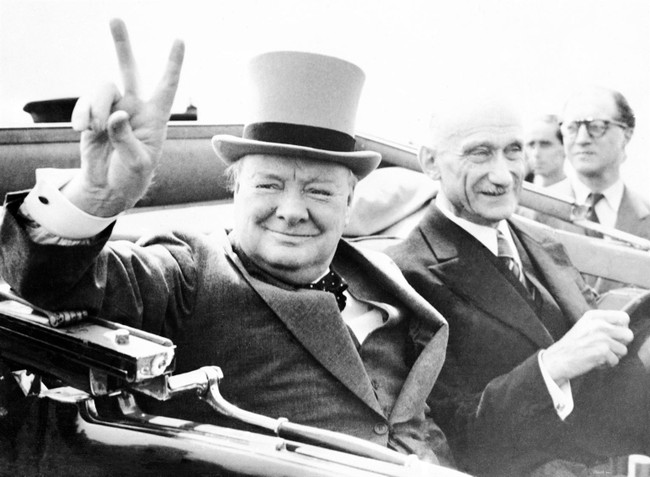
Eighty years ago today, former British Prime Minister Winston Churchill stood before an audience at Westminster College in Fulton, Mo. President Harry S. Truman sat beside him on stage.
Although Churchill was out of office, his words carried enormous weight in a world still recovering from World War II, but which believed that peace had arrived.
Churchill believed something else entirely. His speech, titled “The Sinews of Peace,” warned that a new political and military divide had already taken shape across Europe. One phrase from that afternoon would become permanently embedded in modern history.
“From Stettin in the Baltic to Trieste in the Adriatic, an ‘iron curtain‘ has descended across the continent. Behind that line lie all the capitals of the ancient states of Central and Eastern Europe. Warsaw, Berlin, Prague, Vienna, Budapest, Belgrade, Bucharest, and Sofia; all these famous cities and the populations around them lie in what I must call the Soviet sphere, and all are subject, in one form or another, not only to Soviet influence but to a very high and in some cases increasing measure of control from Moscow.”
Churchill believed Western leaders misunderstood Soviet intentions after the victory over Nazi Germany failed to secure unity among former allies. Instead, Stalin’s government expanded influence through political pressure, intimidation, and military presence across the eastern half of Europe.
Churchill didn’t deliver the speech casually; he’d spent months studying reports on Soviet behavior in Eastern Europe. British diplomats warned that democratic governments were being pushed aside.
Communist parties supported by Moscow steadily gained power. Churchill feared Western hesitation would allow Stalin’s system to harden into permanent control. The speech called for a strong alliance between the United States and Britain to defend democratic institutions, maintain military readiness, and prevent further Soviet expansion. Churchill argued that strength and cooperation offered the best path to preserving peace in the postwar world.
Churchill knew that while the world looked forward to putting the horrors of war behind, events at the beginning of 1946 portended an even darker future ahead. In the wake of the Allied victory, the Soviet Union had begun shaping Eastern Europe in its image, bringing the governments of many nations into line with Moscow. On February 9, Premier Joseph Stalin gave a speech in which he declared that war between the East and West was inevitable. On February 22, the American Ambassador to Moscow, George F. Kennan, sent the famous “Long Telegram” warning of the Soviet Union’s perpetual hostility towards the West.
Communist parties supported by Moscow steadily gained power. Churchill feared Western hesitation would allow Stalin’s system to harden into permanent control. The speech called for a strong alliance between Britain and the United States to defend democratic institutions, maintain military readiness, and prevent further expansion. Churchill argued that strength and cooperation offered the best path to preserving peace in the postwar world.
The immediate reaction proved mixed. Many Americans admired Churchill’s wartime leadership, yet some political leaders believed his warning sounded too confrontational toward a former ally. President Truman never formally endorsed every line of the speech, though his decision to invite Churchill to speak in Missouri suggested sympathy with its message.
The United States stands at this time at the pinnacle of world power. It is a solemn moment for the American Democracy. For with primacy in power is also joined an awe inspiring accountability to the future. If you look around you, you must feel not only the sense of duty done but also you must feel anxiety lest you fall below the level of achievement. Opportunity is here now, clear and shining for both our countries. To reject it or ignore it or fritter it away will bring upon us all the long reproaches of the after-time. It is necessary that constancy of mind, persistency of purpose, and the grand simplicity of decision shall guide and rule the conduct of the English-speaking peoples in peace as they did in war. We must, and I believe we shall, prove ourselves equal to this severe requirement.
Some critics argued that Churchill risked provoking unnecessary tension with Moscow, while others believed he simply said what diplomats privately understood.
Uncle Joe Stalin reacted sharply. Within days of the speech, Stalin compared Churchill’s warning to the ideology that fueled Adolf Hitler’s rise to power, and insisted Eastern European governments had chosen their own political direction:
Mr Churchill wanders around the truth when he speaks of the growth of the influence of the communist parties in Eastern Europe… The growth of the influence of communism cannot be considered accidental. It is a normal function. The influence of the communists grew because, during the hard years of the mastery of fascism in Europe, communists slowed themselves to be reliable, daring and self-sacrificing fighters against fascist regimes for the liberty of peoples.
Stalin framed Churchill’s remarks as an attempt to justify Western hostility toward the Soviet Union. The Kremlin launched a wave of propaganda attacking Churchill personally while defending Soviet actions across the region.
But Churchill’s speech soon proved accurate, and history moved along briskly. In 1947, President Truman announced the Truman Doctrine, committing the United States to support nations resisting communist expansion.
Secretary of State George C. Marshall launched the Marshall Plan to rebuild Western Europe and stabilize democratic governments. In 1949, the U.S. and several European nations formed the North Atlantic Treaty Organization under the leadership of Secretary General Hastings Ismay, NATO’s first leader.
The Cold War had officially begun.
For more than four decades, Churchill’s phrase described a hardened geopolitical boundary beyond which Soviet-backed governments ruled Eastern Europe under tight political control. The Berlin Wall stood as the most visible symbol of that division. Communist governments remained in place until 1989, when democratic movements swept across Eastern Europe and dismantled Soviet authority.
Two years later, the Soviet Union itself dissolved under the leadership of President Mikhail Gorbachev.
Exclusively for our VIPs: Why the IRS, Postal Service, and Others Maintain Armed Tactical Teams
Churchill’s Fulton speech now occupies a unique place in history. Many historians regard it as the moment when a wartime alliance transformed into an open strategic rivalry. Churchill recognized the shift before most leaders were comfortable admitting it.
Churchill’s “Iron Curtain” speech didn’t start the Cold War, yet it identified the emerging conflict with remarkable clarity.
Today, Westminster College preserves the memory of that moment. The small Missouri campus hosts the National Churchill Museum, where the church of St. Mary the Virgin from London now stands after being relocated, brick by brick, to Fulton. Visitors walk through exhibits explaining how one speech helped define an entire era of politics.
History often turns on moments when a leader pronounces what others hesitate to say aloud. Churchill’s warning in Missouri proved how one speech can shape decades of policy and strategy. PJ Media VIP members who support independent reporting help keep this kind of historical clarity alive today. Join PJ Media VIP and receive 60% off your membership with the promo code FIGHT.