President Trump took steps Tuesday to secure oil shipments in the Middle East as the U.S. continued to bombard Iran, and Tehran retaliated by striking oil-rich Arab states.
Mr. Trump said he directed the U.S. Development Finance Corporation to provide political risk insurance at a “reasonable price” to energy traders and other maritime traffic in the Gulf region.
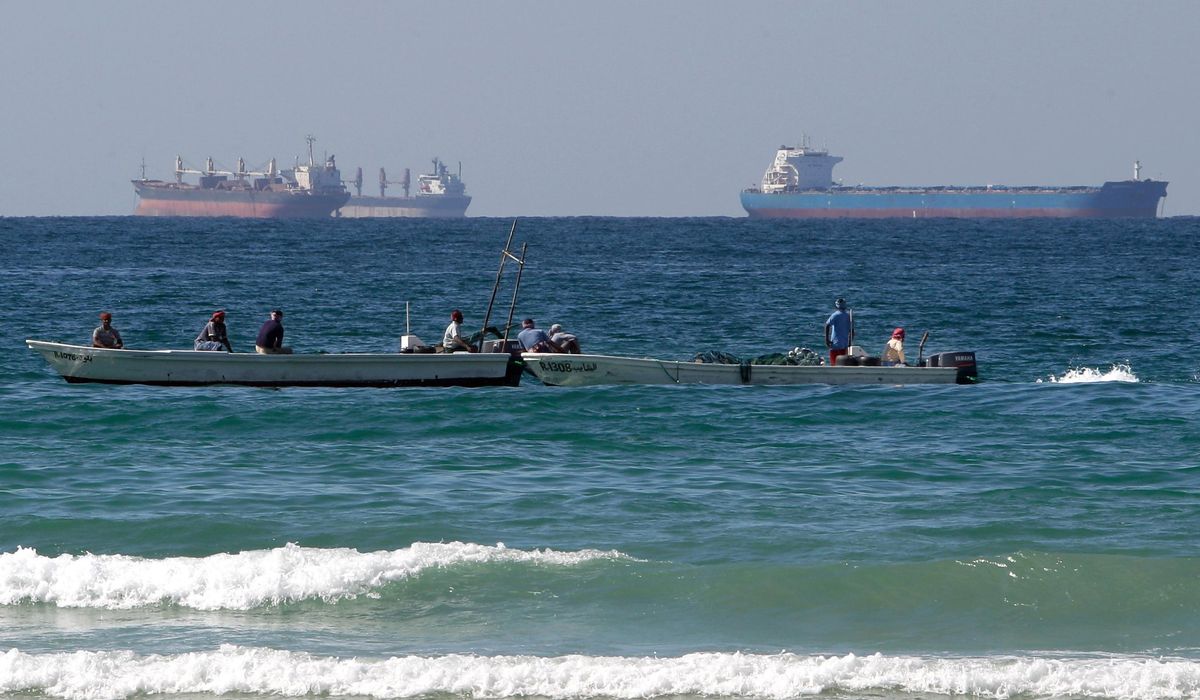
Fears of oil shortages spiked after an Iranian Revolutionary Guard official said Monday that the Strait of Hormuz, a vital oil tanker artery bordering Iran, would be closed and that ships trying to traverse it would be “set ablaze.”
Mr. Trump said he will direct the U.S. Navy to escort ships through the strait, if necessary.
“No matter what, the United States will ensure the FREE FLOW of ENERGY to the WORLD,” he wrote on Truth Social.
The president’s guarantees helped Wall Street rebound from big losses earlier in the day.
Still, the Dow Jones Industrial Average fell 400 points, reversing a Monday rebound, and the other major New York indexes both finished down roughly 1%.
The international benchmark for oil — Brent crude — jumped 3% to nearly $81 a barrel, after a 6% rise on Monday.
Mr. Trump, speaking at the White House, said he was not worried about prices.
“As soon as this ends, those prices are going to drop, I believe, lower than even before,” he said during a meeting with German Chancellor Friedrich Merz.
Later Tuesday, Mr. Trump met with Energy Secretary Chris Wright and Treasury Secretary Scott Bessent ahead of his Truth Social post announcing oil measures.
Mr. Trump ordered joint U.S.-Israeli strikes on Iran early Saturday, saying Tehran did not agree to American demands during negotiations over the Islamic republic’s nuclear ambitions, missile programs and support for terrorist proxies in the Middle East.
Tehran retaliated against Israel and U.S. allies after the strikes killed Supreme Leader Ayatollah Ali Khamenei and other top officials, raising fears of a widening and prolonged conflict. Iran also has targeted U.S. military bases.
Stocks had plummeted early Monday, the first day of trading since the war began, before rebounding later in the day.
But U.S. stocks fell again on Tuesday as investors realized the U.S.-Israeli war with Iran is likely deepening instead of abating after days of military strikes.
Iran targeted the U.S. embassy in Riyadh, Saudi Arabia, and Israel continued to attack Iran-backed Hezbollah forces in Lebanon.
Also, Iran is targeting oil-rich Gulf states such as Kuwait and the United Arab Emirates.
Market turmoil threatened what had been a positive talking point for the president. Mr. Trump boasted about record highs on the stock market as recently as Friday.
“Is anybody unhappy with the job I’m doing?” Mr. Trump said in Corpus Christi, Texas. “Your 401(k)s have doubled, right? Are they doubled?”
The International Monetary Fund, a 191-nation group that promotes economic stability and fights poverty, said it is monitoring developments in the Middle East.
“So far, we have observed disruptions to trade and economic activity, surges in energy prices, and volatility in financial markets,” the IMF said in a written statement. “The situation remains highly fluid and adds to an already uncertain global economic environment. It is too early to assess the economic impact on the region and the global economy. That impact will depend on the extent and duration of the conflict.”