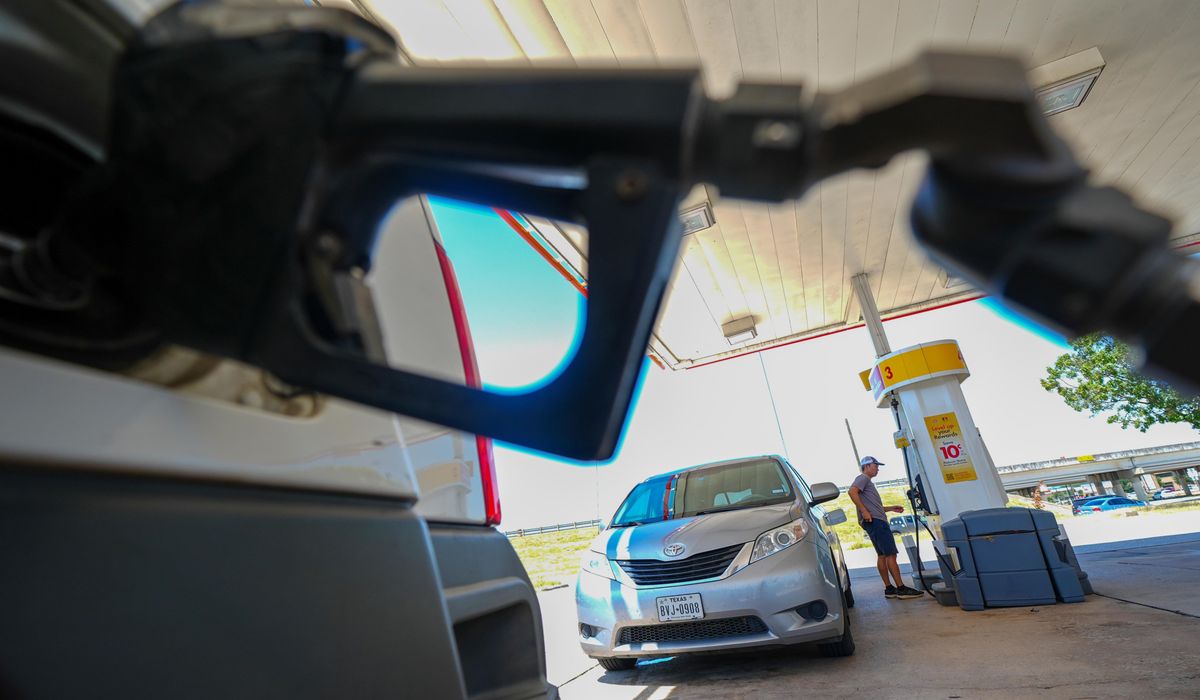
The Iran war hit Anne Dulske’s gas budget in Jackson, Mississippi, on Tuesday morning. She said it cost about $15 more than usual to fill her tank, a reflection of prices that have been climbing for days at the local level even as the national average moved sharply higher overnight. Across the country, millions of Americans were getting the same unwelcome message.
The national average for a gallon of regular unleaded gasoline rose 11 cents overnight to about $3.11, according to AAA, a jarring jump that analysts say could accelerate if fighting in the Middle East continues to severely disrupt one of the world’s most important oil shipping corridors. The increase carries particular political sting for President Trump, who told Congress last week that he had seen $1.85-a-gallon gasoline at one station during a visit to Iowa, citing it as evidence his energy policies were working.
The White House did not immediately respond to a request from The Associated Press for comment on the price spike Tuesday.
“It’s going to affect everything in our lives,” Ms. Dulske told the AP. She had previously noticed gas prices slowly declining and said she was caught off guard when she learned the United States and Israel had attacked Iran over the weekend. “It’s very scary, and it does hit closer to home than people think.”
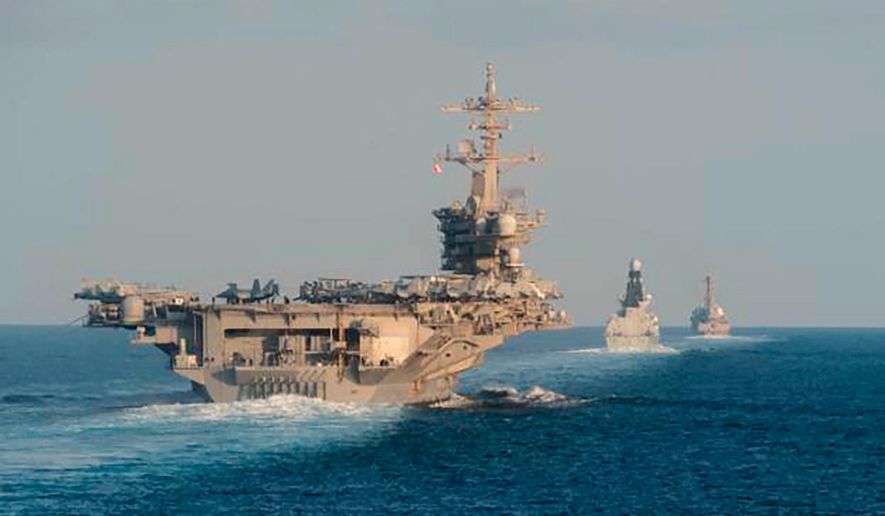
In this Nov. 19, 2019, file …
more >
The price surge follows Iran’s retaliatory campaign, which The Associated Press reported has unfolded on two distinct fronts: drone strikes on energy infrastructure in Qatar that shut down that nation’s liquefied natural gas production, and a separate drone strike on the U.S. Embassy in Saudi Arabia — a significant escalation targeting American diplomatic facilities. Iranian forces have also severely disrupted tanker traffic through the Strait of Hormuz — the narrow chokepoint at the mouth of the Persian Gulf through which flows amounting to about one-fifth of global oil and petroleum product consumption have transited in recent years, according to the U.S. Energy Information Administration. Analysts described the scale of the disruption as extraordinary.
“We have not seen anything like this in pretty much the history of the Strait of Hormuz,” Claudio Galimberti, chief economist at energy research firm Rystad Energy, told NPR, comparing what he described as an “effective closure” to blocking the aorta of a circulatory system.
On Tuesday, oil prices soared to levels not seen in more than a year: benchmark U.S. crude jumped 8.6% to $77.36 a barrel Tuesday, while Brent crude, the international standard, added 6.7% to $81.29 a barrel, according to the AP.
Mr. Trump addressed the rising prices in the Oval Office Tuesday, projecting confidence the spike would be short-lived. “We have a little high oil prices for a little while, but as soon as this ends, those prices are going to drop, I believe, lower than even before,” he said.
Whether that proves true depends heavily on how long the conflict lasts — and how broadly it spreads. The Washington Times reported Monday that Mr. Trump said he projected the war would last four to five weeks but added, “We have capability to go far longer than that. We’ll do it.”
What it means at the pump
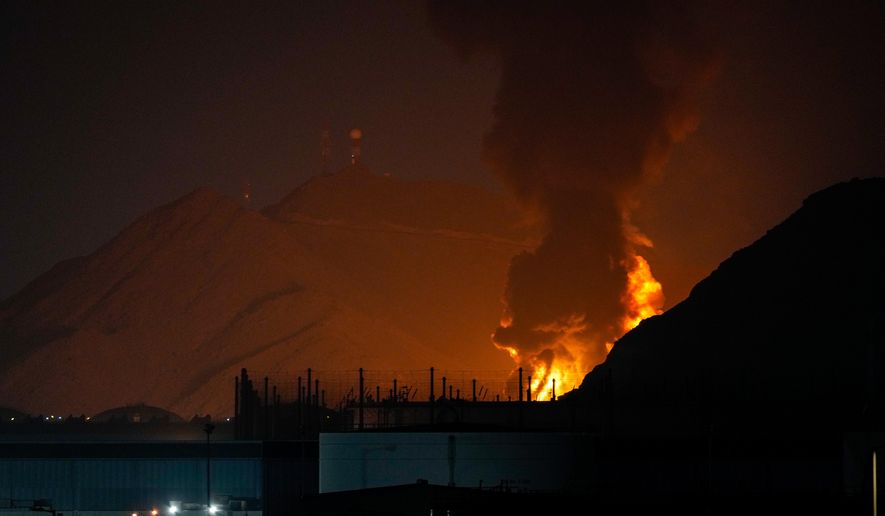
Large fire and plume of smoke …
more >
For American consumers, the math is sobering. Dallas Fed economists have noted a rule of thumb that a $10 jump in crude oil prices can translate into roughly a 25-cent-a-gallon increase in gasoline prices over several weeks, as The Times has reported, though the pass-through is not immediate. With crude up sharply since last week, drivers could be looking at additional pain at the pump in the weeks ahead.
Analysts offer a wide range of projections that underscore how much depends on the conflict’s duration and scope. Patrick DeHaan, head of petroleum analysis at GasBuddy, estimates prices could climb 10 to 30 cents per gallon on average in coming days, with some individual stations potentially seeing increases of as much as 85 cents. He told the AP he doubts the national average for regular unleaded would reach $4 a gallon based on current conditions, though he acknowledged he could not rule it out entirely.
At the other end of the spectrum, analysts at JPMorgan have projected Brent crude could reach $120 per barrel if the Hormuz disruption persists. That’s a level that historically would push regular gasoline well past $4 nationally. Deutsche Bank warned in a note to clients that prices could surge considerably higher in a worst-case scenario, according to CNBC.
“We are knee-deep into the gas price increases,” Mr. DeHaan said. “Many Americans seem very panicked that prices could hit multiple dollars higher than that, which at this point, I wouldn’t say anything’s impossible, but certainly it’s quite improbable based on the current developments.”
The last time conditions produced a comparable shock was Russia’s invasion of Ukraine in February 2022, when gasoline prices climbed to a record national average high by June of that year. During that crisis, the Biden administration released a record 180 million barrels from the Strategic Petroleum Reserve to help tame prices. The White House has not announced any plans to tap the reserve; spokeswoman Karoline Leavitt said the administration would continue to monitor the situation, according to CNN.
One potential buffer, according to the administration: Energy Secretary Chris Wright told CBS News that tankers carrying Venezuelan oil are now arriving in the U.S., a development the administration has linked to its posture toward Venezuela following Nicolás Maduro’s capture. “Absolutely, it helps push gas prices down,” Mr. Wright told CBS News. Independent analysts note, however, that those potential gains are being more than offset in the near term by the disruption to Gulf oil flows.
Nerves in Europe, too
The anxiety is not confined to the United States. In a suburb of Paris, drivers waited in a queue of 15 cars to fill up at seven pumps, which were charging about 1.846 euros per liter for diesel Tuesday, the AP reported.
“I’m heading out to the countryside and I’m almost out of fuel,” Laurence Rihouay told the AP at a petrol station outside the French capital. “But there are a lot of people here. There’s never usually this many.”
European anxiety runs deeper than American, in part because Iran’s strike on Qatar’s LNG facilities has hammered natural gas supplies. Qatar is a major supplier of liquefied natural gas to Europe, which relies on LNG shipments to replace Russian pipeline gas lost after Moscow’s invasion of Ukraine. European natural gas futures surged more than 40% following the Qatar strikes, according to TIME, while daily freight rates for LNG tankers jumped by a similar margin.
Abdelilah Khalil, getting gasoline at a station outside Paris, told the AP he feared the worst. “With Iran and the Strait of Hormuz effectively blocked, it is causing alarm everywhere and driving up oil prices,” he said. “It’s panic on board, everyone is worried, and I think that’s why many people are rushing to gas stations to fill up.”
Ripple effects
The price spike at the pump arrives at a precarious moment for the broader U.S. economy. January’s Consumer Price Index report showed inflation cooling to a nine-month low, according to Bureau of Labor Statistics data, raising hopes that price pressures were finally easing. Higher oil prices threaten to reverse that progress, and analysts warn the effects extend well beyond the gas station.
“Oil does not operate in isolation,” Nigel Green, chief executive of investment advisory firm deVere Group, wrote in a note to clients, as reported by CBS News. “Higher freight costs, higher airline fuel bills, higher distribution expenses. Corporate margins tighten or prices rise. Often both.”
An uptick in inflation could compel the Federal Reserve to hold off on the interest rate cuts Mr. Trump has been pushing for. With oil prices rising, traders are now pushing back their forecasts for rate cuts further into the summer, according to CME Group data cited by The Times.
The ripple effects were visible on Wall Street Tuesday, where the Dow Jones Industrial Average dropped 840 points, or 1.7%, according to Times reporting. Airlines, facing both higher fuel bills and canceled flights across the Middle East, were among the worst performers, with American Airlines down 3.1% and United Airlines falling 2.4%.
What’s next for gas prices?
In Burlington, Massachusetts, prices at one station neared $4 a gallon for regular unleaded Tuesday. Erin Kelly called the price tag “hefty” and told the AP she paid more than $5 for premium gas while driving her father’s car as her own was being repaired, a reminder that pump prices vary significantly by grade and region.
“We already are paying more in the grocery store,” Ms. Kelly said. “We’re paying even more than we were paying before at the gas pump. So, I don’t know, it’s a little concerning.”
In Jackson, Mississippi, Brody Wilkins was filling gas canisters when he noticed prices had jumped to $2.99 a gallon. Mr. Wilkins, who works for a landscaping and construction company, told the AP he is concerned about how the increase will affect his business.
“We use gas nonstop,” Mr. Wilkins said. “I don’t know how long this is supposed to last, but I hope not very long.”
For now, many in the market are betting the disruption will prove temporary. Defense Secretary Pete Hegseth sought to tamp down fears of a drawn-out conflict Monday, telling reporters at the Pentagon: “This is not Iraq. This is not endless. This is the opposite.”
“The crude market is extremely measured,” energy trader Rebecca Babin of CIBC Private Wealth told NPR. “I don’t see panic out there.”
The Associated Press contributed to this report.
This article is written with the assistance of generative artificial intelligence based solely on Washington Times original reporting and wire services. For more information, please read our AI policy or contact Steve Fink, Director of Artificial Intelligence, at sfink@washingtontimes.com
The Washington Times AI Ethics Newsroom Committee can be reached at aispotlight@washingtontimes.com.