A recent poll finds that 41% of young voters would support outsourcing most state and federal policy decisions to an artificial intelligence capable of running the government more efficiently.
Rasmussen and the free market Heartland Institute asked likely voters aged 18-39: “If AI continues to improve, would you support a proposal to take power away from most human lawmakers and instead give an advanced AI system the authority to control the majority of public policy decisions?”
“We found that young voters overwhelmingly believe the current system is failing them economically and politically,” Donald Kendal, director of Heartland’s Socialism Research Center, said Tuesday. “Because of this, we appear to be seeing more younger voters turn toward someone or something that promises solutions to their problems, even if that ‘someone’ is artificial.”
Support for placing AI in charge of government functions was highest among self-identified conservatives. Mr. Kendal said in an email that conservatives “have an inherently more cynical view of our institutions and are more likely to embrace what might be considered more radical reforms” than other groups.
The poll found that 55% of conservative respondents, 45% of moderate respondents and 28% of liberals endorsed AI controlling most policy decisions.
Another 36% of likely voters in the age group supported letting AI determine the “rights that belong to individuals and families, including rights related to speech, religious practices, government authority, and property.”
That included 50% of conservative respondents, 34% of moderate respondents and 25% of liberal respondents.
And 35% endorsed giving AI “control all of the world’s largest militaries, with the express purpose of reducing the number of people who die from war.”
That percentage rose to 40% of those aged 18-24 who favored an AI-run military. The poll also found that 49% of all conservatives embraced the idea, compared with 33% of moderates and 24% of liberals.
Rasmussen surveyed 1,496 likely voters aged 18-39 for the Illinois-based Heartland Institute from Oct. 31 to Nov. 2. The margin of error was plus or minus 3 percentage points at the 95% confidence level.
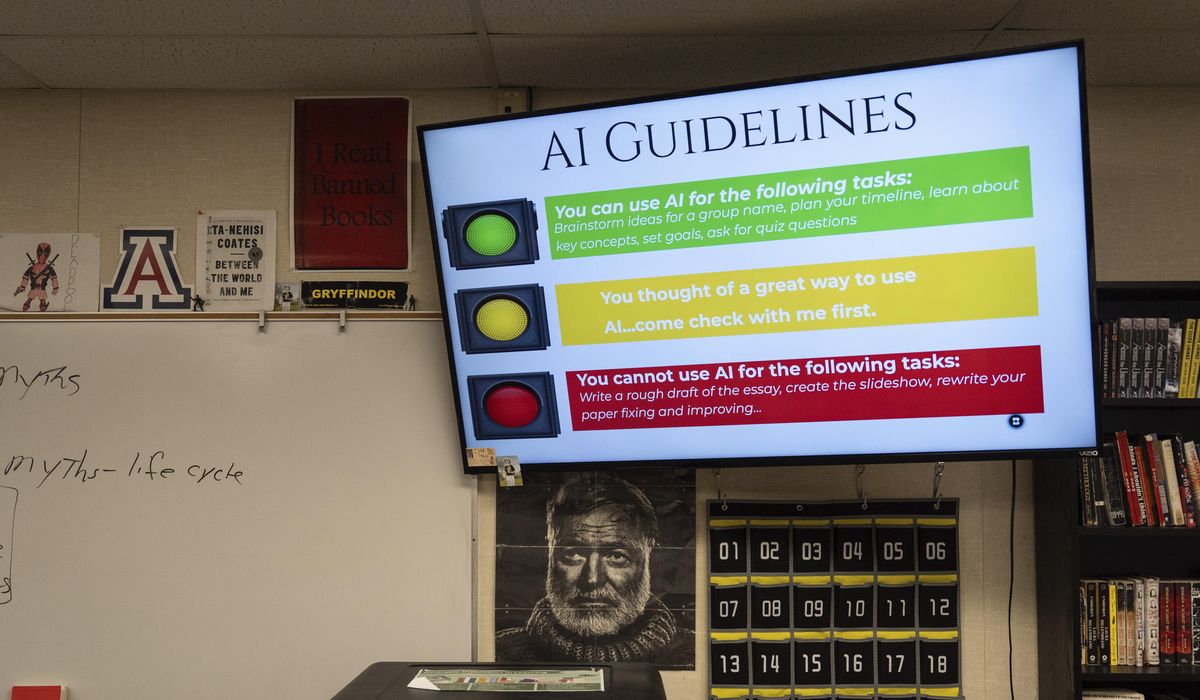
The findings come as Democrats have joined Republicans in a rare display of bipartisan support for embedding AI in schools and government workplaces.
The Department of Health and Human Services last week launched an AI strategy to make its employees more efficient, expanding the Trump administration’s embrace of the technology as it downsizes the federal workforce.
In California, home to the nation’s most lucrative technology companies, Gov. Gavin Newsom has ordered the use of AI in state services to “reduce highway congestion, improve roadway safety and enhance customer service in a state call center.”
Some political and historical analysts reached for comment said the Rasmussen/Heartland poll confirms that a growing number of young people agree that AI can run such systems better than human bureaucrats.
“The poll reveals how naive many of our young students are about AI,” Donald Critchlow, director of Arizona State University’s Center for American Institutions, said in an email. “The global elites we see trying to censure social media today, fining and even arresting people for alleged hate speech, would love nothing more than having AI controlling policymaking.”
Ronald J. Rychlak, a professor of law and government at the University of Mississippi, called the readiness to outsource government functions to AI “very concerning” for free speech.
“There is an insulation provided by our Constitution that could perhaps be mimicked by AI but will never be successfully replaced,” Mr. Rychlak said.
Others warned against concluding that most young people trust AI. They noted that at least 6 in 10 poll respondents still opposed offloading policy, military and human rights decisions to an advanced AI.
“I doubt even Gen Z voters would be OK with Terminator-style autonomous robots making decisions on whom to pursue with potentially lethal force without human involvement,” said Ilya Shapiro, a libertarian constitutional law expert at the Manhattan Institute.
Robert Wyllie, a political scientist teaching at Ashland University, a Christian school in Ohio, pointed to an April survey from the Pew Research Center that found 48% of teens reporting that social media has hurt their peers.
“For young prospective voters to favor outsourcing government functions to AI, then, tells us nothing about their general optimism about technology,” Mr. Wyllie said. “To the contrary, they are generally more pessimistic about technology than previous generations, so this tells us more about their dissatisfaction with the job humans are doing in government.”